Microchip Cat Feeder to Stop Food Stealing UK: The Setting That Actually Stops the Thief Is Not in the Manual
Your greedy cat clears the other one's bowl before she has finished sniffing it. A chip-reading lid is supposed to end that, and for most owners it does. The ones it failed keep describing the same two gaps, and both are fixable before you buy.
- One Cat Beat It in Five Minutes. Another Owner Is Five Years In.
- Does a Microchip Cat Feeder Stop Food Stealing? The Three Ways Cats Beat It
- The Microchip Cat Feeder to Stop Food Stealing UK Owners Buy, and What It Takes to Make It Work
- The Hub Is Not in the Box, and 28 of the Last 100 Reviewers Want You to Know
- Lifetime Score 4.1. The Last Hundred Buyers: 3.69.
- Versus the Plain SureFeed, a Timed Feeder, a Chip-Reading Cat Flap, and Just Shutting a Door
- Two Cats, One Grazer, and a Bill That Does Not Stop at the Feeder
You put two bowls down. The greedy one hoovers hers, walks straight over, and starts on her sister's while the slow eater is still deciding whether she fancies it. Do that every day for a year and you end up with one overweight cat and one underweight cat, and if either of them is on a vet diet you have a real mess on your hands.
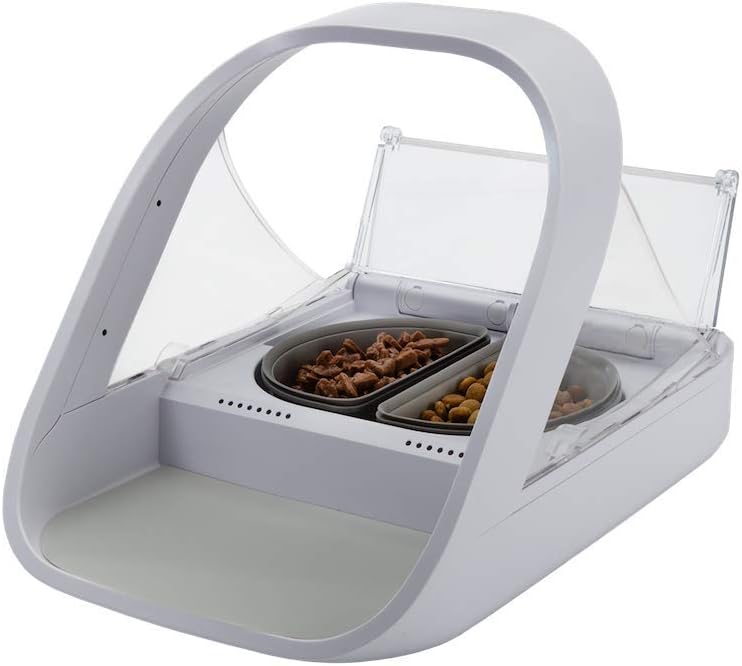
The Sure Petcare SureFeed Microchip Pet Feeder Connect is the device everyone points you at when you describe that scene. It reads your cat's existing microchip, opens only for her, and shuts again when she walks away. On paper the problem is solved.
In practice, the 100 most-recent reviews on the Amazon UK listing sit at opposite ends of the star chart: 51 five-stars and 21 one-stars, and a thin middle. Same feeder, same job, opposite verdicts. That is not random noise. Read the two camps side by side and the split has a cause, and it is one you can do something about before you spend the money.
One Cat Beat It in Five Minutes. Another Owner Is Five Years In.
James, a Canadian buyer, bought his for exactly the reason you are reading this page. His review is one star: "Got this so our second cat would stop stealing our other cat's food. Our cat within 5 minutes figured out how to paw the barrier open."
Book Lizard, five years down the line, gave five: "My grazer can graze and my would-be-chonker can inhale her own food but can't get the grazer's food and she knows it."
Same hardware. Same problem. The difference between those two outcomes is not luck, and it is not the cats. Buried in the middle of Book Lizard's review is the thing James never did:
"I had to call customer service to put one feeder in 'intruder mode' so that it would close faster and prevent the unauthorized cat from sneaking in and grabbing food when the authorized cat had the lid open."
She also bought the back covers. James had neither, and his cat found the gap before the kettle had boiled.
That, really, is the whole review. The SureFeed Connect does stop food stealing. The version of it that arrives in the box does not always.
Does a Microchip Cat Feeder Stop Food Stealing? The Three Ways Cats Beat It
Around a dozen of the 100 most-recent reviews describe the wrong animal getting to the food anyway, or a bodge the owner had to add to stop it. Some come from five-star reviewers flagging it as a caveat rather than a dealbreaker. Their stories fall into three groups, and knowing which one applies to your cat is most of the buying decision.
1. The open back
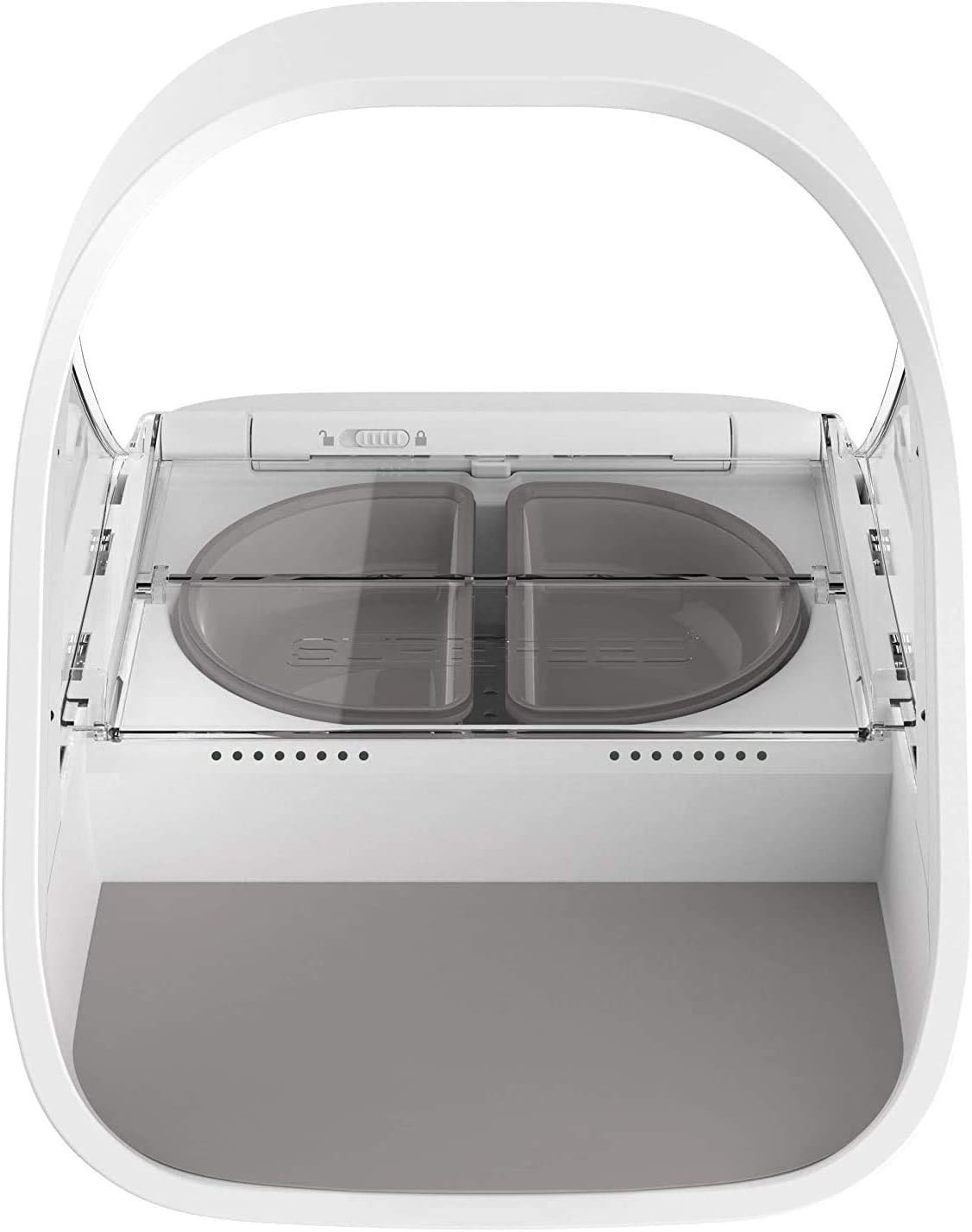
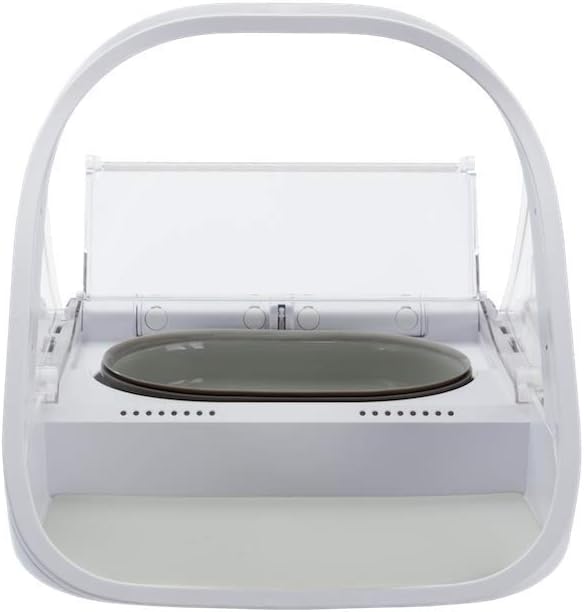
The unit is open at the rear. Your cat puts her head in from the front; the thief walks round and helps himself from behind. Eladio, a Spanish buyer, says he cannot understand why the back is not covered, because one of his cats pokes its head in from behind while the other eats and takes some of the food. A French owner, fencing, fixed it with a cardboard box wedged behind the bowl, and notes you can buy a proper rear cover instead. The Baron, a UK buyer, is blunter: "There's obviously a flaw and design fault as you really do need to buy the clear plastic backs to stop persistent animals stealing each others food in multi-pet households." He counts those covers as an extra cost per unit on top of a feeder that is not cheap.
The counter-example matters too. Raine Louis, four stars, reports the opposite: "Didn't have any issue with him coming through the back to steal food." Whether the open back is a flaw or a non-issue depends entirely on how motivated your thief is.
2. The slow lid
The lid sits open while your cat eats, and takes a moment to close once she leaves. A determined cat uses that moment. Christian, one star, says his bowl takes far too long to shut, which gives his second cat plenty of time to slide its head underneath. vns.1234, one star, reports the same pattern: the cat who should not be eating there learned to sneak in while his brother is mid-meal, and the lid simply stays open while he does. In Italy, elisabetta morelli gave three stars and describes a greedy cat who shoulders the slow cat out of the way entirely, rear covers and all.
3. The chip reading itself
Rarest, but the most damning when it happens. Heather Guiste, one star, programmed her feeder to the RFID collar tag that comes in the box rather than to her cat's implanted microchip, and then found it opening for the wrong cat: "it would seem it actually opens for any pet with a micro-chip that can fit under the arch". elisabetta morelli's two feeders both started opening for the greedy cat's chip, when only one should. Juston Deig had the opposite fault and says the sensor sits too far forward to read his cats' chips at all.
Set against all that: dozens of owners in the same 100 reviews report it working first time, exactly as advertised. Kate, five stars, sums up the win: "Thin cat is happy, eats his food when he wants it, fat cat not so happy lol, he's on a diet!!" PL, who has three cats, says that after a couple of weeks in training mode "they know which bowl is theirs and patiently wait for it to open before feeding". Leif has three cats on different food and reports the unauthorised ones "sit there frustrated that it won't open".
The Microchip Cat Feeder to Stop Food Stealing UK Owners Buy, and What It Takes to Make It Work
Two fixes come up over and over in the reviews that succeeded. Neither is printed on the box.
Close the back
Sure Petcare sell a clear rear cover separately. If your thief has form, buy it at the same time as the feeder instead of learning the hard way. Or copy fencing and wedge a cardboard box behind the bowl, which costs nothing and reportedly does the job.
Speed up the lid
This is the one nobody tells you about. The mode that makes the lid shut smartly behind your cat is called "intruder mode", and several reviewers say it is undocumented.
Tregaron, four stars, puts it best: "various undocumented 'secret' custom modes are apparently available hidden behind a call to customer service, which is silly, so loses a star." elisabetta morelli found the same, and only learned about the hidden settings by reading American forums, because the manual does not mention them. LB, two stars, emailed Sure Petcare to ask how to turn intruder mode on and got back "a list of instructions that don't match up with what the pet feeder has".
Cheila, four stars, went the full distance. She bought the flap that covers the back, "but that wasn't enough to deter my fat cat", so she bought the hub as well, purely so that customer service could set the feeder to intruder mode remotely. Her verdict on the mode itself: "The app is quite limited in options, but the intruder mode worked!" She sent the lot back in the end, because the two replacement units Sure Petcare shipped her were buggier than the first, but on the feeder that behaved, the mode did exactly what it promised.
The hub does at least put the lid speed in your own hands. CrazyCatLady, five stars, bought four feeders and says: "I have the connect version and set the lid to close in a second so nobody else can shove their head in." Note that Cheila and Book Lizard both owned the hub and still needed customer service to switch intruder mode on, so budget for the phone call either way.
Book Lizard's parting line, five years in, is the most useful sentence in the entire review set: "If you get one and have any concerns, try calling customer service. They have options that aren't immediately obvious!"
Which is a strange thing to have to write about a feeder at this price. The setting that turns it from a nice covered bowl into an actual anti-theft device is sitting behind a phone call.
The Hub Is Not in the Box, and 28 of the Last 100 Reviewers Want You to Know
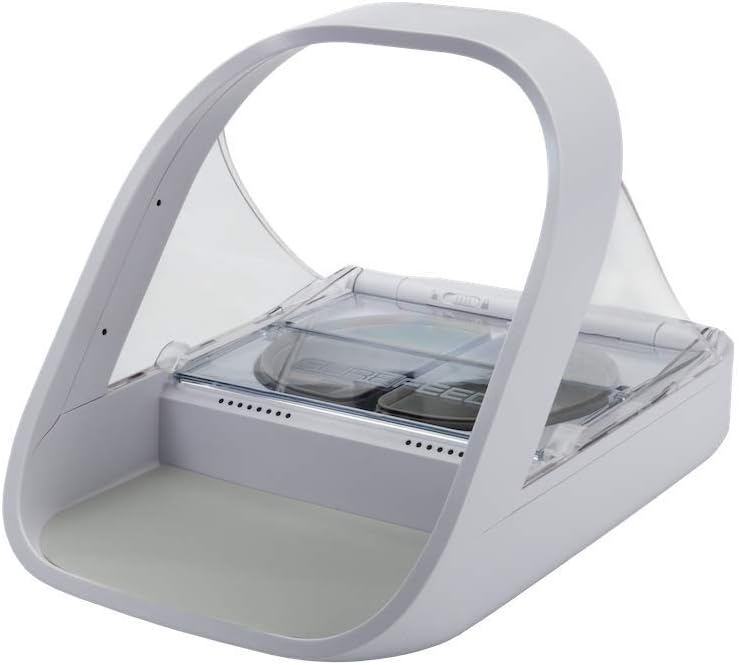
Read the listing title all the way to the end and it does tell you: "Hub and 4 x C Cell Batteries Required, Not Included". Almost nobody reads that far.
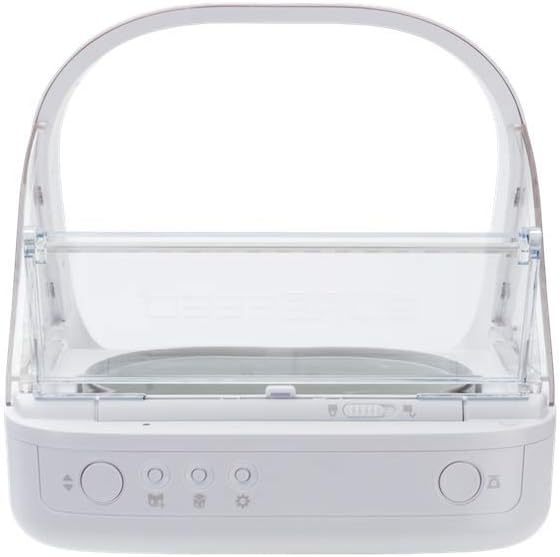
28 of the 100 most-recent reviews mention the hub, and a good share of them are furious about it. Angela, one star, gives the cleanest summary of why: buy the Connect without the hub and "it will function exactly like the less expensive one". No app. No feeding data. No scale. No lid-speed setting.
Justine, four stars, marks exactly where the line falls: "all of the features outside of the 'read pet', 'training mode', and 'manual open' REQUIRE the app, which REQUIRES the connect hub." CptnFizzbin, one star, is more direct: "Buy the standard version if you really want the microchip part, or look elsewhere for an automatic feeder."
Not everyone thinks this is a scandal. AlexJ, a German buyer who gave it five stars, argues that of course an app-controlled device needs a hub, the same as Philips Hue or Ring do, but says the manufacturer should be far clearer about it than one line of small print. That is a fair reading. The anger is not really about the hub existing. It is about discovering it on the kitchen floor with the box already open.
And the batteries
Four C cells, not included, and the listing promises up to 6 months of life from a set. Owners disagree wildly. Harvey Johnson got precisely the advertised six months. Sarah Burns, one star, got two weeks: "Generally the feeder works great, other than the batteries draining in 2 weeks!" Tregaron, measuring properly on a fresh set of Duracell C cells, projected "maybe 4-6 weeks at this rate". stucody burned through plenty early on, then found they started lasting much longer, and wonders whether training mode was eating them. A German reviewer calls the thing a battery eater.
The single most common wish across the whole sample is simply a mains plug. As Nayeba puts it, in a five-star review recommending the feeder: "Wish you could plug these in."
Lifetime Score 4.1. The Last Hundred Buyers: 3.69.
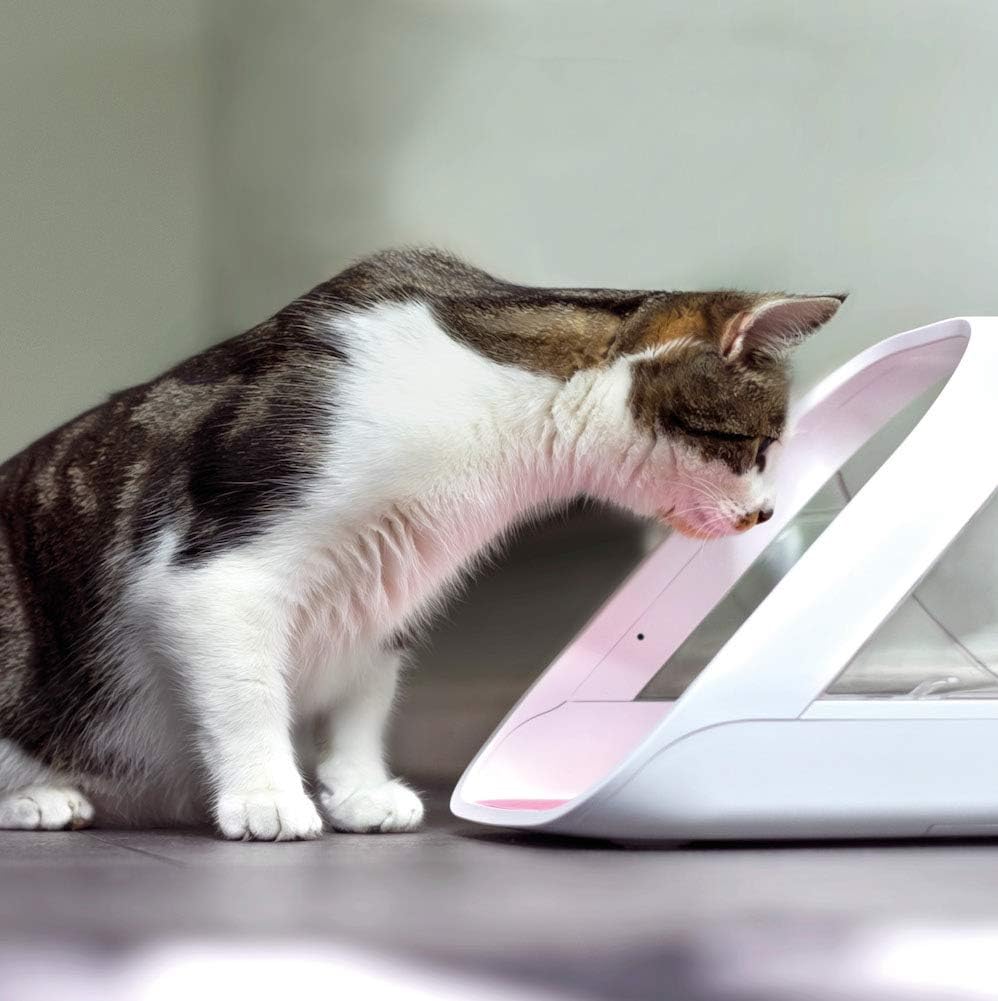
The listing carries 4.1 stars from 907 ratings. The 100 most-recent reviews average 3.69. That gap is worth understanding before you spend, because it is not random drift.
Fifty-one of those hundred gave five stars. Twenty-one gave one. The one-stars cluster around three complaints: the hub surprise, cats beating the lid, and units dying.
The death clock
This is the one that should give you pause. Jonny, one star, bought his in February 2021; it stopped working in September 2024, and Sure Petcare told him it fell outside the 3-year warranty. DrUltra100, one star: "The feeder works great until it doesn't. They last about 2 years then break down." Lothar Gores, three stars, says three previous units each failed after around three years, one stopping recognising the microchip, one with a scale failure, one with a motor failure in the door, and that one of two newly ordered units arrived with a cracked spur gear on the motor shaft. M. Holden's lasted a year.
The listing does advertise a 3-year warranty, and a cluster of failures at or just past the three-year mark is exactly the pattern several of these owners describe. Worth registering yours on day one. M. Holden did not, and regrets it.
There is a long-life camp too, and it is not small. Book Lizard is five years in and still recommending. richcy bought one when it first came out and says it "finally broke down after many, many years of use", adding that the replacement has a much quieter motor. HG Boston had one issue after roughly four years of constant use and otherwise calls them magic.
One thing to know about the reviews themselves
Amazon pools this listing hard, and it changes how you should read the score. Only 36 of the 100 most-recent reviews come from UK buyers. The rest arrive from France, Canada, Germany, the United States, Spain and Italy, which is why several of the angriest hub complaints quote dollar figures rather than pounds. The listing also pools the feeder on its own with the feeder-plus-hub bundle. Two of the five-star reviewers say outright that they bought their unit direct from Sure Petcare rather than from Amazon. One buyer, Captsx1, ordered two Connect feeders and was shipped two of the non-Connect model by mistake, which is worth knowing given the boxes look similar.
Versus the Plain SureFeed, a Timed Feeder, a Chip-Reading Cat Flap, and Just Shutting a Door
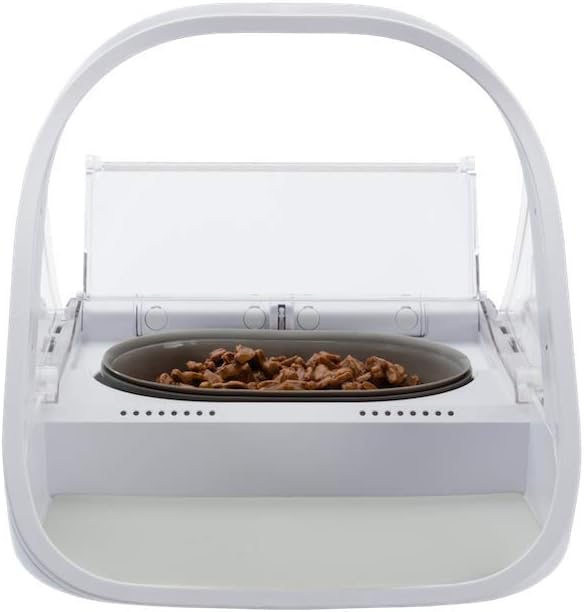
This is the comparison that decides it, and the reviews are unusually clear about which way each one falls.
Versus the plain SureFeed (no Connect, no hub)
Same chip reader, same lid, same core job. What you lose is the app, the scale and the feeding data. What you save is the Connect premium and the cost of a hub. If you are not going to buy the hub, owners tell you plainly that you are paying more for nothing: Angela's "it will function exactly like the less expensive one" is the entire argument in one line. Christian goes further and says he would take the non-connected bowl, because on that model he can adjust the lid closing speed without an app, a hub or a phone call. AlexJ makes the same point, noting that Sure Petcare's cheaper feeders read the chip and open or stay shut with no internet involved. If your only goal is "the other cat cannot get in", the plain model is the value pick and the Connect is an upgrade you have to justify.
Versus a plain timed feeder
A timer opens a flap at 7am whether your greedy cat is standing over it or not. It solves "I am at work at teatime". It does nothing at all about "the other cat clears her bowl", because the thief just learns the schedule and waits. Worth saying the other way round too: the SureFeed is not a substitute for a timed feeder. It has no hopper and no timed dispensing. Book Lizard, a fan, wishes it did: "I wish there were a way to have a timed food dispenser." A German owner wants the same feature, so the cats cannot overeat when nobody is home to portion things out. You fill the bowl, the lid guards it. That is the trick, and that is the whole trick.
Versus a microchip cat flap
The heavier tool. Zone the cats into separate rooms with a chip-reading flap and the excluded cat cannot reach the bowl at all, which is a far more solid barrier than a lid a cat can paw at. The price is a door you are willing to cut, a room you can spare, and a cat who will accept being shut out of it. Auros, five stars, runs both: the feeder for meals, a chip-activated door for curfew. That is where a serious multi-cat household tends to end up.
Versus feeding them in separate rooms
Free, effective, and almost certainly the thing you already tried before landing on this page. elisabetta morelli, who is unhappy with her feeders, says the definitive fix is feeding the cats in separate rooms, but she is not always home, and her slow cat eats small amounts spread across the whole day.
That is the gap, and it is the important one. If your cat grazes, separate rooms means standing guard all day. No amount of door-shutting solves it. Auros says it better than we can: the chip-activated feeder means "we don't need to lock the poor old girl in the bedroom for hours, to give her time to eat without having her food stolen."
That is the one job nothing else on this list does, and it is why this feeder keeps selling despite everything above.
Two Cats, One Grazer, and a Bill That Does Not Stop at the Feeder
Buy it if
You have a grazer and a hoover sharing a kitchen. One of your cats is on a prescription or vet diet the other must not touch, which is the exact use case the listing sells and the reason two reviewers here say their own vet pointed them at a chip-reading bowl. You are out of the house during the day, so standing over them is not an option. Add the rear cover if your thief has previous, and ring customer service about the faster-closing modes on day one rather than in month three.
Buy the hub with it, or buy a different model
This is the sharpest thing the reviews have to say. Without the hub you lose the app, the feeding data, the scale and the ability to set the lid speed yourself, which is to say you lose everything the Connect adds over the cheaper standard SureFeed. Work the hub and four C cells into your budget before you decide the feeder is affordable, because neither one is in the box.
Skip it if
You have a big cat. Shab, five stars, loves the feeder but reckons a rag doll, Maine coon or Bengal may find it too small, and worries about whisker fatigue on a long-whiskered cat. Skip it if you want timed dispensing, because it does not do that. Skip it if you need to plug it in, because you cannot. And skip it if you will not commit to cleaning it carefully, because the clear side shields do not come off. Mrs H, four stars, says "it is impossible to clean under the side shields properly. If it clicked off to clean it would be five stars all the way", and Nakia warns that crumbs and moisture get trapped under those panels with no way to reach them. If wet food is the plan, factor that in, and note that the stainless steel bowls are a separate purchase.
The verdict
The SureFeed Connect does the thing the search promises. It stops the other cat stealing the food, and when it lands, owners reach for big language: one titles the review "Saved my sanity!! (and my cat's health)" and describes no longer having to sit with the cats around the clock. Another says it means an elderly cat no longer has to be shut in a bedroom for hours just to finish a meal.
But it does not do it reliably in the configuration Amazon ships you, and the fact that the setting which makes it work is behind a support call rather than in the manual is a poor look on a feeder that costs what this one costs. The slide from a lifetime 4.1 to 3.69 across the most recent hundred buyers is driven by problems that are mostly avoidable and partly not.
Go in with the hub, the rear cover, a set of C cells and the customer service number saved, and it is the best answer anybody sells to this problem. Go in with just the box and there is a fair chance your cat will be eating out of the wrong bowl by teatime.
3.8 out of 5. Check today's price on Amazon before you commit, and price the hub in at the same time.
Sure Petcare SureFeed Microchip Pet Feeder Connect
Reads your cat's existing microchip and opens for her alone, so the greedy one in the house cannot clear her bowl. Stores up to 32 pet IDs, seals wet and dry food to keep flies out and odours in, and comes with an RFID collar tag for cats without a chip. Hub and 4 x C cell batteries required, not included.