Sixteen PoE Ports, One 76-Watt Pot: Picking a PoE Switch for Home CCTV Cameras UK Houses Won't Outgrow
A camera on the gable end has no plug socket anywhere near it. That is the entire point of PoE, and it is why the box at the other end of the cable matters more than most people think. With this NETGEAR, one number decides everything, and it is not sixteen.
- The Camera Goes Where the Plug Socket Isn't
- A PoE Injector Per Camera Is Cheaper, Until You Own Six of Them
- Your NVR Already Has PoE Ports. Go and Count Them Again.
- Sizing a PoE Switch for Home CCTV Cameras UK Homes: 76 Watts Matters More Than 16 Ports
- FlexPoE Is the Whole Reason to Buy the LP Instead of Something Cheaper
- Against the No-Name Budget Switch: What the Extra Money Buys, and What It Doesn't
- Two Things That Catch People Out on Delivery Day
- The House This Switch Suits, and the Three It Doesn't
The best spot for a security camera is almost never near a plug socket. It is the gable end above the bedroom window, the corner over the garage door, the far end of the garden where the shed and the bikes are. Up there you have brickwork, a soffit and daylight, and no mains supply within twenty metres of any of it.
Power over Ethernet solves that. One network cable carries the video back to the recorder and the power out to the camera, so the camera needs nothing at its end except a cable clip. Almost every wired CCTV kit sold in the UK is built on it, which is why nobody really argues about whether to use PoE. What people get wrong is the box at the other end of those cables.
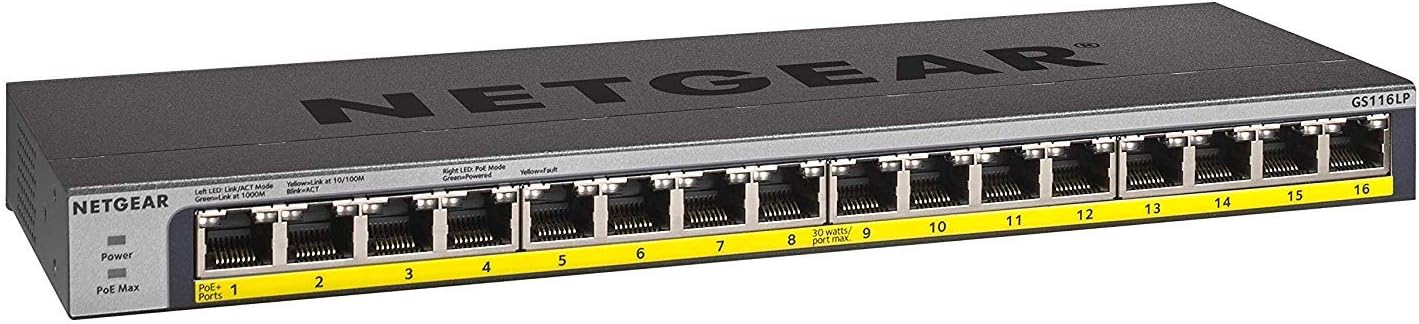
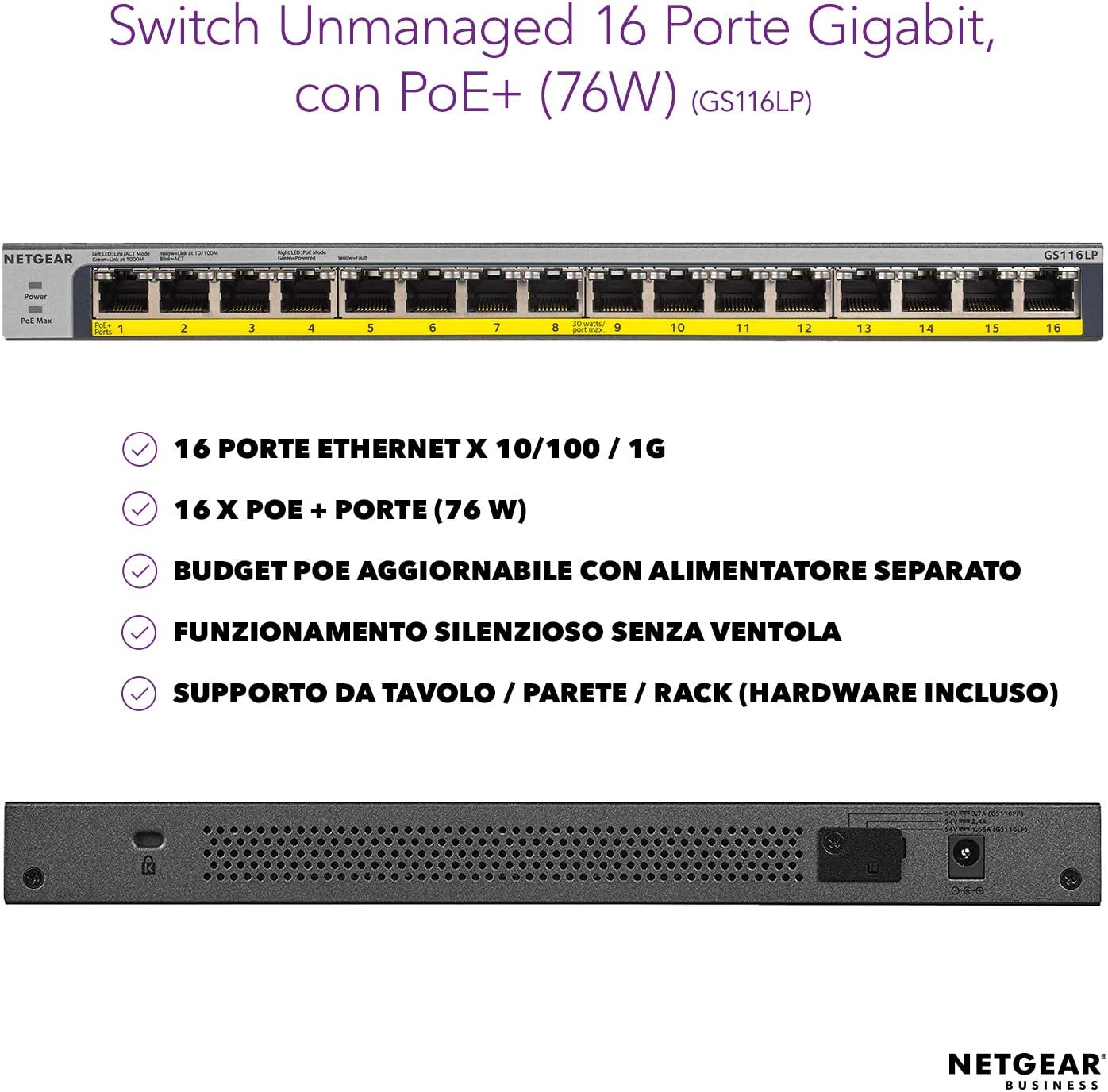
NETGEAR's GS116LP is the box a lot of them land on: sixteen gigabit ports, every one of them PoE+, no configuration to do, and mounting hardware in the carton for a desk, a wall or a 19-inch rack. It sits on a 4.7-star average from 407 Amazon UK ratings. But the number that decides whether it suits your house is not sixteen. It is 76.
The Camera Goes Where the Plug Socket Isn't
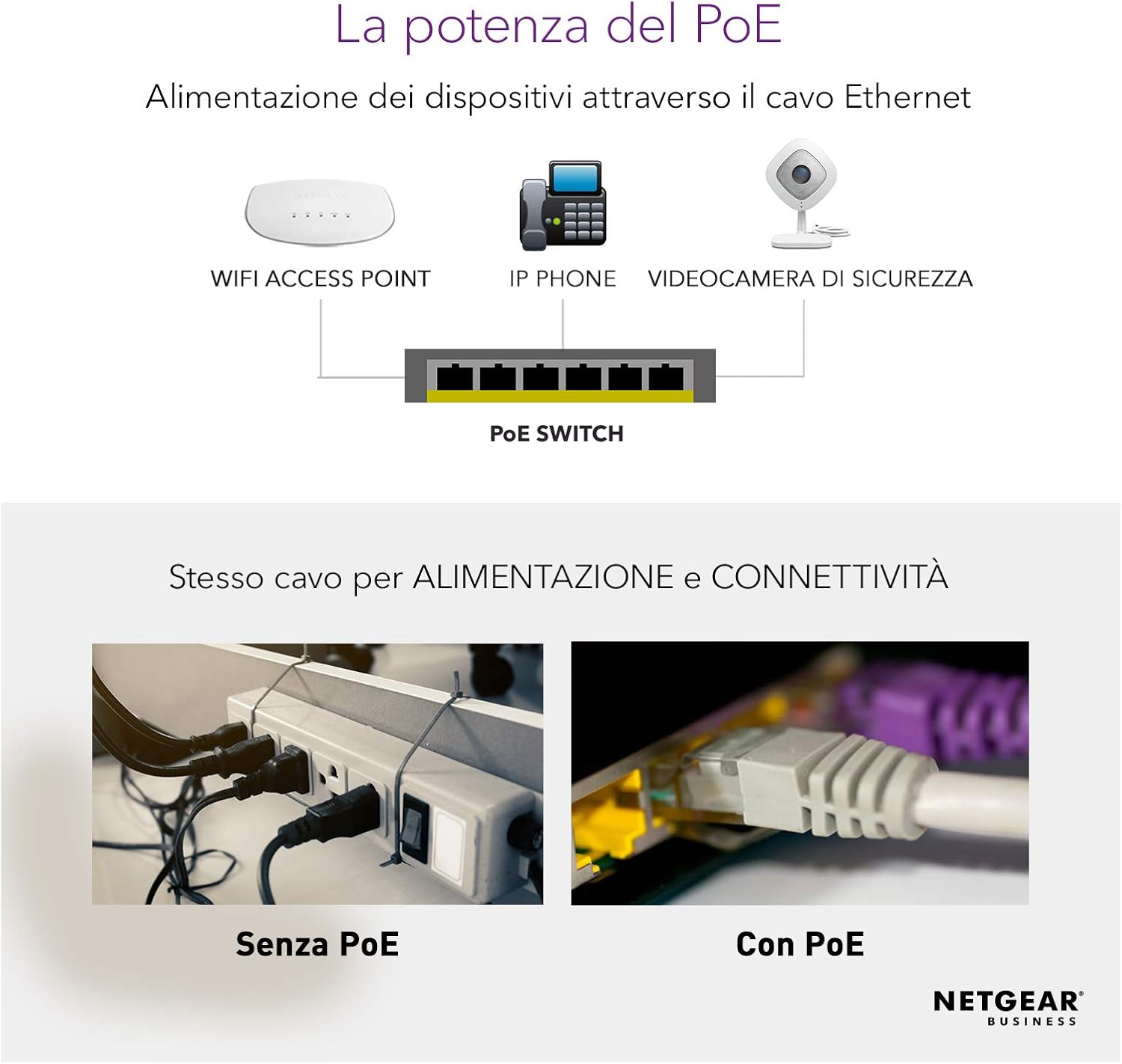
Strip away the jargon and a PoE switch does one job: it puts electricity onto the same Ethernet cable that is already carrying your camera's video. No socket at the camera, no extension lead down the side of the house, no drilling through the wall a second time for a power run. NETGEAR's own listing artwork makes the point better than any spec sheet, showing a power strip crammed with wall-warts on one side and a single network plug on the other.
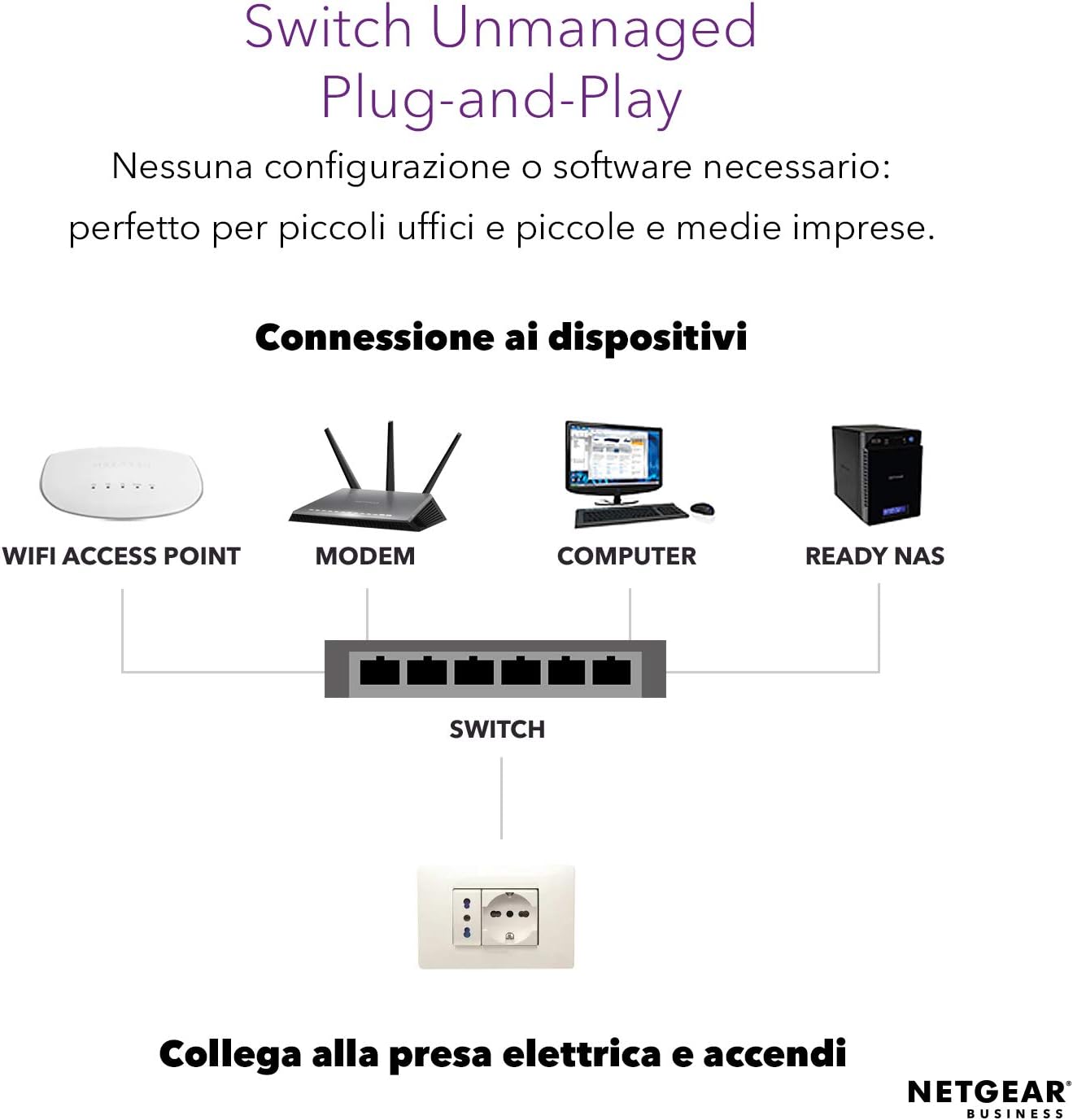
The GS116LP is the plain version of that idea. The listing calls it plug and play, with no software and no configuration required, and owners keep confirming it in about eight words. Paul, a five-star UK reviewer, wrote "Plug and play no issues at all" and added "No issues powering POE APs or getting Gb speeds". AD Matheson: "Worked straight out of the box - ideal." benbeck, replacing a 4-port PoE unit, reports it was "in production in 15 minutes".
And CCTV is clearly what a lot of these are doing. Harald Kutscha, a five-star German owner, has eight surveillance cameras plus a recorder connected to one. Another German owner runs Reolink cameras and several Unifi access points and says it works flawlessly, having bought three of them. A UK reviewer using the initial M says it is a "High-quality switch that powers almost the entire house", running "a whole bunch of Unifi cameras" alongside the Xbox and the rest of the wired kit.
A PoE Injector Per Camera Is Cheaper, Until You Own Six of Them
The obvious cheap alternative is a PoE injector: a small brick that sits between your router and the camera run, pushing power onto the cable. For one camera it is the least you can spend and it works perfectly well. Nobody needs a sixteen-port switch to feed a single doorbell camera.
The trouble starts at camera three. Every injector wants its own mains socket wherever that cable terminates, so the tidy one-cable install you wanted at the camera end turns into a nest of bricks, adapters and a shared extension lead at the cupboard end. There is no single thing to power-cycle when a camera sulks, no single thing to check when one goes dark, and no headroom at all when you decide you want a camera on the side gate too. Then somebody unplugs the wrong brick to charge a phone and you lose the driveway for a week without noticing.
Injectors are the right answer for one or two cameras. They are the wrong answer for a house.
Your NVR Already Has PoE Ports. Go and Count Them Again.
If you bought a boxed kit, the recorder on your shelf already has PoE ports on the back and they already work. For plenty of houses that is where the story should end, and you should not spend money on a switch you do not need. Two things push people onto a separate one.
The first is arithmetic. The ports on the back of a recorder are a fixed allocation. The day you want one more camera than the recorder has ports, you cannot buy one more port, and the only upgrade path a kit gives you is a whole new recorder. benbeck's review is that story in a line: a 4-port PoE unit swapped out for this one, up and running in a quarter of an hour. Harald Kutscha has eight cameras and the recorder itself on a GS116LP.
The second is what those recorder ports are for. They exist to feed the recorder's cameras and nothing else. They are not general-purpose network ports for a ceiling access point, a PoE doorbell or the desktop in the spare room. A real switch changes the shape of the whole install: as M's UK review describes it, the cameras, the games console and the rest of the house's Ethernet all come home to the same box, and the recorder becomes just another device plugged into the network rather than the thing the network has been built around.
Sizing a PoE Switch for Home CCTV Cameras UK Homes: 76 Watts Matters More Than 16 Ports
This is the section that decides your purchase, so slow down here.
Sixteen ports, and every one is PoE+. The front panel is printed "30 watts/port max." and a French owner, SAS S., quotes the same 30W figure in a four-star review. What the front panel does not shout about is that all sixteen ports drink from a single 76W pot. You can plug sixteen devices in. You cannot draw thirty watts on sixteen ports, and you cannot draw it on three.
Serialoser, a French five-star owner who wrote by far the most useful review on the listing, does the maths out loud: port 1 goes to the router, which leaves fifteen, and spreading 76W evenly across fifteen ports works out at roughly five watts each. The conclusion Serialoser draws is that 76W is simultaneously a lot for a domestic setup and not much given the port count, and that anyone planning to feed power-hungry kit should go straight to a model with a beefier supply. Peter P., a five-star German owner, lands in the same place from a different angle: he reckons the bundled supply covers around four PoE devices, and he only needed two.
Now look at what people are actually running on it. Harald Kutscha has eight cameras plus a recorder and gave it five stars without a word about running short of power. The German owner with the Reolink cameras and multiple Unifi access points calls it faultless. The variable is what class of device you are feeding. A fixed bullet or dome camera is a modest load. A PTZ with motors to drive, a camera with a heated housing for January, or a PoE+ ceiling access point working hard are in a different league, and two or three of those will swallow most of 76W between them.
So the pre-purchase job is five minutes with a calculator, not a shopping decision. Find the rated power draw printed on each camera's spec sheet, add them up, add anything else PoE you plan to hang off the switch, and leave yourself headroom. Comfortably under 76 and this is the right size of switch. Anywhere near it and you need the next section before you click buy.
One tip from Serialoser worth knowing before you patch anything in: when the switch runs out of budget it starts shedding ports by priority, numbered 1 through 16, with port 16 the first to be switched off. Put the front-door camera on a low port number. Put the one pointed at the compost bin on 16.
FlexPoE Is the Whole Reason to Buy the LP Instead of Something Cheaper
The two letters on the end of the model number are the argument for this switch. NETGEAR's listing says the GS116LP ships with a 76W budget and supports FlexPoE, which expands it to 183W with a separate power supply. Serialoser explains what that means on the bench: you replace the supplied brick with a bigger one and move a selector on the back of the unit. The switch stays. The cabling stays. The ports stay. Loriot, another five-star German owner, makes the same point from the other direction and rates it as an excellent solution: if PoE demand grows, you do not need a new switch, only a stronger power supply.
Budget PoE switches do not work like this. Their power budget is welded to the chassis, so when you run out of watts you buy a whole new switch and re-patch everything into it. Paying more for the LP is really paying for the right to change your mind about how many cameras you want in three years' time, which for anyone still adding cameras is the most valuable thing on the spec sheet.
Two caveats. The bigger supply is sold separately, so if you already know you will pass 76W, price the upgrade at the same time rather than pretending 76 will stretch. And Loriot flags that the supply voltage is an unusual one, so tracking down a cheap third-party replacement takes some hunting. Check today's price on Amazon for the switch, then cost the bigger supply on top before you commit to the platform.
Against the No-Name Budget Switch: What the Extra Money Buys, and What It Doesn't
Search Amazon UK for a 16-port PoE switch and you will find boxes at a fraction of what NETGEAR is asking, with the same port count on the label and a similar claimed budget. Here is what the owners who have run both say the extra buys you.
No fan. This is the one that matters most for home CCTV, because the switch ends up in a hall cupboard, under the stairs or on a shelf in the loft, and cheap PoE boxes often come with a fan in them. NETGEAR's listing calls out silent fanless operation and Serialoser confirms it after living with one: no operating noise at all, no ventilation, no crackling components. An Italian owner is blunter, calling it the only choice worth recommending for anyone who does not want to listen to cooling fans.
Ports that all work. Loriot came to it from cheap kit where that was not a given, and reports that every port on the NETGEAR runs without complaint. Loriot also points out it is only slightly wider than the 8-port switch it replaced, and that it fitted under the desk without a fight.
The mounting hardware. Desk, wall or 19-inch rack, all included, and rack users confirm it turns up in the box. andrew fowler fitted one in a rack and calls it well built. Titan 65 describes a "Nice metal unit" that "came with all mountings".
What the extra money does not buy is immunity, and this is where the recent sample gets uncomfortable. Twelve of the 64 most-recent reviews are one star. Seven of those twelve describe a switch that failed, went unstable or never worked properly in the first place: adam's "burnt out" after two months and took his hardwired Ethernet down with it; Norbert Gerth's died after five or six months; Fabi's kept dropping the link and eventually would only run at 100 Mbit/s; Thomas K.'s network froze solid after a few days and needed a reboot to come back; Markus K.'s refused to power an access point over PoE at all; Mohamed Al Marzouqi's would only sync at 100 Mbit rather than gigabit; an Italian buyer's simply arrived not working. A 4.7 average across 407 ratings is a strong headline, but the recent run has a rougher tail than that headline suggests, and you should go in knowing it.
When it does fail, the reviewers are consistent about where the weak point sits, and it is not the hardware. adam says NETGEAR "couldn't care less", offered him a replacement but no refund, and that "Amazon were great and sorted the issue out". Markus K. and Fabi, both German owners, land in the same place: they are finished with the brand's support. So buy it from Amazon, keep the order where you can find it, and plan to lean on Amazon's returns rather than a manufacturer helpline if the worst happens.
Two Things That Catch People Out on Delivery Day
Do not buy this one used. Four of the twelve one-star reviews are about what arrived rather than what the switch does. Matthias Benn's turned up with the power supply and the 19-inch mounting frame both missing, and with every sign of having already been in service with another customer. Matthias S. received used stock that was also incomplete. A French buyer opened the box to find a switch that did not match the photo and sent it straight back. On a PoE switch the power supply is the product: the entire 76W budget lives in that brick, and FlexPoE means the brick is also your upgrade path. A bargain unit with no brick in the carton is not a bargain, it is a paperweight. Even a positive review carries the warning. Lars Roloff gave a Warehouse Deals unit five stars because it runs perfectly, then described it as heavily scratched, with cable ties cut off it and another company's asset sticker still stuck to the case.
Make room for the brick. The power supply is big, several owners flag it, and the listing photos do not really prepare you. Brenda I. calls it an "enormous power supply brick" and complains that "many of the pictures in the description omit" it. Serialoser says the same, a huge supply to find space for, while noting that the leads are at least a decent length. Loriot likens it to a small laptop supply and says the only thing stopping the install being perfect is that the plug is straight rather than right-angled. Martin Lauterbach, four stars, says the power plug slips out of the socket too easily. Measure the shelf in your comms cupboard before you order, and route the lead where a knee cannot catch it.
One UK note, since Brenda I.'s one star is really about American power cords: this is an international listing, and Loriot confirms two mains leads in the box, a German one and a UK one. Buying on Amazon UK, you get a lead that fits your wall.
And a rack quirk, if that is where it is going. Two owners point out the unit is less than 1U thick, so it looks slightly odd at the front of a rack. Paul says the fittings are in the box but are not 1U, so it sits "a little untidy fitted". Titan 65 mounted one at the back of the rack for exactly that reason. Goluppo, two stars, had to abandon a server cabinet job because the rack-mount set turned up short of fixings, so check that bag before you book an afternoon for the install.
The House This Switch Suits, and the Three It Doesn't

Buy it if you are running somewhere between four and ten PoE cameras, you have run out of ports on the back of the recorder, and you want the cameras, the access points and the rest of the wired house coming back to one quiet box. Buy it if the switch has to live somewhere you can hear it, because there is no fan in this one. Buy it above all if you are not certain how many cameras you will end up with, because FlexPoE means the switch you buy today can take a bigger power supply in two years instead of being ripped out and replaced. That upgrade path is the single best reason to choose this over a cheaper box.
Skip it if you have one or two cameras. A PoE injector each is cheaper and does the identical job at that scale, and you will not miss the other fourteen ports.
Skip it if you want VLANs, port monitoring or anything you log into. This is deliberately the bottom rung of NETGEAR's range: unmanaged, no software, no web interface, nothing to configure. benbeck, who otherwise rates it five stars, puts it plainly: "Pity it's not manageable". If your plan is to isolate the cameras from the rest of the network on their own VLAN, spend the extra on a smart-managed switch and be done with it.
Skip it if your camera list is heavy on PTZs, heated housings or hungry PoE+ access points, unless you are buying the bigger supply at the same time. Sixteen ports sounds like plenty. Seventy-six watts runs out a lot faster than sixteen ports suggests.
Across all 407 ratings this sits at 4.7. Across the 64 most-recent reviews it drops to 4.14, and that gap is real: a handful of dead units, a handful of boxes arriving incomplete, and a manufacturer support line nobody has a kind word for. We rate it 4.3. It is the right switch for a home CCTV setup that is still growing, provided you buy it new, buy it from Amazon, and do the wattage sum before you order rather than after.
A five-star owner, khoo hwee lian, summed up the buying advice better than we can: "Cheapest 16 port POE in the market. Perfect if you don't need all of them to be POE." That is exactly the switch this is, and exactly the house it suits.
NETGEAR 16 Port PoE Switch (GS116LP)
Sixteen gigabit ports, all PoE+, a 76W power budget you can raise later with FlexPoE, and no fan to listen to in the cupboard. Plug it in and patch your cameras.