Chalk and Cheese, or Pillows Over the Speakers? The Bluetooth Receiver for an Old Hi-Fi Amplifier UK Owners Argue About
One buyer says the difference against his old cheap adapter was like chalk and cheese. Another, listening through a Benchmark DAC and a Cyrus amplifier, says it sounds like pillows are covering his speakers. Once you know which socket each of them plugged into, both make sense.
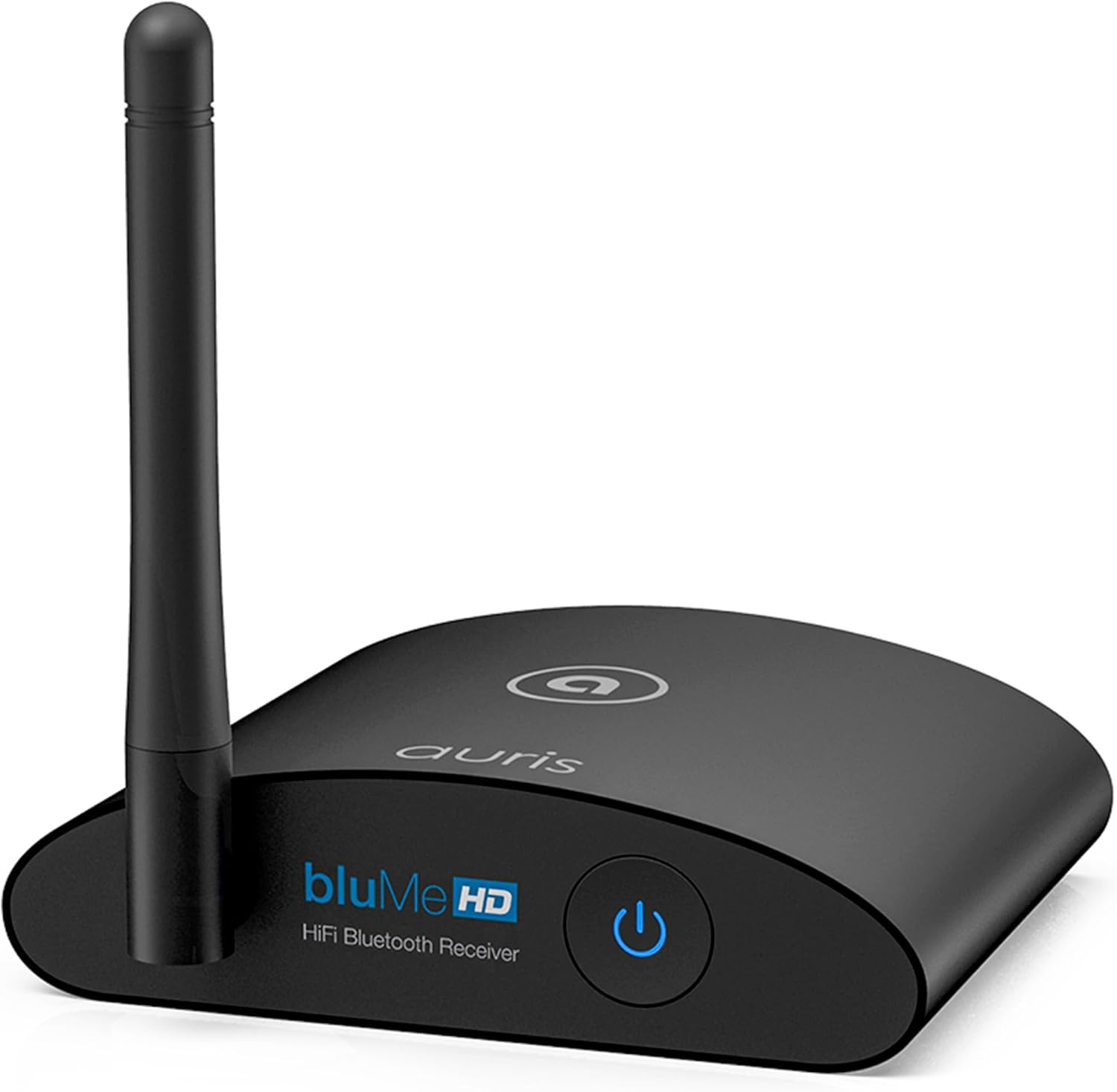
- Ten Reviewers Came Here From a Cheaper Adapter. Nine Gave This One Five Stars.
- What the DAC and the Codec List Actually Buy You
- The Treble Argument, and Which Side of It You Will Land On
- Wiring It Into an Old Amp: the Hot Output and the Non-UK Plug
- Range and Pairing: the Second Thing That Decides This Purchase
- Head to Head: the Cheap Dongle, the 1Mii B06 Plus and the BluMe Pro
- The Bluetooth Receiver for an Old Hi-Fi Amplifier UK Buyers Should Get, and Who Should Skip It
One buyer had been putting up with a cheap Bluetooth adapter and the flat, lifeless sound it made. He bought this one instead and wrote that the difference was "like chalk and cheese". Another buyer, running a Benchmark DAC, a Cyrus amplifier and a pair of Monitor Audio speakers, wrote that the same box sounded like "there are pillows covering my speakers".
Neither is exaggerating, and neither is wrong. The reason they disagree so violently is sitting in the second man's own review, in a sentence most people skip.
That split is the whole story of the Auris BluMe HD, and it is why this review skips the spec-sheet tour. If you already own an amp worth keeping, one question decides the purchase: is the DAC and codec chain inside this thing audibly better than a cheap adapter, or are you paying for a metal case and a good antenna? The 100 most-recent reviews answer it, and the answer turns out to depend on which socket on the back you plug into.
Ten Reviewers Came Here From a Cheaper Adapter. Nine Gave This One Five Stars.
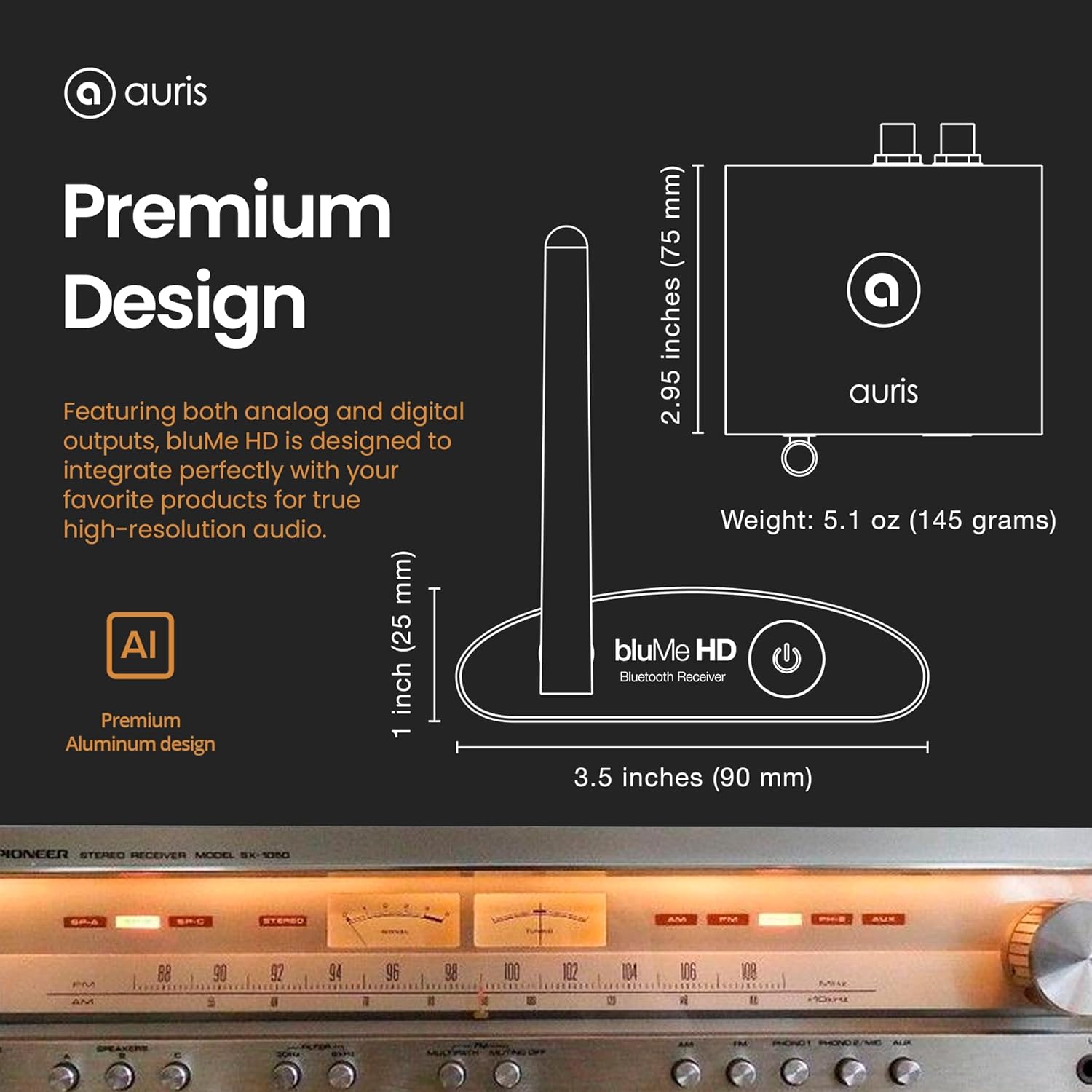
The most useful thing in this review file is not the 4.6-star average across 2,419 ratings. It is how many people arrived here having already tried the cheap route and come away unhappy. Ten of the 100 most-recent reviews describe swapping out an older or cheaper Bluetooth adapter for this one. Nine of those ten gave it five stars. The tenth wrote the one-star review this whole article ends up hanging on, and we will come to him. (Worth knowing before you read further: 90 of those 100 are UK reviews, with the other ten carried over from the US, Italian, Indian and Canadian storefronts, which is normal for a listing that has been on sale this long.)
AndyB tried "one of the cheaper versions of these" and was "quite disappointed by the flatness of the sound", then doubled down on this model: "it is like chalk and cheese, this model sounds fabulous". Simon Avenell had bought a cheaper receiver first, one carrying a respectable 4.5-star rating of its own, and found "sound quality wasn't great and streaming dropped out a bit". Another buyer who had lived with a thirty-quid connector says "the difference is huge". Andrew Dunning tried "a cheapy plastic one which I struggled to connect" and reckons the Auris "was definitely worth the extra money".
Then there is the noise floor, which is where budget dongles really come unstuck. Pig_Thomas had been through two receivers, "one which was Logitech and the other a almost carbon copy Chinese brand", and both gave him "the power hum and the circuit board noise. Very audible." Feeding his Rokit G4 8-inch active subs, that hum was "unbearably distracting" with nothing even playing. Switching to the Auris fixed it. Mits came from an Eskin adapter that pushed "a lot of noise" into a pair of Beolab 6000s and reports the Auris delivers "crystal clear highs, mids and lows", adding that he "couldn't notice any background humming, crackling, hissing or buzzing even with my ears right up to the speakers".
The dissent is worth as much as the praise. Jake upgraded from a UGreen receiver that "suffered from intermittent stuttering", and he is careful about what actually improved: "The sound fidelity isn't noticeably enhanced from the cheaper one, although I haven't done an A/B comparison. But the most important thing to me is that the audio stream is now rock solid."
And the Auris is not immune to the fault it usually cures. One three-star reviewer, posting as 'anonymous hifi enthusiast', heard "digital chatter noise (a bit like modem noise)" during quiet passages, concluded "the analog side is not sufficiently decoupled from the digital side", allowed that "perhaps it was just my sample", and returned it. That is one unit in a hundred, but if your speakers are the kind that show up a noise floor, it is the risk you are taking.
What the DAC and the Codec List Actually Buy You
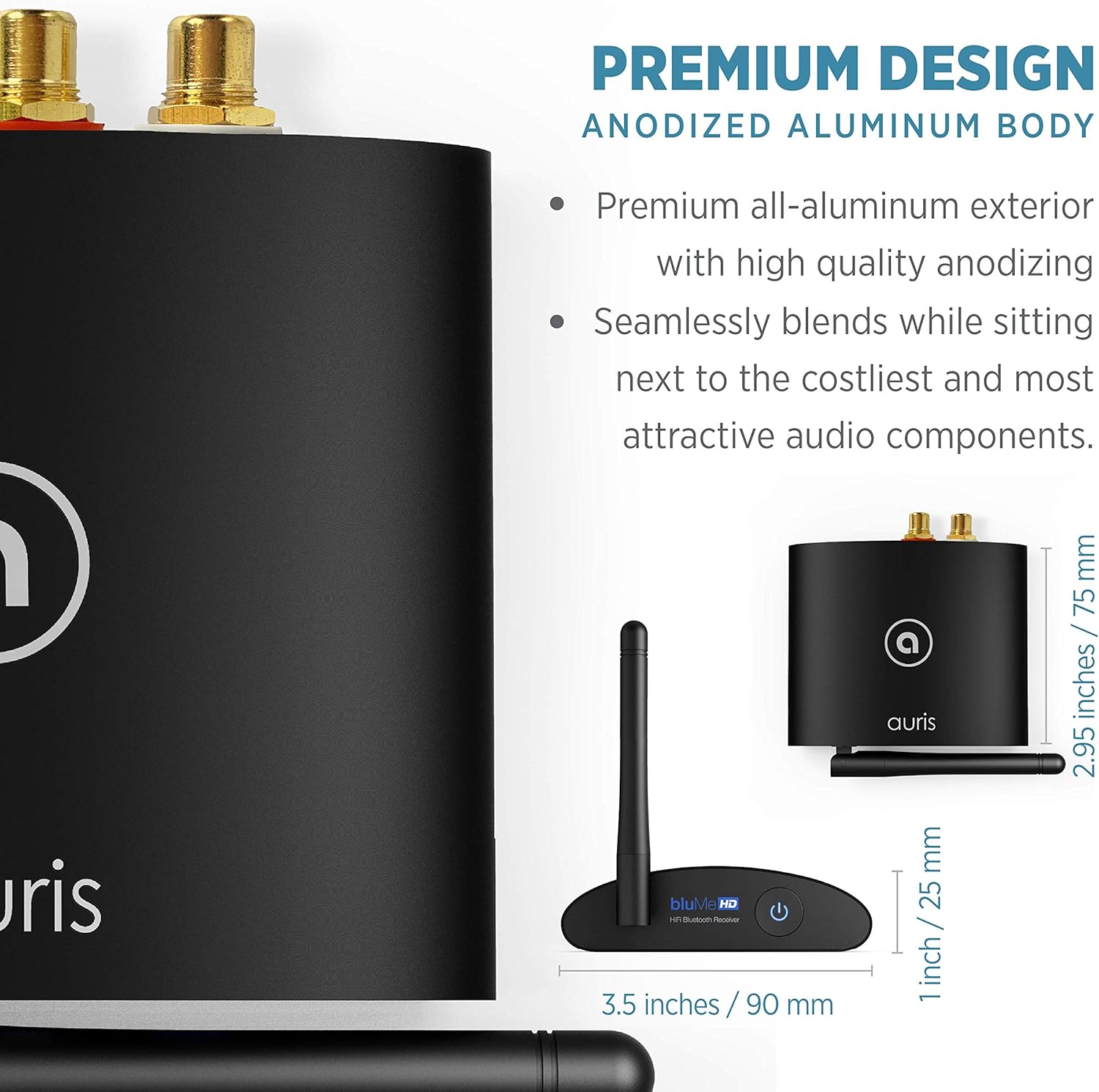
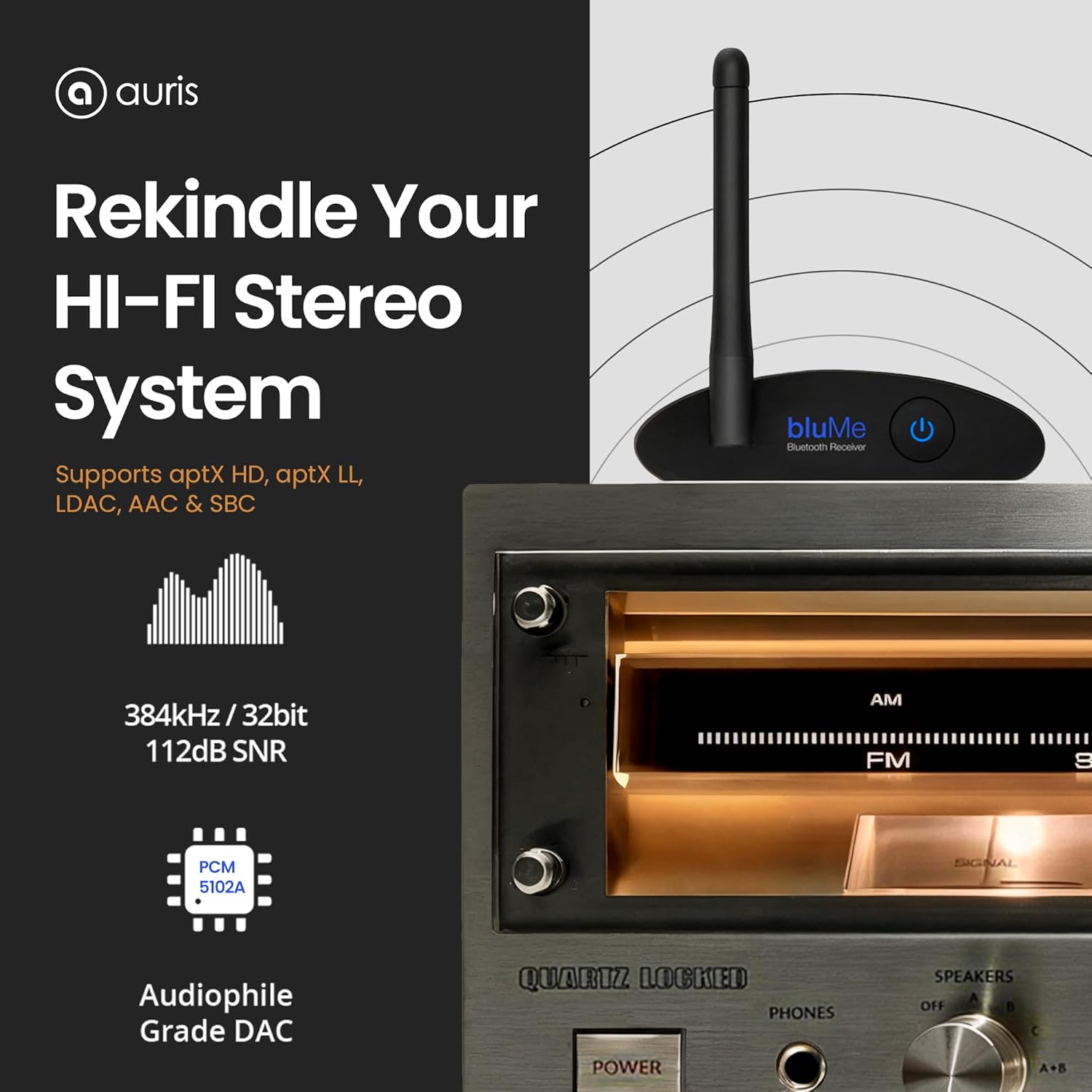
The listing gives you Bluetooth 5.3, decoding for aptX HD, aptX Low Latency, LDAC and AAC, a 384kHz/32-bit upsampling DAC, and both analogue RCA and digital optical outputs. Here is what that means in a living room rather than on a box.
The DAC is the point. Your old amp expects a line-level analogue signal on its RCA inputs, and the BluMe HD does the digital-to-analogue conversion itself before handing it over. It is not turning Spotify into a studio master. What it is doing is the same job your CD player's internal DAC does, and doing it in a metal case rather than a plastic one, which is why the noise-floor stories in the section above keep going the way they do.
The codecs matter less than the marketing suggests, and that is a compliment to the hardware rather than a criticism. LDAC and aptX HD only do anything if your phone speaks them, which mostly means Android. iPhones stream AAC. Yet a large chunk of the happiest reviews here come from iPhone and iPad owners: one buyer streaming to an old but good hi-fi, Louise Bryant running an iPhone and iPad into a Cambridge Audio amp, and Ian M, who describes himself as "a bit of an audiophile", saying the device "improved my music streaming quite considerably" through his Denon. If iPhone owners are this pleased, the DAC and the analogue output stage are doing most of the heavy lifting, not the exotic codecs on the box.
Get an Android phone and a high-bitrate source together and the ceiling goes up again. Andy Lanson, running Tidal Masters into an Arcam setup, says that "paired with a good phone with the right chips" it "does sound fantastic". Stuart Ford bought it specifically because his Blue Aura amp could not handle Amazon Music HD, and describes the result as "like a thick grill has been removed from my Dali Oberon 1 speakers".
Now the ceiling itself, because several reviewers are refreshingly clear about where it sits. Andy Lanson again: "Was wondering if it could match CD quality, not quite, however this will depend on your setup." A buyer with twenty-year-old separates and a Yamaha DSP found the sound "outstanding" but conceded "you don't get the depth and precision compared to a Linn LP12". D. B., listening through Naim speakers and a Linn amp, thought the sound was "very good but it just wasn't as crisp and clear as my hifi... usually puts out". Mr S Hounsom rates it four stars while noting sound quality "nowhere near as good as CD or Vinyl".
So: it gets you most of the way. On a mid-tier system you will stop thinking about the gap within a week. If your front end is Linn or Naim money, the gap is still there and you will hear it.
The Treble Argument, and Which Side of It You Will Land On
Four reviews in the sample say the sound is dull or the treble is missing. They deserve a proper hearing, because the people writing them are not casual listeners.
S. Palmer wrote the most detailed negative review on the page. In his words, the Auris "significantly boosts the bass so it's boomy and unnatural and slices the treble right off", with "a huge treble cut starting at around 6khz, so cymbals, high hats, snares, etc are severely muted". His summary is the line that sticks: "The Auris sounds like there are pillows covering my speakers." He was listening through a Benchmark DAC3, a Cyrus Stereo 200, Monitor Audio Silver bookshelves and a REL sub, so this is not someone guessing.
And then, buried in his own review, the detail that reframes it completely: "I only used the optical output, so I can't comment on the internal DAC."
He goes on to guess that if the internal DAC is fed the same signal "then it should also sound bad". It is a guess, and it is not what the people actually using the analogue outputs report: they are overwhelmingly the ones calling it crystal clear, iPhone owners on AAC included. Which leaves the pivot of this whole product. S. Palmer was never listening to the Auris DAC. He was using the BluMe HD purely as a digital transport into his own Benchmark, and what he heard was whatever the Auris does to the signal before it leaves the optical socket. He has since moved to an iFi Zen Blue, which he says outputs a bit-perfect signal. Take his review as what it is: a warning about the digital output, not the analogue one.
None of the other three mentions the optical output, so that explanation does not cover everything. Friend4U runs it into a Rega Brio R with B&W 607s, hears no hum, rates channel separation "excellent", and still says "the high frequency end is missing", adding that next to an Audioengine B1 the Auris "lacks fine treble". Andyinpoole fed a pair of Quad amplifiers and found the sound "very dull". An Italian reviewer, pooled onto this listing from another storefront, reports losing the high tones alongside volume swings and delays.
The other side of the argument is much larger. M Hoyle calls it "a 'bright' sound". D.Gough reports an "immediate drastic improvement in detail". Alex, on good speakers and a good amp, says "the sound is crisp and clean, probably the best Bluetooth receiver I have tried". Mits, ear pressed to a Beolab, hears crystal clear highs.
Read all of it together and a coherent picture appears. The BluMe HD's voicing sits on the warm, bass-forward side of neutral. Andrew Dunning finding his ancient hi-fi sounded "surprisingly bassy" fits that. So does S. Palmer's "boomy". On a system that leans bright, an older solid-state amp with hard-edged tweeters, that tilt is a gift, and it explains why so many of these reviews read like conversion stories. On a system that is already warm and thick, Quads being the textbook example, you are pushing a rich sound further in the direction it already goes, and "very dull" is precisely what you would expect to come back.
So the question to ask is not whether this receiver is any good. It is which way your system already leans. Answer that, and the contradictory reviews stop being contradictory.
Wiring It Into an Old Amp: the Hot Output and the Non-UK Plug
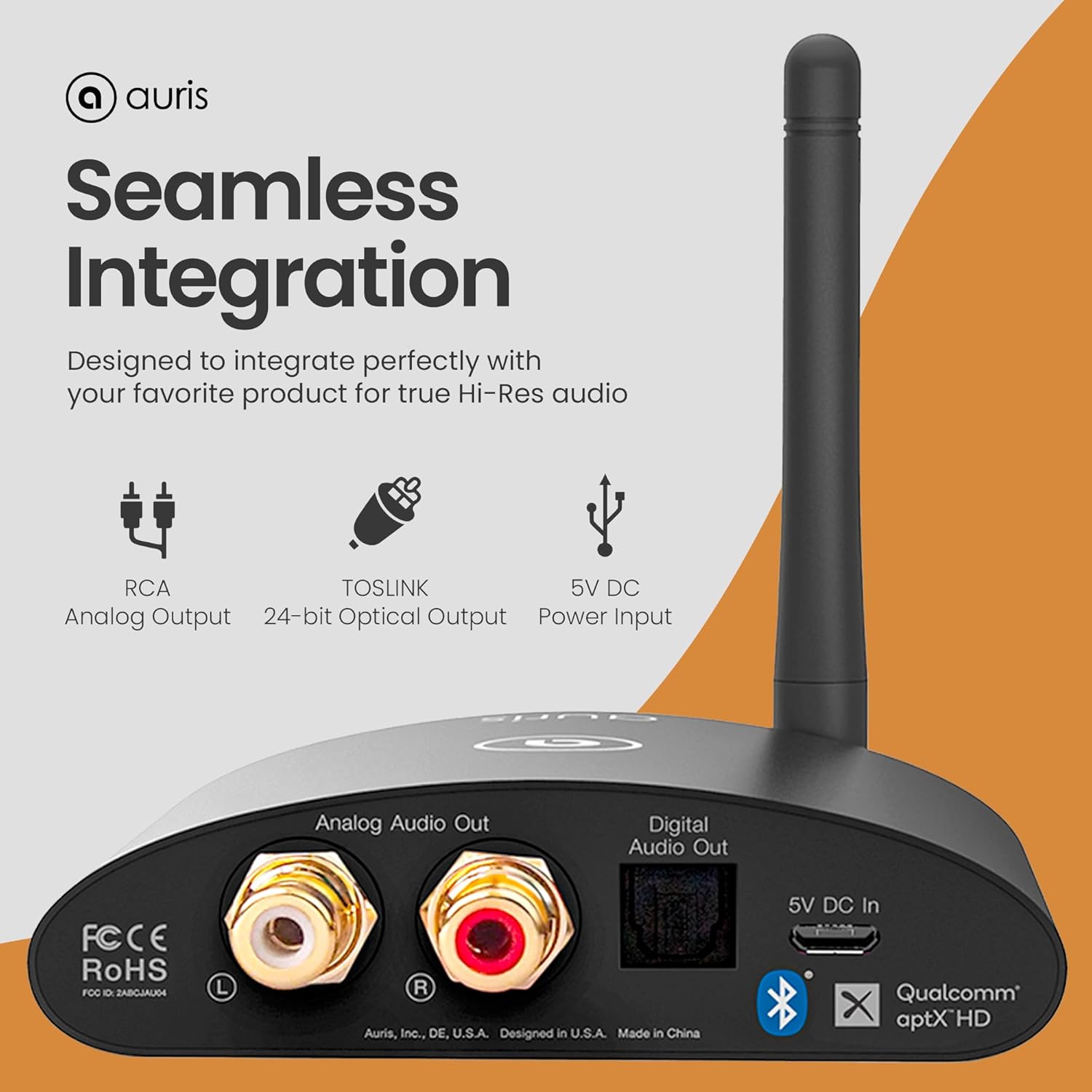
Three practical things nobody tells you before the box arrives, all of which come straight from reviewers.
First, the output is hot. Mits noticed it immediately: "the signal out on this device drives these particular speakers too loud despite dropping the volume on the mobile device to minimum." His reading of it is exactly right, and it is good news for the job you are buying it for: "This means a strong output signal suitable for an amplifier but not necessarily directly to speakers which have no independent volume control." If you are feeding an amp with a volume knob, plenty of level in hand is what you want. If you are feeding active speakers with no volume control, you have a problem and no way to trim it. Michelle Y., reviewing from the US storefront, hit the edge of this even with an amp, finding it can "overdrive" the RCA input "on certain songs causing distortion". If that happens to you, pull the volume down on the phone rather than the amp.
Second, which input to use. Reviewers plug it into whatever spare line input the amp has going: one used an unused RCA pair marked video in on an Arcam Alpha, Fran took the CD input on a NAD 3240PE. Any line input works. The one to avoid is the phono input, which is built for a turntable's much lower signal and will sound wrong with a line-level source.
Third, the box. The cables are all in there, and reviewers confirm it: RCA to RCA plus RCA to 3.5mm, along with the power supply. The catch is that one buyer received a "power supply (non uk plug)", which he shrugged off because he had USB plugs lying around anyway. That is the fix, and it is a non-issue in practice: the unit takes USB power, so any charger or USB port you already own will run it. Louise Bryant simply ran the power lead into the back of her Xbox. Do budget for a longer USB cable though. DLofty's four-star review contains exactly one complaint: "Cable between device and power supply is very short, had to buy a longer one." Behind a hi-fi rack, that matters.
Range and Pairing: the Second Thing That Decides This Purchase
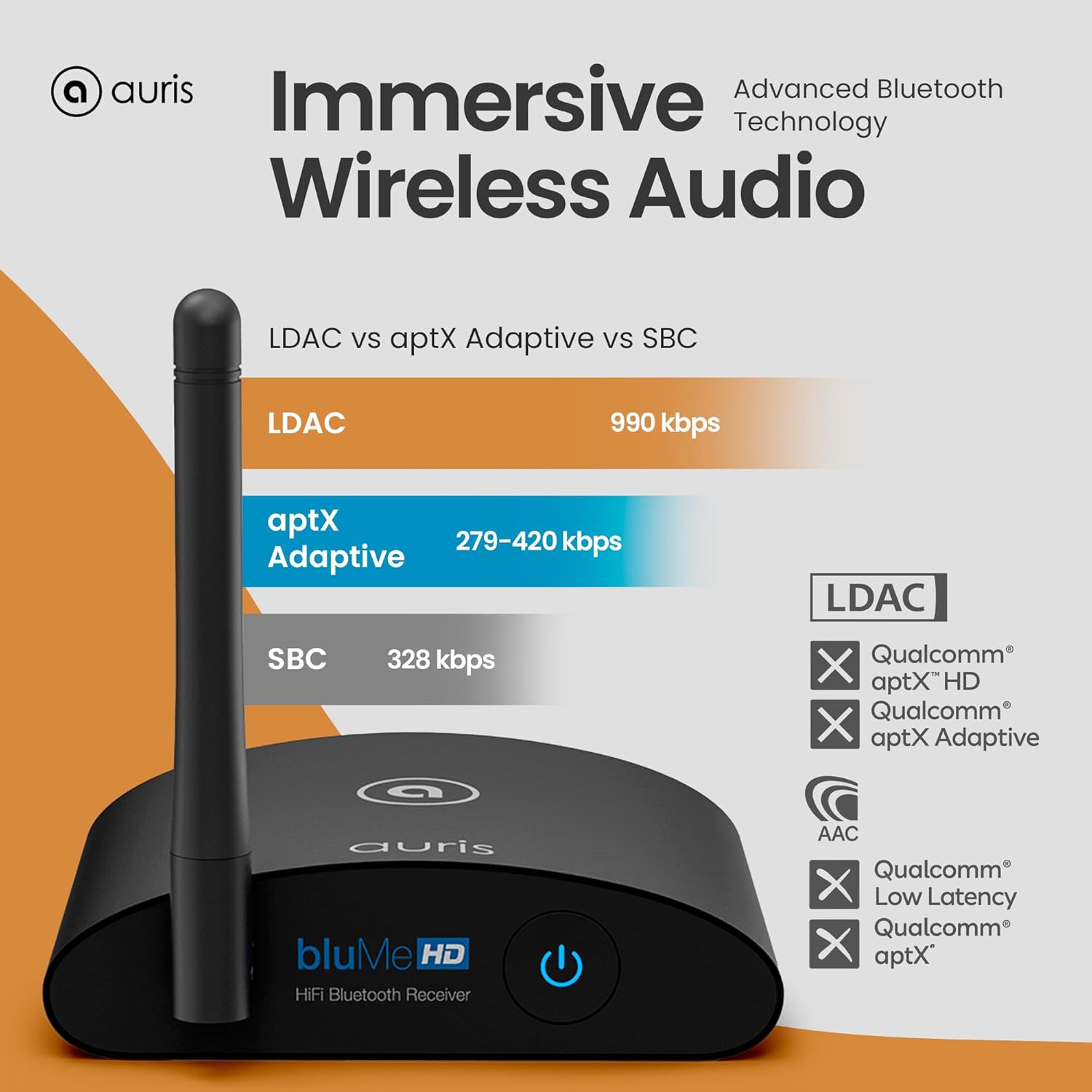
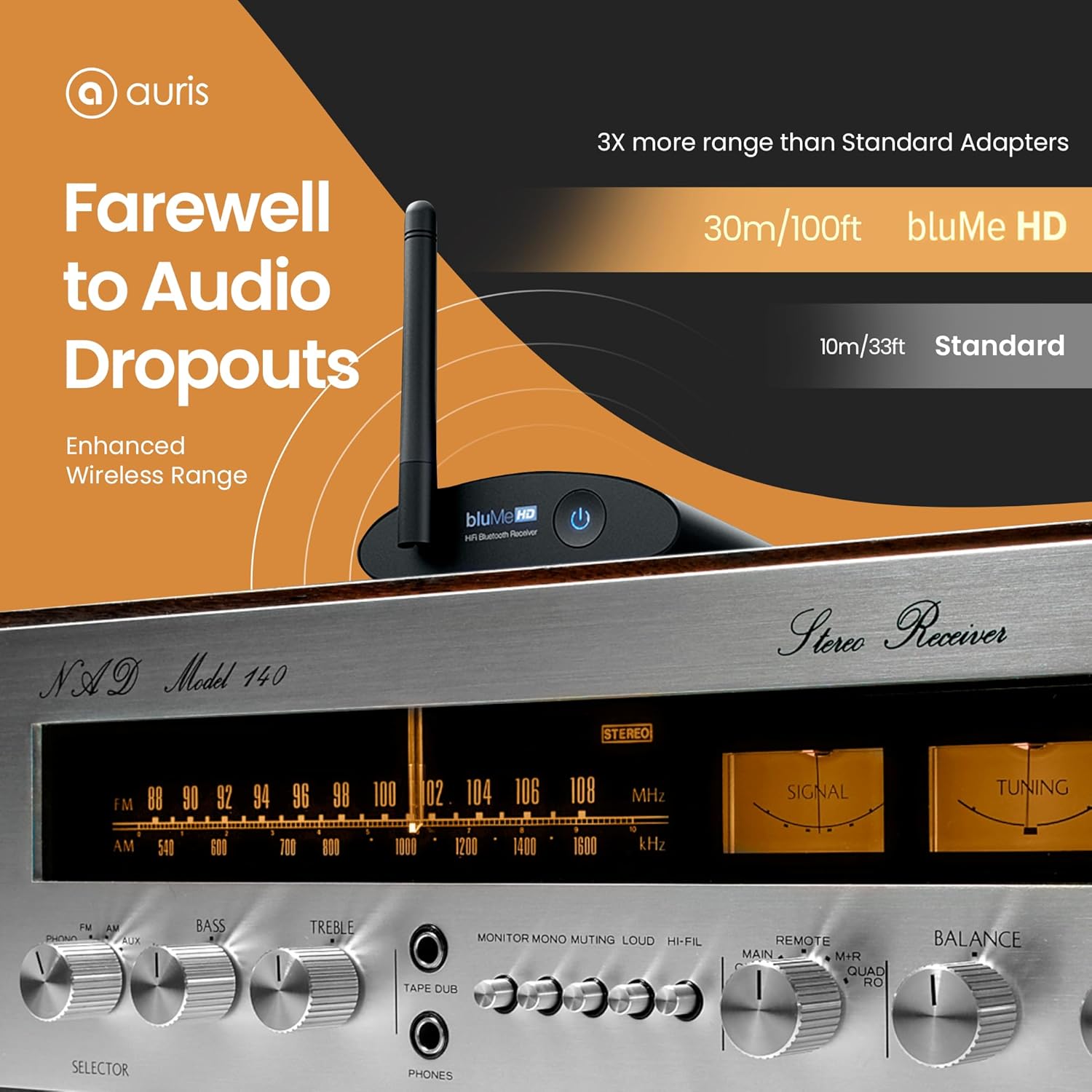
Auris claims 100+ feet and says it works through multiple walls. The reviews back that up more convincingly than most range claims survive contact with a British house.
Jake, the UGreen upgrader, is blunt about the difference: "I couldn't go into the next room with the UGreen, but the Auris is currently ticking along happily about 10 metres away, through two brick walls." Paul F streams across "about 10m (and two solid wood doors)" where his old Bose transmitter "would drop out every few mins". Paul Goodman lives in a mid-terrace, went "up into the loft room and could still stream music from my iPhone 5 to the ground floor with no loss". Mr. Stephen L. Long has one running a church PA system, where a device three metres away in a different room does not affect pickup, and an hour after being switched off it reconnects "within about 5 seconds".
Not everyone gets that. One two-star reviewer found it "useless in my house over a range of less than 12 Metres". Randy L. Maybon, one of the US reviews pooled onto the listing, never got started at all: "It powered on, but I could never get it to connect to any of my devices." Another one-star says the connection "keep breaking up and after reset work for 1 hour then starting breaking up". Five one-star reviews in a hundred, and two of those five never got a stable connection at all. That is the failure rate you are gambling against.
The gripe that will actually affect you, though, is subtler, and Julz Angell docked a star for it after originally giving five: "it will only store and remember connection at a time", and if you unpair a device, "getting it to reconnect can take many (many) tries". If one person in the house streams to the amp, that is invisible. If two of you want to hand the music back and forth, this is the flaw that will wind you up. The re-pairing button is fiddly too. Mr. Stephen L. Long found "too short a press and re-pairing didn't occur, too long a press and it broadcast 'turning off' over the church's PA system", which is a sentence you can only write from experience.
Two small touches reviewers keep mentioning and both are welcome. The unit speaks: John Nogales likes "that it talks and tells you your device is connected". And the blue LED that blinks when nothing is paired can be silenced, because a long press turns the unit off, which as S.Hughes points out "stops the blue light flashing when it's not connected".
Head to Head: the Cheap Dongle, the 1Mii B06 Plus and the BluMe Pro
Versus the cheap generic dongle. Ten reviewers already ran this experiment on your behalf, and the result is lopsided in one specific way. On noise and stability, the cheap adapter loses almost every time: hum, circuit-board hiss, stuttering, dropouts in the next room. On tone, the picture is fuzzier, and Jake's candour is the counterweight the marketing will not give you, because he could not hear a fidelity difference at all. So the call is about your speakers, not your ears. If your system is modest and your listening room is a busy kitchen, a cheap dongle is fine and you should keep the money. If your speakers are revealing enough that a noise floor bothers you, no amount of budget-dongle luck fixes that.
Versus the 1Mii B06 Plus. This is the one most UK buyers cross-shop, and on the numbers it looks like a rout: roughly 14,200 ratings at 4.5 stars against the Auris's 2,419 at 4.6. Ratings volume is not sound quality, though, and the number that actually decides this is not printed on either box: how well the analogue output stage is isolated from the digital one. Pig_Thomas's power hum and the three-star reviewer's digital chatter are the exact failure mode at stake, and on this listing almost everybody clears it. That is what you are paying for: a metal case and an output stage that stays quiet when your amp's volume is up and nothing is playing. If you own bookshelf speakers from Argos, the Auris is an expensive route to a result you will never hear. If your amp cost more than your phone, buy the Auris and stop thinking about it.
Versus the Auris BluMe Pro. The step-up model in the same range is the obvious upsell once you have settled on the brand. Here is the call, and it is the least obvious one in this article: if you are buying a Bluetooth receiver in order to feed your own external DAC, do not buy either of them. The single most detailed negative review on this listing came from a reviewer doing precisely that, and he ended up on an iFi Zen Blue. Spending more inside the same brand's digital chain means spending more on the one part of this product with a real question mark hanging over it. Buy the BluMe HD for its analogue outputs, where the evidence is overwhelmingly good, or buy a different brand entirely for a clean digital feed. The middle option is the one I would leave on the shelf.
The Bluetooth Receiver for an Old Hi-Fi Amplifier UK Buyers Should Get, and Who Should Skip It
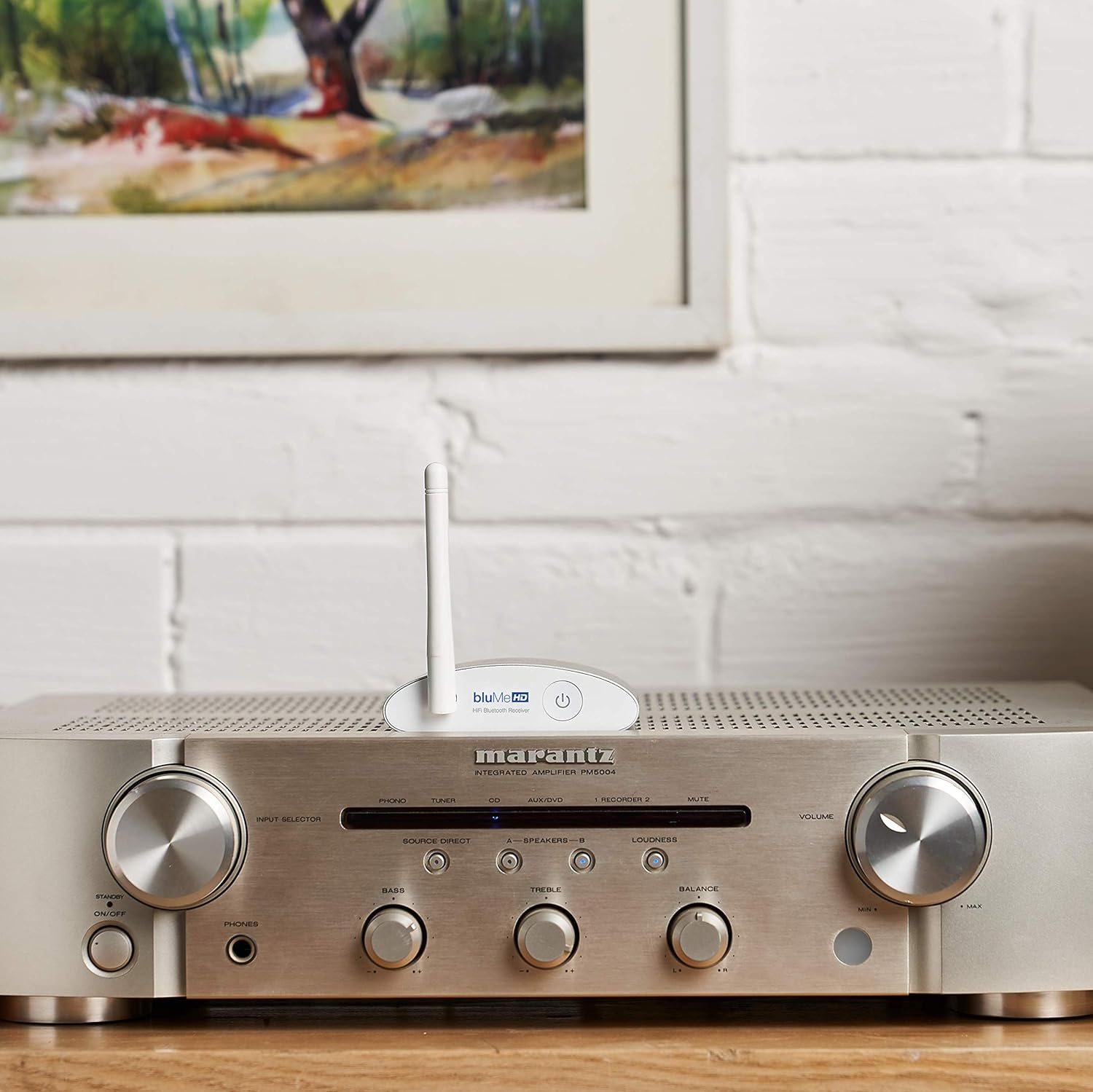
Buy it if your amp has a spare line input and you want your phone to sound like it belongs in the rack rather than apologising for itself. Buy it if your current adapter hums, hisses or stutters, because that is the complaint this fixes most reliably of all. Buy it if your system leans neutral or bright, or if you are streaming a high-bitrate service from an Android phone that speaks LDAC or aptX HD. Buy it if you want to walk to the far end of the house, or up into the loft, without the music breaking up. And buy it if you were seriously considering replacing a perfectly good twenty-year-old amplifier just to get Bluetooth on it, because several people here talked themselves out of a several-hundred-pound upgrade and are glad they did.
Skip it if you already own a good external DAC and want a clean digital feed into it, because the optical path is where every serious complaint clusters. Skip it if your system is already warm and thick-sounding, where a bass-forward receiver will tip it over. Skip it if two or three people in the house need to swap the stream between them all day, because it remembers one device at a time and re-pairing is a chore. And skip it if you are running active speakers with no volume control, because the output is hot and there is no way to trim it at the box.
For everyone else, which is most people who go looking for this at half nine on a Sunday night while staring at the back of an amp they have owned since university, this is the right answer. It is not cheap, and nobody in the reviews pretends otherwise. It also does the one thing it is sold to do, and it does it without adding a hum to a system you spent years assembling. That is worth paying for. Check today's price on Amazon before you decide.
Auris BluMe HD Long Range Bluetooth 5.3 Music Receiver
A metal-cased Bluetooth receiver with its own audiophile DAC, LDAC and aptX HD decoding, RCA and optical outputs, built to feed a real amplifier rather than a plastic speaker. Buy it for the analogue outputs.