Everyone Explains the 100Wh Rule. Nobody Names the Airline Approved Power Bank for Hand Luggage UK Flyers Should Buy.
Your cabin bag gets taken at the aircraft door because the flight is full. It is going in the hold, and the battery inside it cannot. That one moment decides which power bank you should have packed, and it is not the biggest one you are legally allowed to carry.
- The Rule, Once, Properly: 100Wh in the Cabin, Nothing in the Hold
- So Why Not Just Pack the Biggest Bank You Are Legally Allowed?
- "Nearly Two Full Charges" Is the One Claim I Would Push Back On
- Is It Actually a 45W Fast Charger? The Reviews Split Down the Middle
- The Cable Everyone Loves, and the Phone It Will Not Fit
- Used Once, Then Dead: What the One-Star Reviews Have in Common
- Against the Anker Already in Your Bag
- The Airline Approved Power Bank That Actually Goes in Your Hand Luggage
Type this into a search bar and you get a lecture. Skyscanner explains the rules. Anker explains the rules, twice. Three pages in you can recite the watt-hour limit from memory, and you still have no idea which battery to put in your bag.
So here is the other half of the job. The rule takes one paragraph, and then we can talk about what you are actually buying. INIU's 45W 10,000mAh bank, the one with the glowing paw print on the front, sits on 4.5 stars from 81,536 ratings. The 100 most-recent reviews average 4.39, and 78 of them are five stars. It is a well-liked little thing and it is the right shape for a cabin bag. It also has one pattern in the one-star reviews that you want to know about before you are at 30,000 feet with a flat phone.
The Rule, Once, Properly: 100Wh in the Cabin, Nothing in the Hold
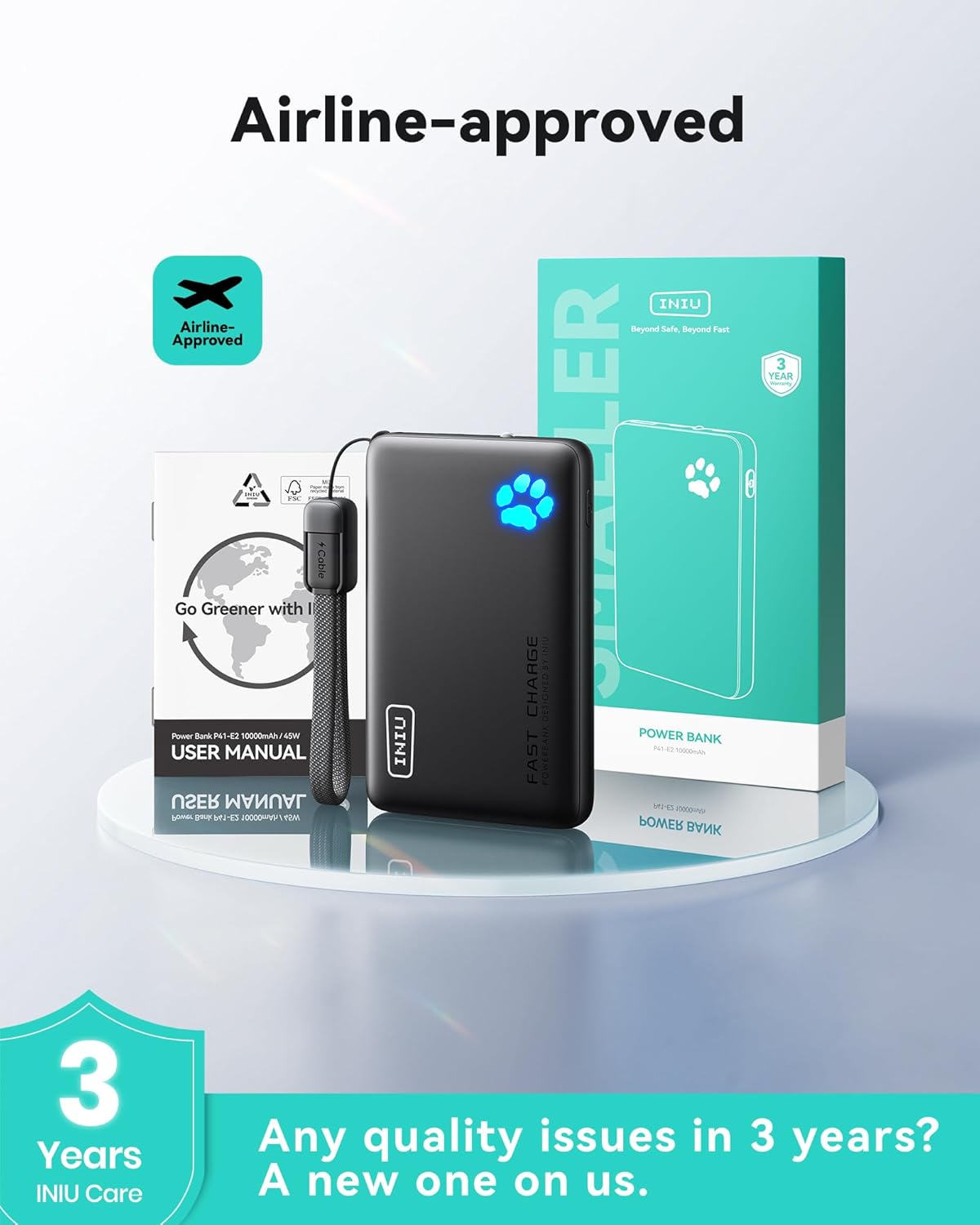
Lithium batteries are capped by energy, not by capacity, which is why the mAh number on the box is not the number an airline cares about. The limit IATA sets, and that UK carriers follow, is 100Wh per battery in hand luggage. Below that you carry it, no permission, no forms. The standard does allow 100Wh to 160Wh with the airline's prior approval, which is a conversation nobody wants to be having at 6am. And the part people forget: a power bank must never go in checked hold luggage. Not in the suitcase, not just this once.
The sum is mAh times cell voltage, divided by 1,000. Cell voltage is 3.7V on virtually every power bank sold, which puts the 100Wh ceiling at roughly 27,000mAh. This INIU is 10,000mAh: 10,000 times 3.7, divided by 1,000, gives 37Wh, sitting inside the limit with an enormous amount of room to spare. INIU stamps an airline-approved badge on the box and calls the thing Flight-Safe, and on the capacity question it has every right to.
The rule that actually catches people is the hold rule, and it catches them at the gate rather than at security. Board a full flight with a cabin bag and there is a fair chance you will be asked to hand it over at the aircraft door. That bag is going below deck. Your power bank cannot go with it, so it comes out and into your pocket before you let go of the handle. Individual airlines can also set their own rules about using or charging a power bank in flight, so give your carrier's page a look before you travel.
So Why Not Just Pack the Biggest Bank You Are Legally Allowed?
The answer is not the one the rules pages imply. If 27,000mAh is the ceiling, a 20,000mAh brick is still perfectly legal and nobody is going to stop you at security. The limit is not what makes a 10,000mAh bank the travel answer, and any article that suggests otherwise is bluffing.
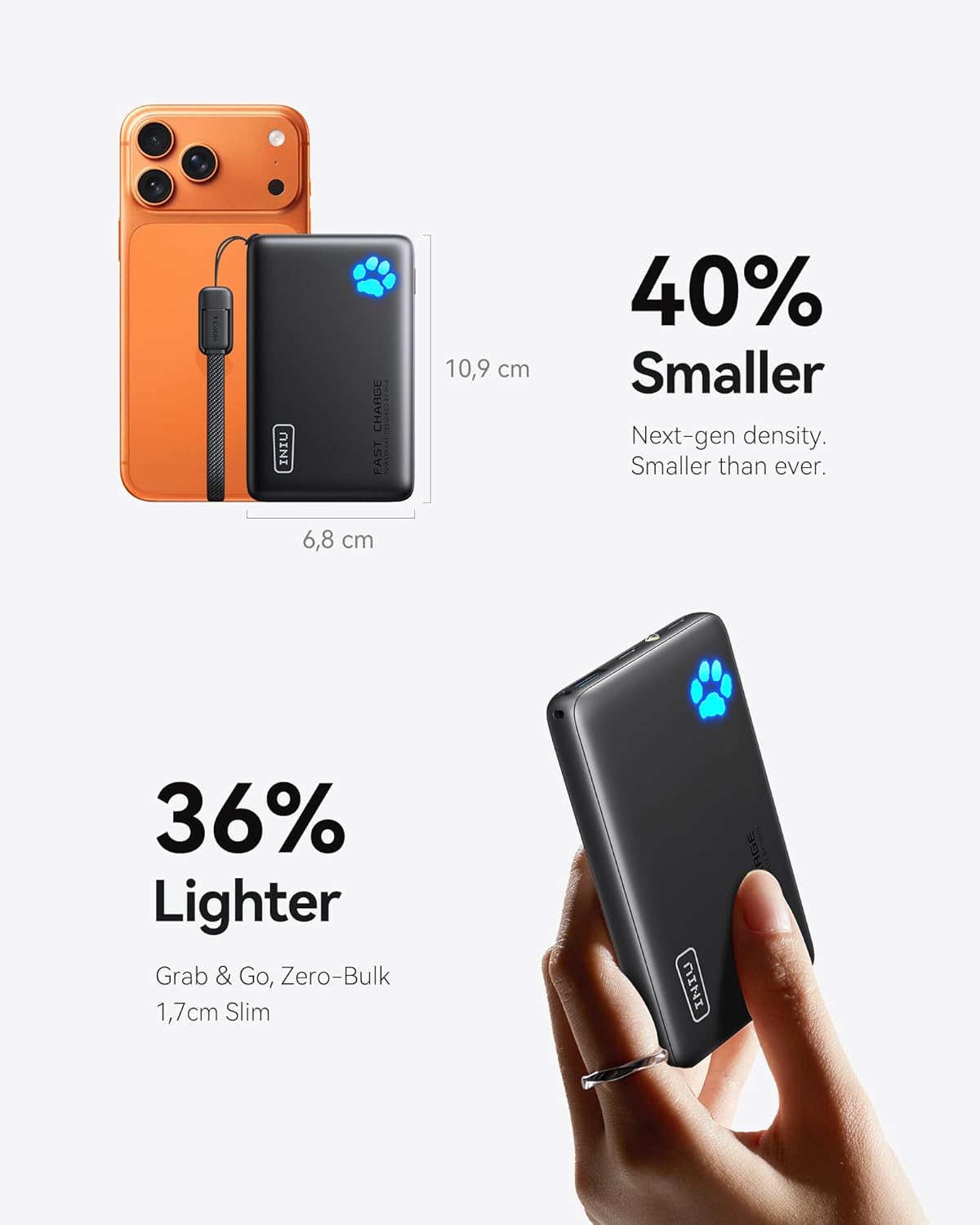
What makes it the travel answer is that you have to carry the thing. All day, through an airport, then around a city. This one measures 10.9cm by 6.8cm and is 1.7cm thick, so roughly a chunky phone. INIU credits its TinyCell battery for making it 40% smaller and 36% lighter than the usual 10,000mAh bank and, whatever the engineering, the result is a battery you stop noticing. The most upvoted five-star review in the recent batch puts it plainly: "It is lightweight and slim so you can carry it in a pocket with other items and you wont even notice it is there."
Kieran took it to Gran Canaria and called it an absolute lifesaver: "super easy to travel with... size is perfect to go in your pocket let alone in your rucksack". That is the whole pitch. A 20,000mAh bank rides in the bottom of a bag and stays there. This one lives in a jacket pocket, which means it is with you in the boarding queue when the phone hits 8% and the boarding pass is on it.
There is a price for that, and it is the next section.
"Nearly Two Full Charges" Is the One Claim I Would Push Back On
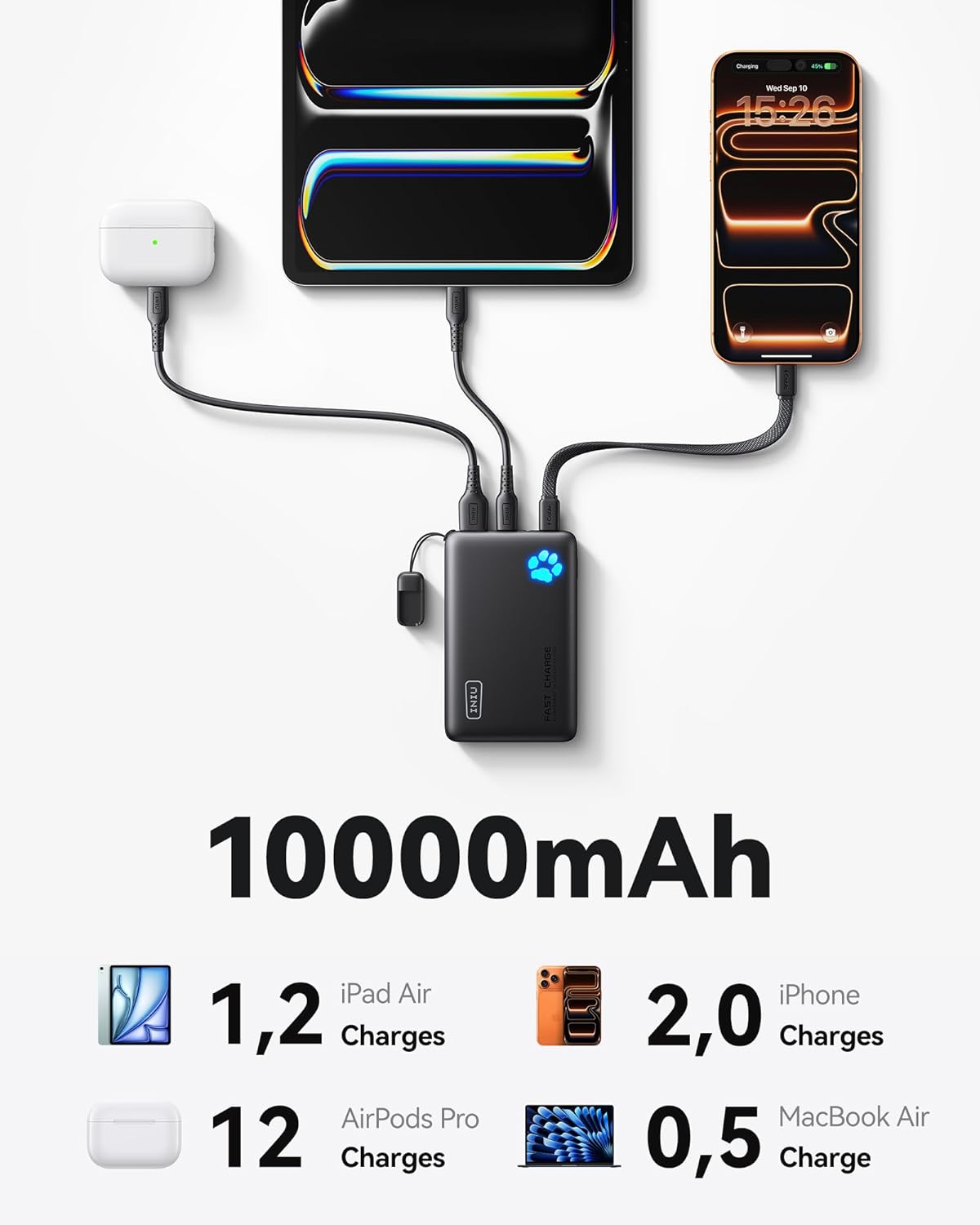
INIU's own graphic promises 2.0 iPhone charges, 1.2 iPad Air charges, 12 AirPods Pro charges or half a MacBook Air. The listing copy calls it "nearly 2 full charges for your smartphone". The most-recent reviewers say something quieter: pick one phone charge and plan around it.
Karen, four stars, did the maths for us. "Unfortunately I don't think this holds two charges for an iPhone - a fully charged pack got my iPhone from 5% to 84% before I needed to recharge the pack so be mindful when travelling that you may need to charge this on a daily basis." Rosie, three stars, landed in the same place: "Definitely better for one full charge than two." Toyah, also three stars, simply said the charge does not last very long.
Plenty of buyers report the opposite. One managed two phone charges "and still some power left". Claire Horn claims four. Which is your cue to read power bank reviews with one eye open, because Amazon pools reviews across every INIU variant on this listing. One five-star reviewer says outright "I got the bigger one not the slim line one", and another describes a unit that is "a bit big in size". Those are not this product. Before you believe any charge count quoted in a review here, check the reviewer is holding the slim 10,000mAh model.
My read: budget for one full phone charge plus a useful splash more, and treat anything above that as a bonus. For a flight, a transfer and an evening of hunting for a plug socket, that is plenty. For three days of walking with no mains power, it is not, and you should be buying the 20,000mAh instead.
Is It Actually a 45W Fast Charger? The Reviews Split Down the Middle
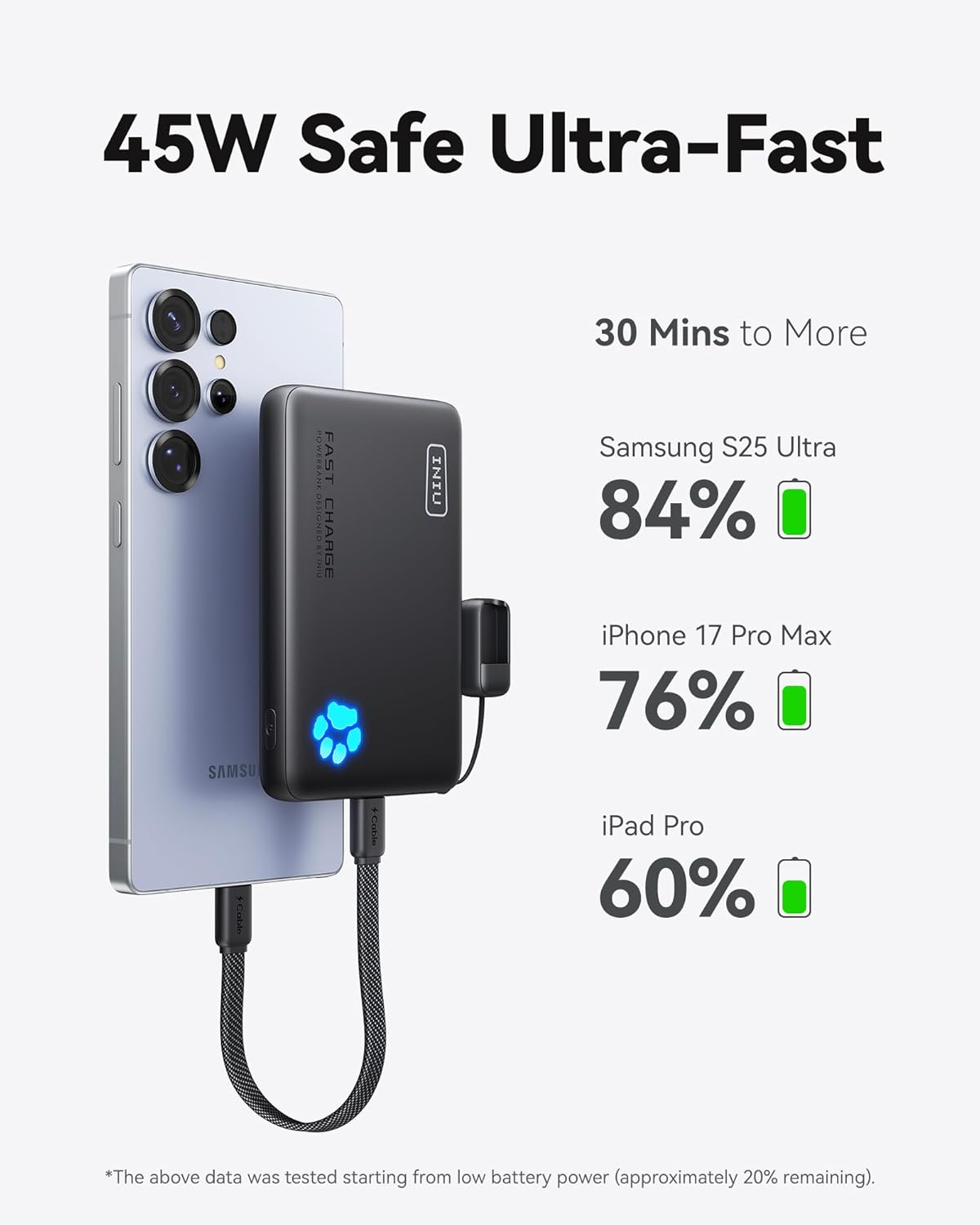
INIU's claim is specific. Thirty minutes from a 20% start takes an iPhone 17 Pro Max to 76%, a Galaxy S25 Ultra to 84%, or an iPad Pro to 60%. That is the kind of speed that turns one coffee before boarding into most of a day's battery.
Then a two-star reviewer says this: "Build quality is good, size weight dimensions is good but unfortunately this is not fast charging like advertised. Charges iPhone 15 Pro Max at 1% per minute." Another two-star review is one line long: "Quite slow charging".
Except Dorin Dumitru, five stars, charges the same iPhone 15 Pro Max and reports it goes "veery fast". And AJM in Uley, who had clearly been let down by other banks: "Very few things can fast charge a iPhone 17 pro max. But the USB-c port does a good job." Same phones, opposite verdicts, and nothing in the reviews resolves the split cleanly. If the 45W figure is the reason you are buying, use the USB-C port and the supplied C-to-C cable, and read the advertised numbers as a best case rather than a guarantee.
The complaint that is consistent is how long the bank itself takes to fill back up. Rosie found she "spent more time recharging it than I have charging my devices". One buyer, starting from the part-charged state it arrived in, had it full in about two hours on the supplied C cable, and a couple of others say it takes a while. That is not a dealbreaker, it is a packing instruction: charge it the night before you fly, not in the forty spare minutes you have at the airport.
The Cable Everyone Loves, and the Phone It Will Not Fit
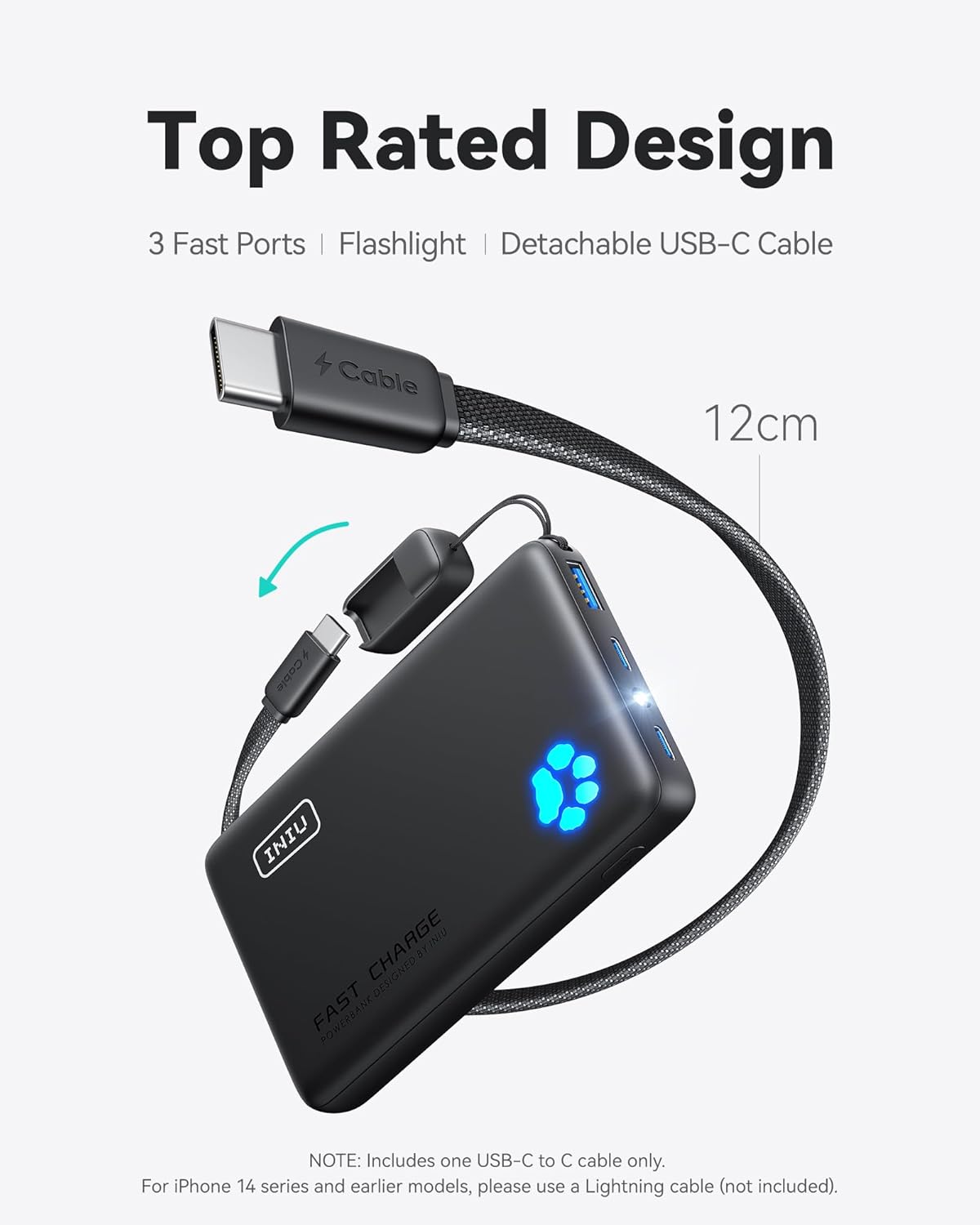
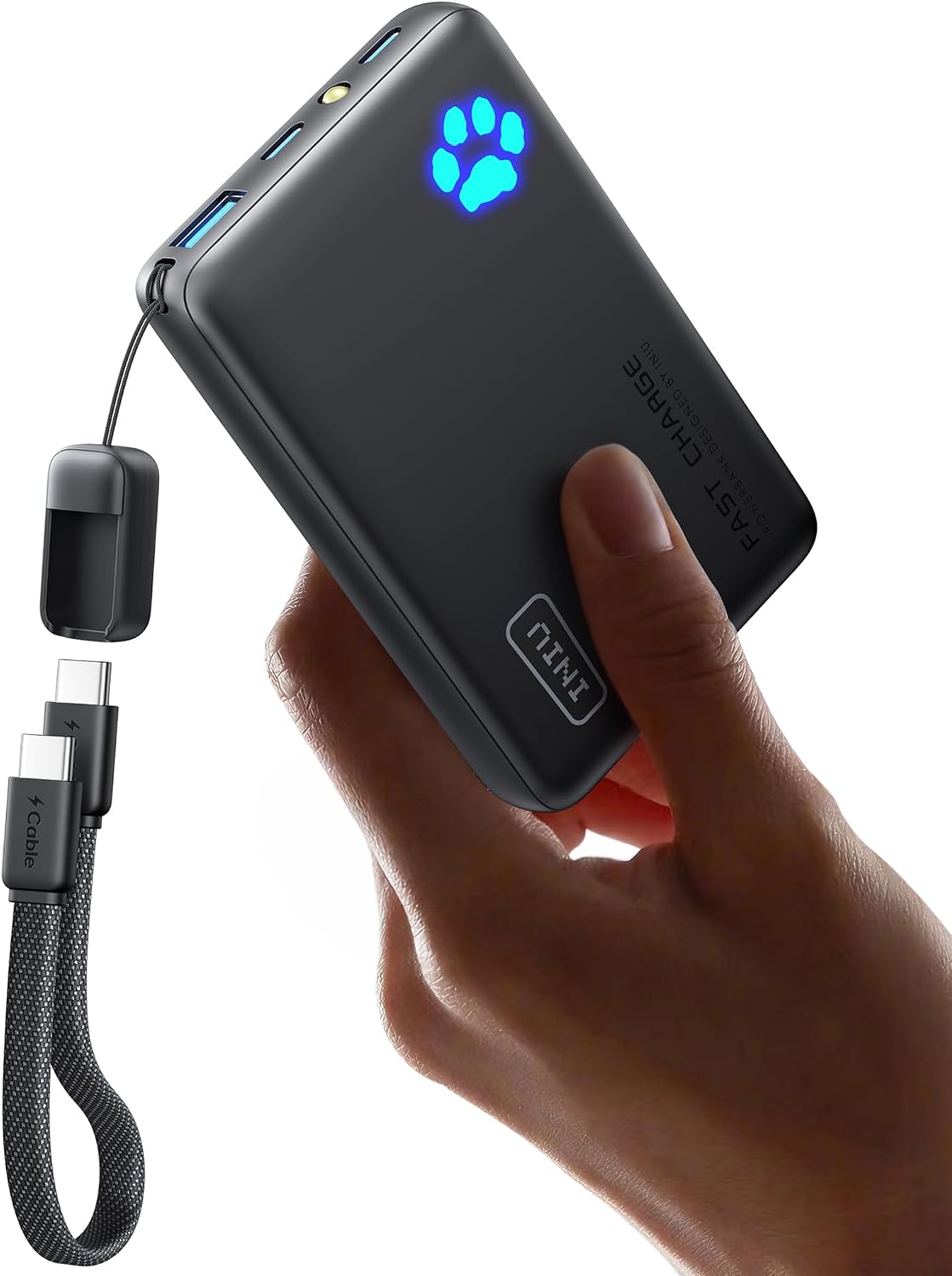
The best idea on this power bank is a 12cm braided USB-C cable that clips to the body as a strap. It is always there, it never migrates to the bottom of a rucksack, and if you wreck it you replace a cable instead of the whole bank. Reviewers keep circling back to it. One writes that "the little 'in built' cable touch really helps, so you don't need to worry where to store the cable". Archie, charging on trains and buses, calls the detachable cable "SO clever - what brilliant invention". Even a reviewer whose unit died after three months stopped to say the cable attached as a strap "was wonderful".
Now the catch, and it is printed on INIU's own product image: the cable in the box is USB-C to USB-C only. On an iPhone 14 or earlier, or anything else still on Lightning, you supply your own lead, which undoes a good chunk of the point of a cable that lives on the bank. Check what your phone takes before you order.
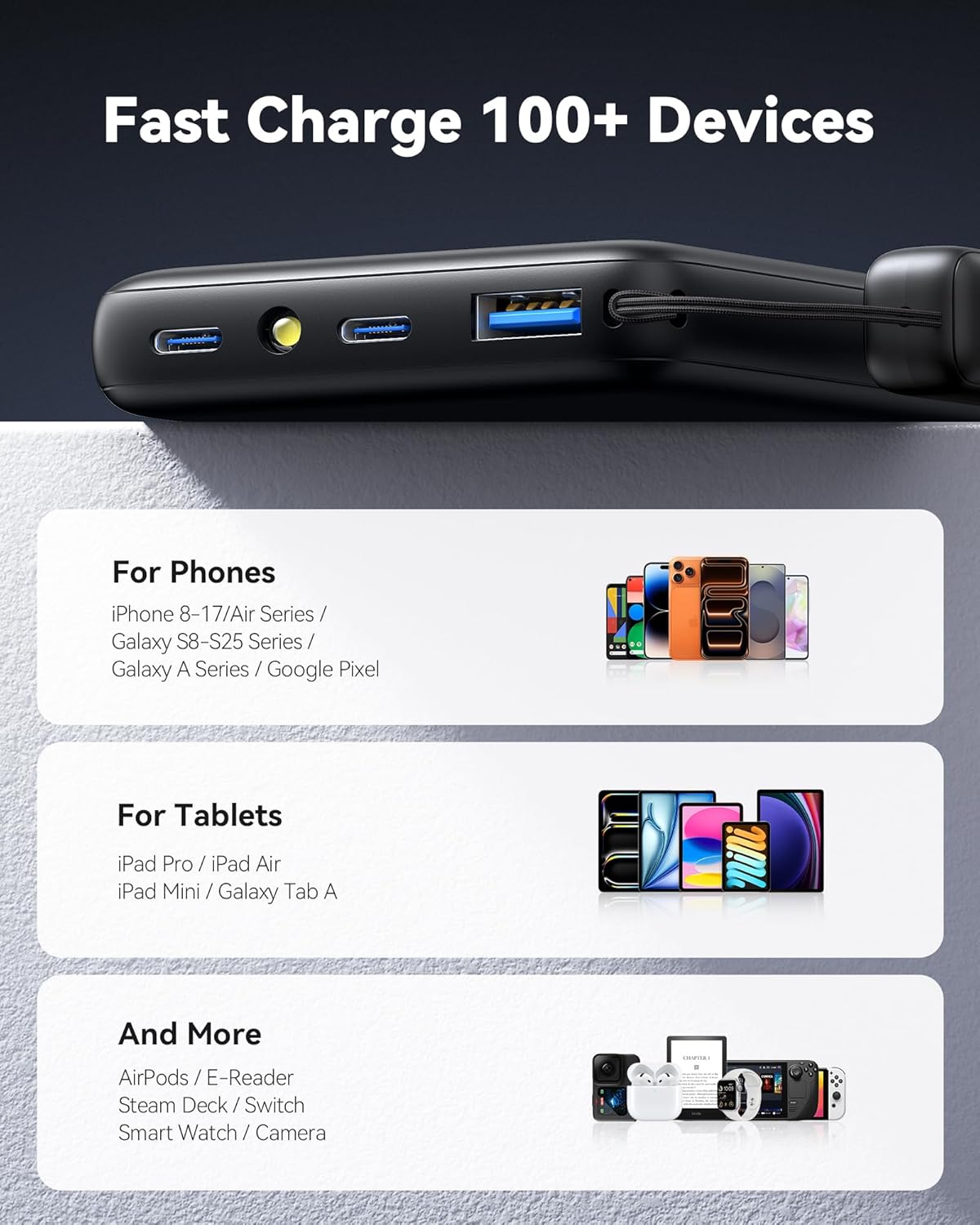
Along the edge you get three fast ports, two USB-C and one USB-A, so a phone, a watch and a friend's dying handset can all feed at once. There is a small flashlight too, which sounds like filler until you are groping around a hostel bunk at 2am. One four-star reviewer flagged that there did not seem to be a setting for Bluetooth earbuds, although they had not charged anything with it at the time of writing, so bear that in mind if low-draw kit is your reason for buying. The paw print on the front is the charge gauge and it runs through five stages. It is also, going by the reviews, a real reason people pick this one: one buyer says the paw detail "is the main reason why I bought it", another loves "the paw print design which tells you when the charger wants charging", a third just calls the paw print indicator "very cool".
Used Once, Then Dead: What the One-Star Reviews Have in Common
This is the part no rules page will ever tell you, and it is the reason to keep reading. Of the 100 most-recent reviews, 11 are one star. Eight of those 11 are not about performance at all. They are about the unit stopping dead.
The timelines are all over the place. One buyer used it once and now it "just doesn't charge or do anything". Another got about ten uses before it went "dead, no lights, no power, no response". L.J got seven weeks. Sari got three months, and the failure "also fried the port it was plugged into". Mickey Ashton got eight months. The nastiest of them is Ben A., who watched it overheat the phone and start flashing before it quit "just passed the return period". AllanB reports the original failed and the replacement failed as well.
Set against that: 78 of the last 100 reviewers gave it five stars, and the lifetime score is 4.5 across 81,536 ratings. Eight bad units in a hundred recent reviews is not a recall. But on a product whose entire job is to work at the single moment you need it, it is not background noise either.
What takes the sting out is the warranty. INIU covers this for three years and says a replacement is on them, which is longer than most of this market offers, and one buyer weighing it up said the three-year cover "gives peace of mind and suggests confidence in the product by the manufacturer". So keep the order in your Amazon history and claim if it dies. And do not let a brand-new, still-boxed bank be your only battery on a trip that matters. Charge it, run it down once, charge it again, then pack it.
Against the Anker Already in Your Bag
Almost everyone reading this either owns an Anker or nearly bought one, so that is the comparison that counts.
Versus the default Anker 10,000mAh. Anker is the safer badge and has the better name for a bank still working in year three. What the INIU adds is the cable strapped to the body, a third port, a torch, and a three-year warranty that outlasts most of the shelf. It is usually the cheaper of the two as well, so check today's price on Amazon and see how wide the gap really is. If it is pennies, take the Anker and sleep easy. If it is a meaningful chunk of money, the INIU's extras make it the better buy.
Versus the unbranded bargain bank. There is always something cheaper with four-point-something stars and a brand name that reads like a captcha. Given how much of this review turned on dead units and warranty claims, paying less to give up the three-year cover is precisely the wrong trade. Skip it.
Versus a magnetic or premium bank. If you are on a recent iPhone and want the battery clinging to the back of the phone while you walk through Gatwick, buy a MagSafe-style one instead and accept it will be thicker in the pocket and pricier at the till. This INIU has no magnets and never claims to.
Versus simply taking a 20,000mAh. Still airline legal, still hand luggage only, roughly double the phone charges and roughly double the bulk. If there is a plug socket waiting at the end of every day, that is weight you carried for nothing. If there is not, buy the bigger one and stop reading.
The Airline Approved Power Bank That Actually Goes in Your Hand Luggage
Buy it if you fly a few times a year, need one battery for one phone, and want to forget it is in your jacket right up until the boarding pass is sitting at 6%. It is the right capacity for the rules, the right size for a pocket, and the strap cable means you are never the person at the gate rummaging for a lead. The paw gauge is a small silly pleasure, and I am fine with that.
Skip it if you need two full phone charges away from mains power, if you are still on Lightning and will not buy an extra cable, or if you want a battery you can leave in a drawer for a year and trust blind. Order it early enough to put it through a full charge cycle before the trip, and keep the receipt so the three-year cover is there if you land on one of the bad units.
Rated 4.3 out of 5. Eleven of the last hundred reviewers mention buying more than one of these, which tells you plenty. The failure rate is real too, and the warranty is the only reason it does not sink the score.
INIU 45W Fast Charging Power Bank, 10000mAh with Detachable Cable
A pocket-sized 10,000mAh bank, around 37Wh and well inside the 100Wh cabin limit, with a 12cm USB-C cable strapped to the body, three fast ports and three years of INIU cover. The one to pack in the hand luggage.