Your Mower Runs at 91 dB. ISOtunes' Bluetooth Ear Defenders for Mowing the Lawn UK Cap the Music at 82.
ISOtunes built a volume ceiling into these on purpose, and it is the single thing the angriest reviewers hate about them. Whether that ceiling ruins them for you comes down to a question nobody asks first: what do you actually mow with?
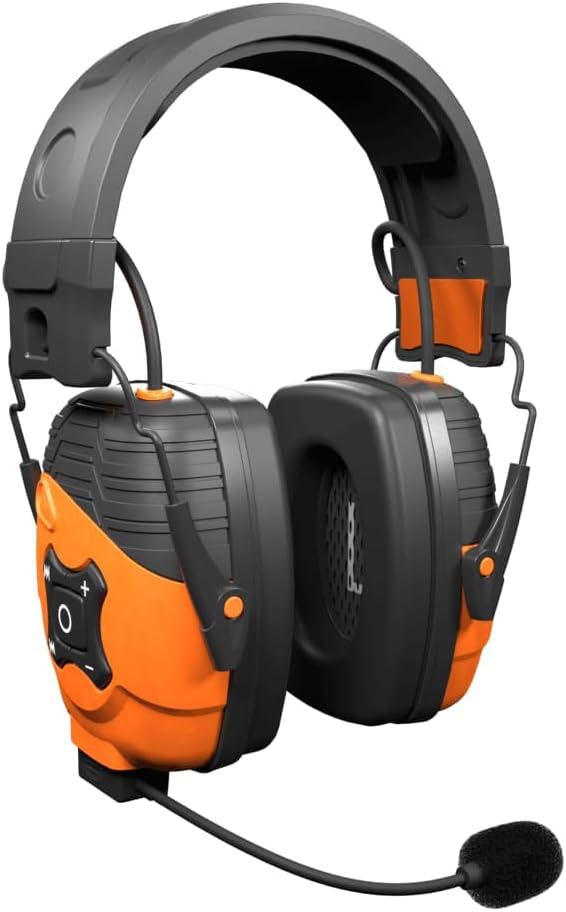
- Your Mower Settles This, Not the Star Rating
- The 82 dB Ceiling Is a Safety Feature Wearing a One-Star Costume
- The Charging Port Is the Part That Breaks
- Two Hours In, Your Head Will Tell You the Truth
- Where You Put Your Phone Changes Whether They Work at All
- Taking a Call With the Engine Running
- Bluetooth Ear Defenders for Mowing the Lawn UK: the Four Options You Are Really Choosing Between
- The Push-Mower Verdict, and the Ride-On One
What do you mow with?
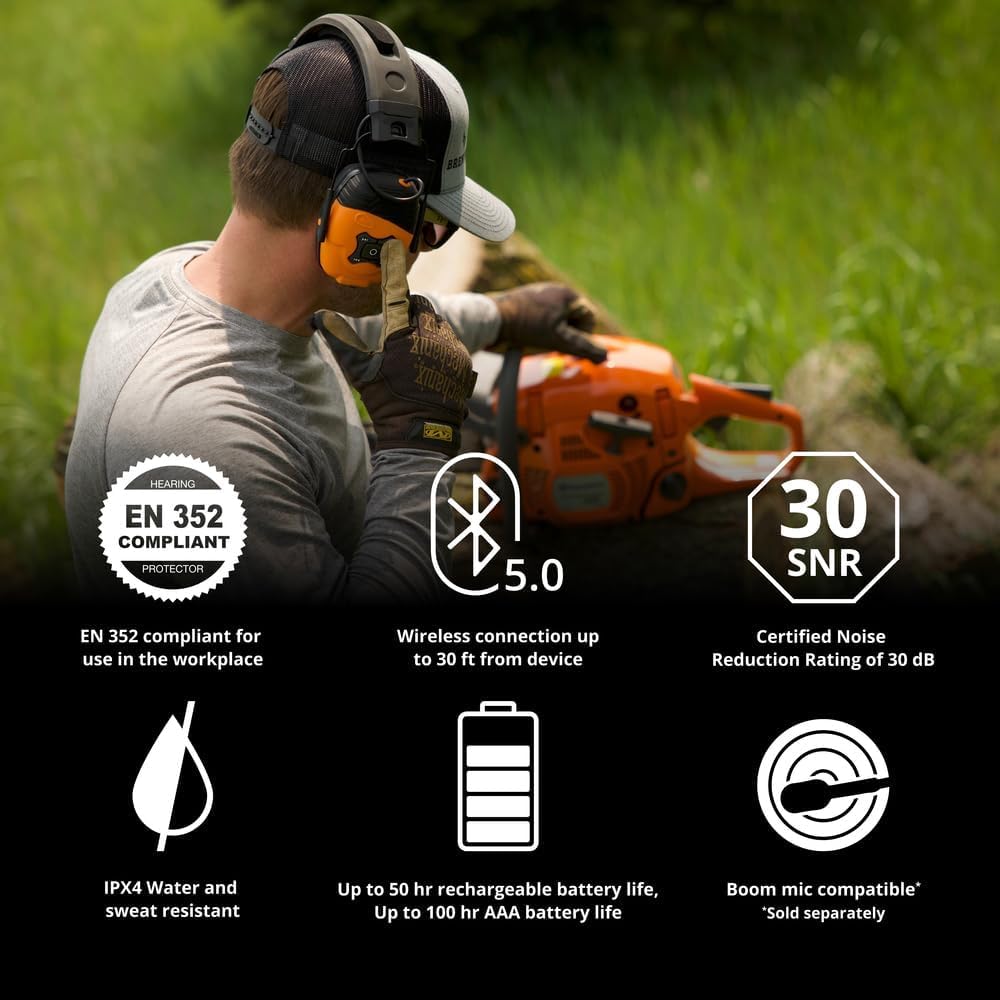
Answer that before you spend anything, because it decides this purchase more thoroughly than any figure printed on the box. The ISOtunes LINK 2.0 has a volume ceiling built into it deliberately. ISOtunes calls the feature SafeMax, and the listing is blunt about what it does: audio output is limited to 82 dB. There is no override, no party mode, no way to wind it past that no matter how hard you press the plus button.
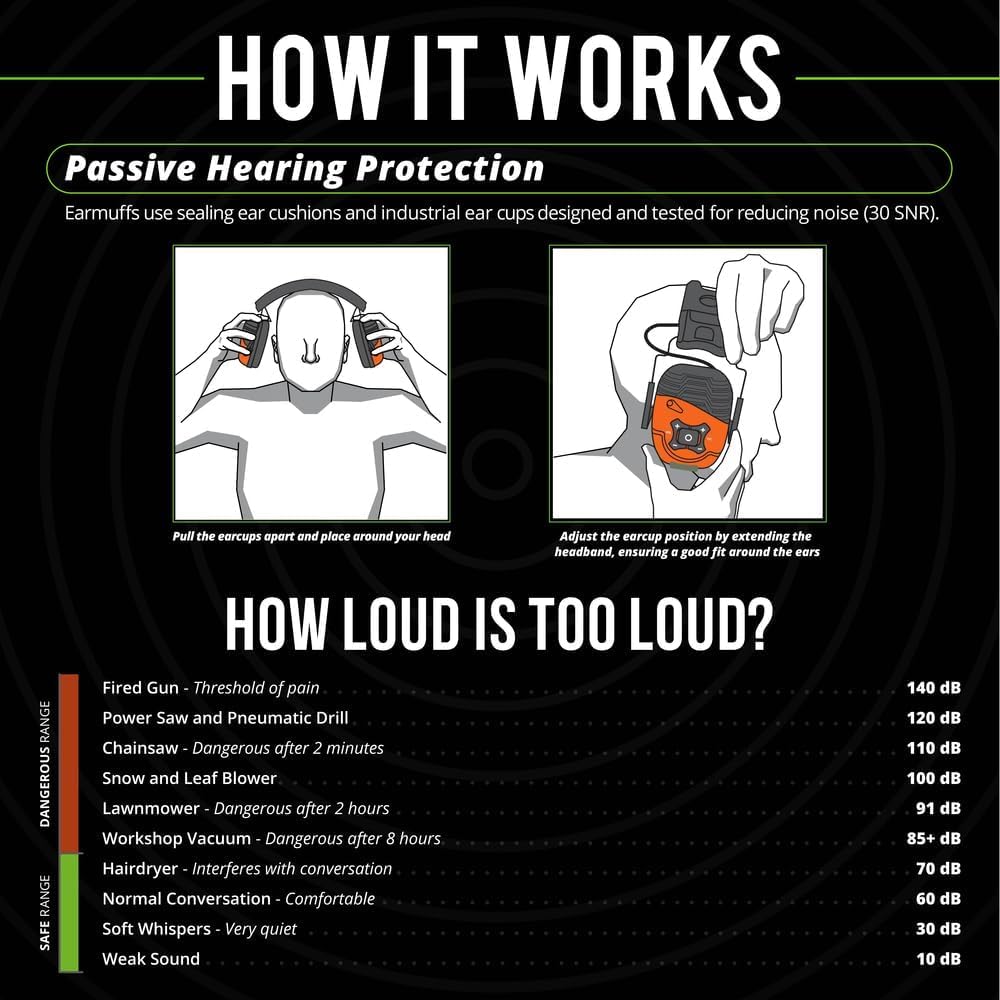
Now look at ISOtunes' own noise chart, the one printed on their Amazon images. Lawnmower: 91 dB. Dangerous after two hours.
A capped pair of headphones and a machine that is louder than the cap. That one tension explains nearly every furious review these have collected and nearly every glowing one, and which camp you end up in has very little to do with the headphones. It has to do with what is in your shed.
Your Mower Settles This, Not the Star Rating
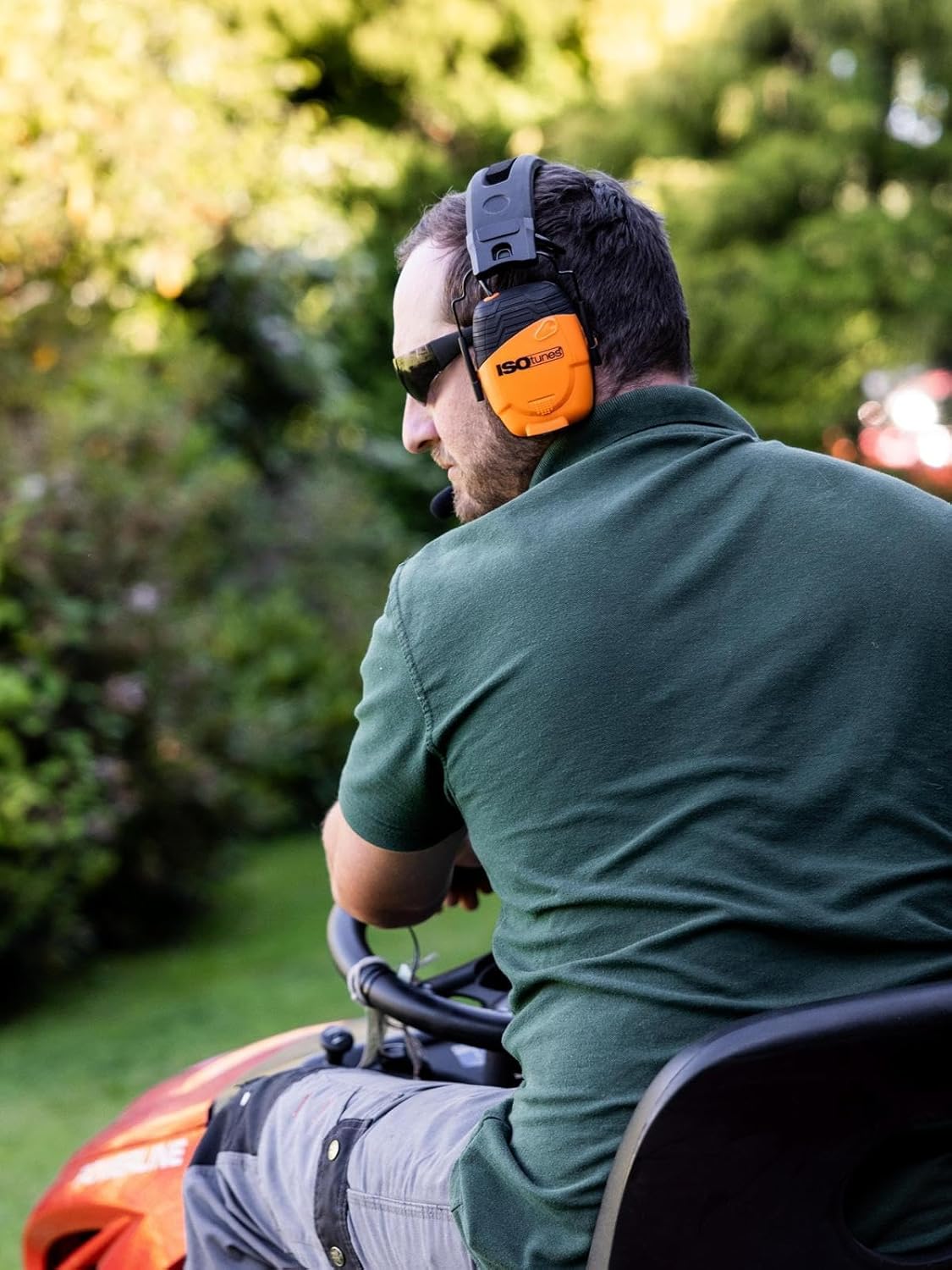
Start with the arithmetic, because it is simpler than the marketing makes it look. The LINK 2.0 is certified to EN 352 with a 30 dB SNR. Feed a 91 dB lawnmower into that and what arrives at your eardrum lands a long way below the 82 dB the music is allowed to reach. On a push mower, the music wins the argument comfortably. That is not a theory, it is what the owners report.
One reviewer splits the whole product in half inside a single review. Running a zero-turn, the verdict is: "The music sounds like it's in the background." Then, in the very next sentence: "But if you're using a push mower or weedeater its pretty clear." There is your buying decision, written by an American owner in 2022 and buried deep in the review pile.
Everyone who hated these was standing behind something big. Guy, a UK buyer, tested them on a commercial mower and warned that "you would experience the same problem on your average ride on mower". A French owner on a lawn tractor found podcasts impossible. An American running a lawn care business found the blower and trimmer fine but "on the lawn mower not so much". Meanwhile the domestic crowd is delighted: "I use these to listen to music while I mow the yard. They block the noise from the mower well and the sound quality for the music is great."
Here is the part that matters for a UK garden, and no listicle will tell you: of the 100 most recent reviews on this listing, 62 come from the United States and only 10 come from the UK. American mowing means ride-ons, zero-turns and commercial crews cutting acres. A British back garden means a push mower or a cordless rotary, and roughly twenty minutes of it. The machines producing the loudest complaints on this product are, for most of the people reading this, machines you do not own.
ISOtunes' own chart quietly confirms the pattern. A leaf blower sits at 100 dB, a full 9 dB above the mower, and sure enough one buyer writes: "I can barely hear my music over my leaf blower with the volume all the way up." The chart predicted exactly that.
The 82 dB Ceiling Is a Safety Feature Wearing a One-Star Costume
Twelve of the last 100 reviewers complain that the music is not loud enough. The complaint turns up in one-star returns and in five-star recommendations alike, which is the tell. "Sound is ok but has a governor," writes one. "Music, just not loud enough," writes Guy, who adds a wonderfully British parenthetical: "(blame the EU?)".
They are all describing the same thing, and it is not a fault. It is the product doing its job.
A five-star reviewer called H. Clonch put it better than ISOtunes' own copywriter managed. The review is titled "If you are looking to jam out with these, don't," and it explains why: "These are design to protect are hearing and that includes the volume level of they music you are listening to." Spelling aside, that is the product understood completely. You are buying ear defenders. The whole reason you are buying them is that sustained loud sound wrecks hearing. Blasting uncapped music into a sealed cup for three hours does precisely the damage you strapped the muffs on to avoid, and the cap is the only thing standing between you and doing it to yourself.
Which reframes the cheaper rivals rather neatly. The budget Bluetooth muffs stacked up against these in the search results will play louder. That is not them beating ISOtunes on engineering. That is them leaving out the safety rail.
The fair criticism is that ISOtunes does not shout about the ceiling. It sits in the fourth bullet point, phrased as a benefit, and a dozen people found out what it meant only after the box arrived. Even fans are irritated by it: one Canadian owner gave five stars and still grumbled that the sound is not loud enough for music, noting pointedly that they are not the first to complain. They are not.
The Charging Port Is the Part That Breaks
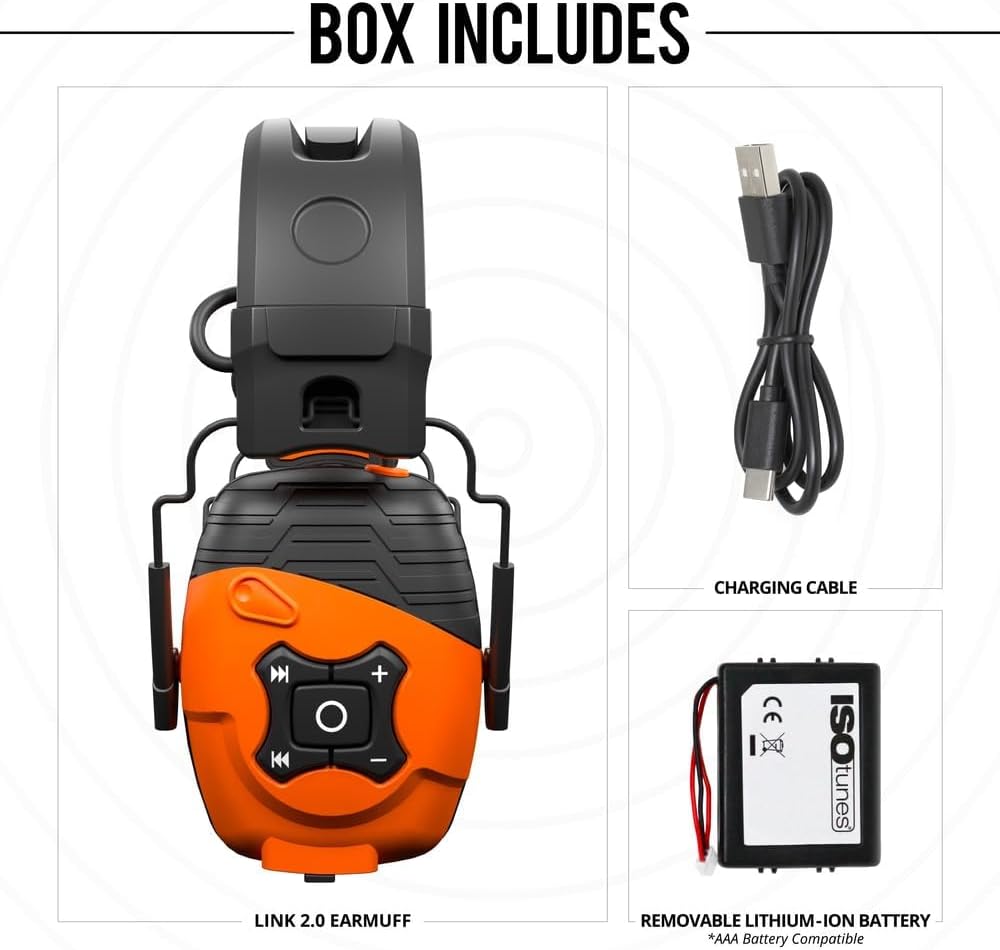
Six of the last 100 buyers report the charging port or the charger giving out. For a product at this end of the price ladder, that is the number worth chewing on.
Steve J bought them twice: "First pair lasted about a year before the charging port fell apart. I purchased a new pair, charging port lasted less than a month." Zyn ski has the most damning version, because it is a sample rather than an anecdote: "three of us at work use these earmuffs, and two of us had the connector break off within a year of use". The same review still finds room to add that "They're fantastic in every other respect, very comfortable, good audio, bluetooth is stable." Mark Briggs was blunter: "charger port is junk, everything else was fine."
Now the mitigating half, which the one-star reviews will not tell you. The battery is a removable lithium-ion pack, and the muffs also run on AAAs. The listing rates them at up to 50 hours rechargeable and up to 100 hours on disposables. When Wayne Crenshaw's charging port broke, the muffs did not go in the bin, they carried on running off disposables. His pair did give up months later over an unrelated Bluetooth fault, but the dead port on its own did not finish them. A dead port on these is an injury, not a funeral, and that is more than you can say for almost any sealed Bluetooth headphone.
The breakages are not confined to the port either. Bruce Dyer, a UK buyer, had the plastic holding the spring-loaded ear cup crack after about a year of light use, and ISOtunes' answer was that the warranty had run out two months earlier. "Not good enough, very disappointing." Another owner had the metal headband arm snap the thin plastic holding it. Another had the side buttons die inside a month.
Support is a coin flip on this evidence. A landscaping company owner rates ISOtunes customer service "5 Stars across the board" and buys nothing else for the crew. A buyer whose port collapsed "called three times and e-mailed twice for warranty help and ZERO response". Both of those are real, and you cannot know in advance which one you will get.
One important caveat before that six frightens you off. The reviews pooled onto this listing run from January 2021 to April 2026 and arrive from seven countries, which means they cover more than one generation of LINK hardware. One buyer describes a "micro USB" port snapping off in March 2024; an Italian buyer a few months later describes unboxing a USB-C charging cable. Those are not the same machine. Several of the oldest port complaints may simply not describe the unit that turns up at your door, so check the current listing photos rather than assuming the worst.
Two Hours In, Your Head Will Tell You the Truth
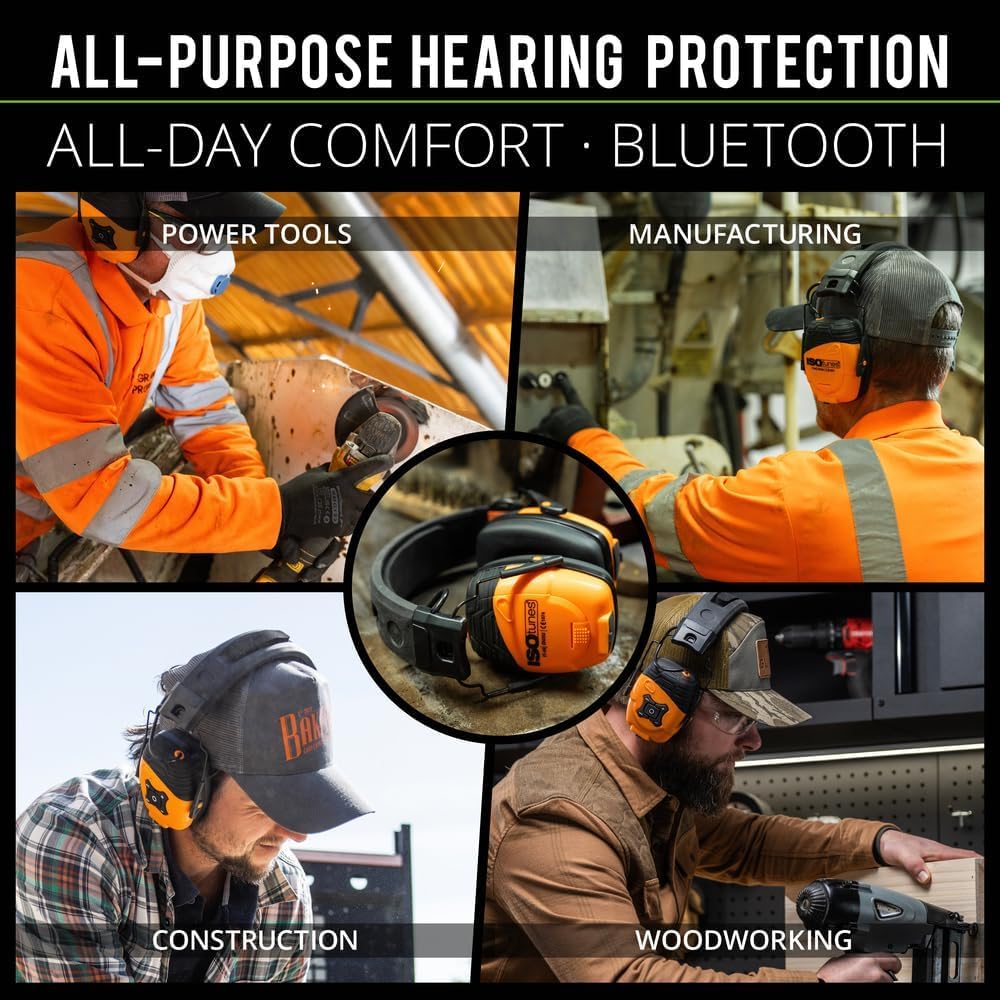
These clamp. Hard. More than twenty of the last 100 reviewers raise comfort in some form, which makes it the most repeated complaint on the listing, and it splits people almost perfectly down the middle, because it depends entirely on the shape of the head you were born with.
Dev02 gave four stars and still shouted about it: "they are TIGHT!!!" An Australian owner said they were "too tight on my head that it gives me headaches" and went back to AirPods for relief. One buyer, who wears a 7 1/4 hat, claims they "caused a bald strip in the middle of my head". Rita Huisman finds they create "a lot of pressure on my ears" and has to take them off and reposition through the day. Joel Morgan manages three hours before the ear cups start to hurt.
And yet. A Canadian buyer switched to these precisely because the alternative hurt more: "I bought these because the 3M brand was really uncomfortable for me. These are not," the review reads, and it adds that the battery survives a full 11-hour shift. H. Clonch, our volume philosopher from earlier, concedes they are not as comfortable as hoped and awards five stars regardless, "because they are more comfortable than any others I have owned".
So it is a lottery, and the only sensible advice is to buy from somewhere you can return to and find out inside the first fortnight.
Two specifics matter more for mowing than for the workshop. The first is glasses. Three reviewers flag it, and one is precise about the mechanism: "They are not so good at blocking sound when using safety glasses. They let sound in when you turn your head." The arm of your sunglasses breaks the seal between the cushion and your skull, and the seal is where the 30 dB lives. Look closely at ISOtunes' own photograph of the man on the ride-on mower. He is wearing sunglasses. The second is sweat: "a 2 hour stint mowing left them wet with sweat, no wicking ability." The IPX4 rating means the muffs will survive that. Your comfort is a separate contract.
A caveat again, and it points the same way as the last one. Several people insist there is no padding whatsoever on the crown of the headband. All of those reviews are from 2021 to 2023. The LINK 2.0 listing specifically promises "a padded headband and memory foam cushions", which suggests the complaint was heard and answered, and that you are reading about a version that is no longer sold.
Where You Put Your Phone Changes Whether They Work at All
This is the finding that never makes it into a top-ten roundup, and it will save some of you a return.
Jeremy Hill, three stars: "The biggest issue is if I'm connected to my phone in my pocket, the headphones can't connect unless I have my phone on the same side as the button side of the headphones." J Mounteer, two stars, bought a pair to mow the lawn and hit the same wall: "if my phone was in a pocket anywhere on my person instead of in my hand I'd get signal interruption. Buffering, short-out, and even complete disconnection even though the phone was in my jeans pocket."
Two people, a year apart, describing identical physics. The Bluetooth radio lives in one ear cup. You are a bag of water, and water eats 2.4 GHz. Put the phone in the trouser pocket on the wrong hip and you have placed an entire torso between the transmitter and the receiver, then blamed the headphones.
The listing claims a wireless connection up to 30 ft from the device, and out on an open lawn that is believable. Indoors it is not: one five-star owner notes the connection fades past about 10 ft "with walls in between". Walls being the operative word.
So, for mowing: chest pocket, or the trouser pocket on the same side as the control cup, or simply clipped to the mower handle. It costs nothing and it turns a two-star complaint into a non-event. If you were about to buy these and you keep your phone in your back left pocket, that sentence was the most useful thing in this review.
Random shutdowns are a separate matter and a real one. "Randomly powers down," says a three-star owner who has had two occurrences in three months. "They occasionally shut off, stop pairing, or pause the audio without me having done anything," says another. Nobody in the reviews has found a fix for that, and it is the one flaw here with no workaround.
Taking a Call With the Engine Running
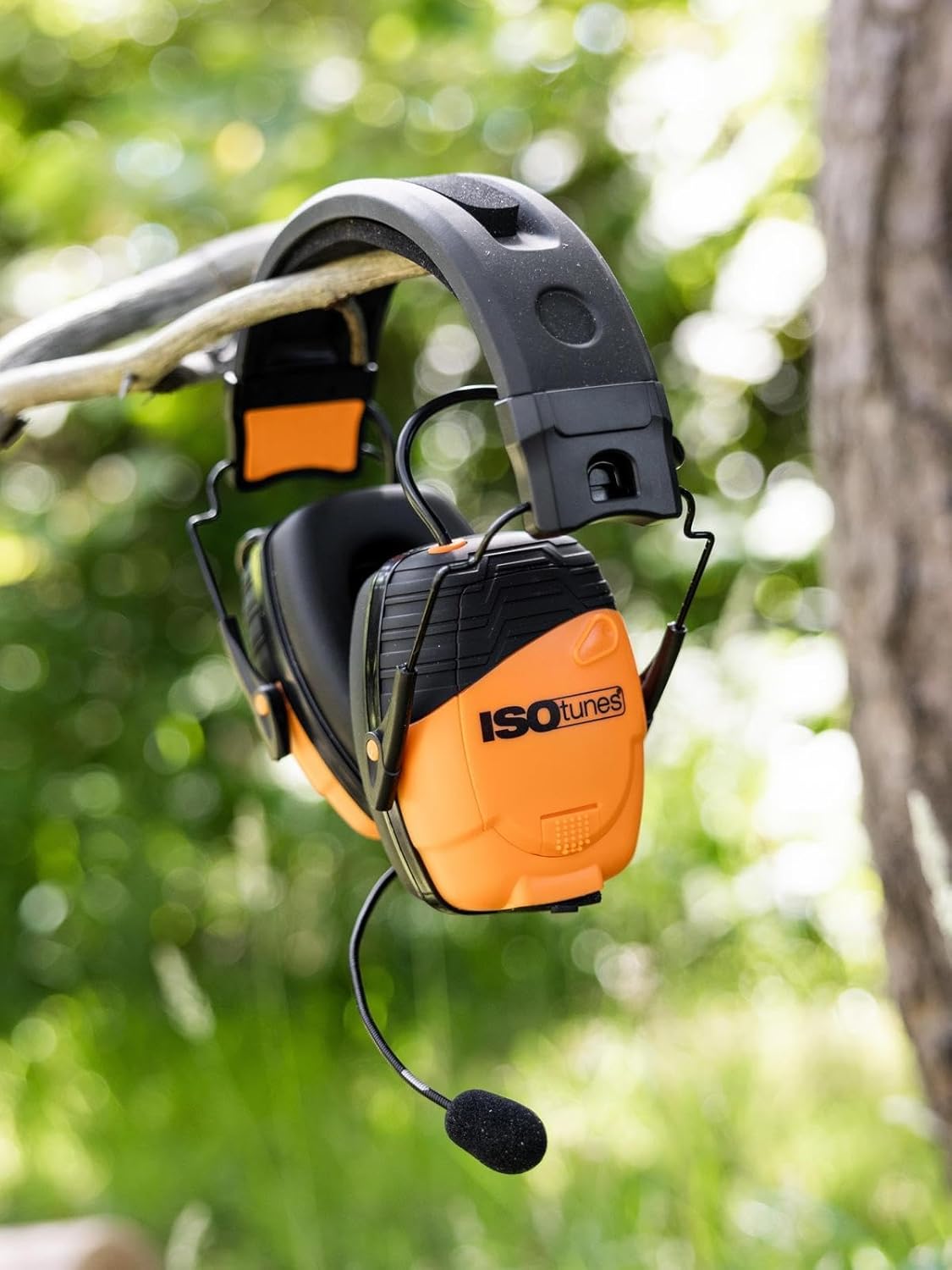
Do not buy these for the microphone. That is the whole section, but the detail is worth having.
Gerald Clarke, a UK workshop user who otherwise adores them, describes the mic with more precision than the spec sheet manages: "the mic works as described it will not work over loud machines but is good enough to be able to tell people to hang on while you find a quiet place." That is exactly the right expectation. Another owner is less forgiving, calling them "basically useless to receive/have phone conversations due to the fact that people always say that there's wayy too much background noise". One buyer who chose them specifically for a noise-cancelling mic concluded that "the noise canceling microphone is not good whatsoever".
There is a counter-camp. One owner took a call from the seat of a backhoe and reports that "I could hear everything petty well and the caller could hear me." Another says calls with heavy background noise "work great". The gap between those experiences probably comes down to how loud the machine is and where the wind is blowing, which is not a comforting thing to hear about a purchase decision.
ISOtunes sells a boom mic separately, and the listing confirms the muffs are compatible with it. Before you add it to the basket, note that a French owner tried the boom and reckoned it added nothing at all. One data point, but it is the only one we have.
Practical translation: take the call with the mower switched off, and these are fine. Try to run a client conversation mid-cut and you will be the person shouting "CAN YOU HEAR ME" into a hedge.
Bluetooth Ear Defenders for Mowing the Lawn UK: the Four Options You Are Really Choosing Between
Nobody arrives at this product cold. You have already decided you want music while you cut the grass and you want to keep your hearing. So the question is not whether the LINK 2.0 is good, it is whether it beats the three other ways of solving the same problem.
1. The budget Bluetooth muffs. The crowd of near-identical listings that fill the rest of the search results, at a fraction of the price. They will play louder, because they have no SafeMax ceiling, which is precisely what the angriest ISOtunes reviewers say they want. The trade is that you are taking a cheaper brand's attenuation figure on trust, and nothing at all stops you pumping unsafe volume into a sealed cup for an afternoon. If loud music is the goal and the noise is moderate, they will make you happier. If protecting your hearing is the goal, that reasoning is running backwards.
2. Passive muffs plus your own earbuds. The 3M and Peltor route, and the cheapest way to be properly quiet. Guy went back to it and did the maths out loud: the Peltors block "95%+", the ISOtunes "probably 60%". Another reviewer notes the equivalent 3M muffs cost meaningfully less. The cost is faff. You are stacking two products, the earbuds get sweaty and lost in the grass, and the volume is uncapped again. Two owners here say they abandoned earbuds precisely because of that: one could hear better and "wasn't likely to lose these", the other wanted "more protection from a product meant for high noise level". A lawn care operator, meanwhile, is thinking about going the other way, back to in-ear.
3. A DAB radio ear defender. If what you want on a Saturday morning is Radio 2 and nothing else, a radio muff does that with no phone, no pairing, no dropouts when you turn your head, and no charging port to snap off. It also gives you no podcasts, no playlists and no calls. For a surprising number of people mowing a lawn, that is a fair swap.
4. The ISOtunes LINK 2.0. What the premium actually buys: EN 352 certification and a stated 30 dB SNR rather than a number invented by a marketplace seller, 50 hours of rechargeable battery with a 100-hour AAA fallback so a flat pair never stops the job, buttons raised enough to work in gardening gloves ("Large buttons, able to use gloves on buttons"), IPX4 against sweat and drizzle, a foldable frame, and a ceiling that prevents you doing to your ears the exact thing you put the muffs on to prevent.
The winner depends on what you are standing behind. For a UK back garden with a push mower or a cordless rotary, the LINK 2.0 wins, and the volume ceiling never once becomes a problem. For a ride-on, a commercial mower or a leaf blower, the review evidence is close to unanimous: the music loses, and you should be shopping for higher-attenuation passive muffs instead. Check today's price on Amazon and decide which of those two gardens is yours.
The Push-Mower Verdict, and the Ride-On One
The lifetime score on this listing is 4.3 stars across 865 ratings. The 100 most recent buyers put it at 3.54, with 15 one-stars. That gap is not a mystery once you have read them: it is the volume ceiling colliding with people who wanted headphones, and the charging port colliding with people who wanted five years. Both are knowable before you spend a penny, which is more than can be said for most gadgets.
Buy them if you cut a domestic lawn with a push or cordless mower, you want protection and music in one object you cannot lose in the long grass, you can live inside an 82 dB ceiling, and you would rather have a certified 30 dB SNR than a number a budget seller typed into a listing. On that machine, in that garden, they do exactly what ISOtunes claims and the owners in that camp are the ones leaving five stars.
Skip them if you run a ride-on, a zero-turn or anything commercial, because the people on those machines wrote most of the one-stars and they were not wrong. Skip them if you need to hold a real conversation over a running engine. Skip them if you already know that tight muffs give you a headache by lunchtime, because these are among the tighter ones on the market.
And go in with your eyes open on the port. Six of the last hundred buyers lost theirs. The AAA backup means that is survivable rather than fatal, the newer units may well have a better connector, and ISOtunes' warranty response is, on this evidence, a lottery. Buy from a seller you can return to, plug the cable in gently for the first month, and you have taken most of the risk out of the one thing that actually goes wrong.
Our score: 3.8 out of 5. An excellent answer to a question a lot of the people reviewing it were never asking.
ISOtunes LINK 2.0 Bluetooth Ear Defenders
Certified 30 dB SNR hearing protection with Bluetooth 5.0, a 50-hour battery, a 100-hour AAA backup and glove-friendly buttons. The right call for a push mower, a strimmer or a workshop.