The Catch With This Smart Radiator Valve for Old Radiators UK Is Not the Radiator
Old radiators, an older valve body underneath, and the suspicion that nothing smart will screw onto either. SONOFF's TRVZB answers that in a single bullet point, then hands you a much bigger question about what you plug it into.
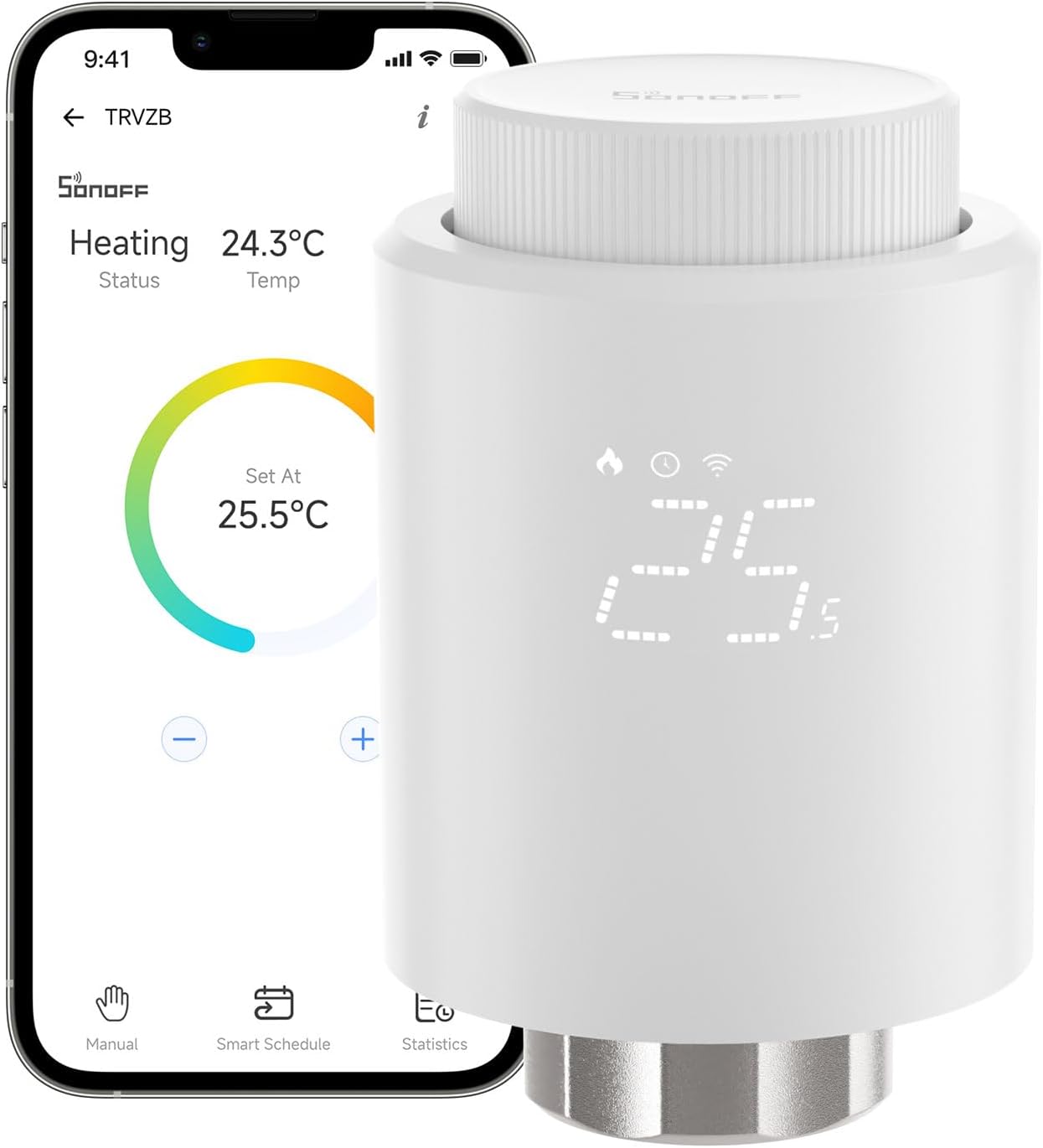
- Is This a Smart Radiator Valve for Old Radiators UK Homes Can Take? One Bullet Point Decides It
- He Cleared His Wall by About 1mm
- 'Add-On' Is the Word to Read Twice
- The Home Assistant Crowd and the App Crowd Are Reviewing Different Products
- It Clicks, It Whirrs, and It Lights Up at Night
- Two Valves, a Nest, and a Plan That Did Not Survive Contact
- Adaptive Mode, and the Firmware Note Underneath It
- Open Window Detection Is a Thermometer Watching for a Draught
- Tado at Three Times the Price, Aqara at Twice, and the Buyer Who Went Back
- 909 Buyers Landed on 4.1. The Thirteen on the Page Are Sunnier Than That.
The worry that sends people to a search box is always the same one. My radiators are old, the valve bodies under the dials are older, and nothing modern is going to screw onto that. It is a reasonable worry. Going by the reviews on this listing, it is also mostly the wrong one.
The SONOFF TRVZB is a Zigbee thermostat head that screws onto a radiator valve you already have. One bullet point carries the entire compatibility promise, and we will pull it apart in a second. But read the reviews Amazon puts on the product page and you find hardly anyone stuck at the radiator. They are stuck on the app, on the hub the valve needs and the box does not contain, or on a Nest thermostat that refuses to acknowledge the thing exists.
The lifetime score is 4.1 from 909 ratings. That is a shrug rather than a recommendation, and working out where the missing star went is basically the whole job here. It turns out to have very little to do with how old your radiators are.
Is This a Smart Radiator Valve for Old Radiators UK Homes Can Take? One Bullet Point Decides It
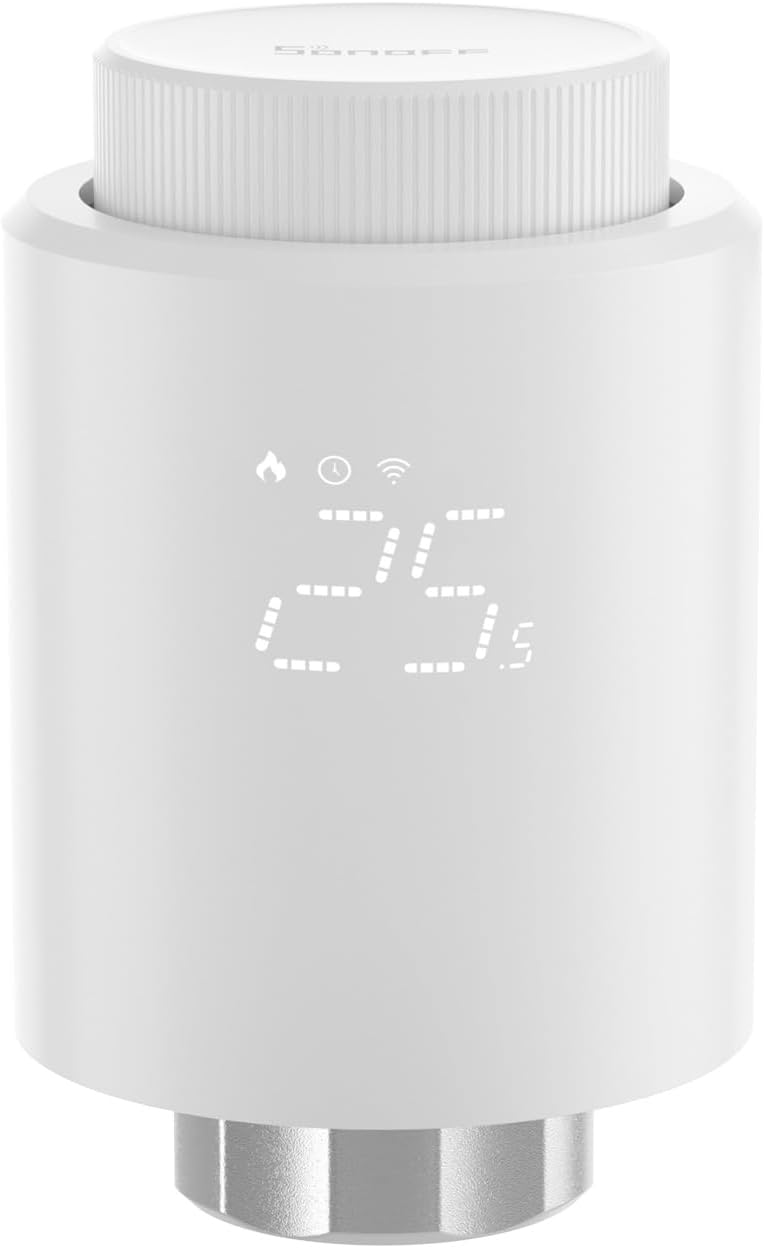
Here is the entire compatibility claim, lifted from the fifth bullet of the listing. The TRVZB "fits existing 'M30 x 1.5mm' radiator valves, and the valve adapters in the package are compatible with most heating systems and manufacturers".
Read that twice, because the word doing all the work is most. Not all. And the listing names not one single valve brand it is compatible with, which is exactly the reassurance an old-radiator buyer is hunting for and exactly what SONOFF declines to give. If your valve bodies carry a brand name you would have to kneel down and squint at to read, this listing will not settle your question. Nothing else in the text does either. I went through all ten listing images looking for an adapter chart, and there isn't one.
What the reviews add is thinner than you would like, but it is real. One UK buyer with a pile of Sonoff kit already installed reports that his "radiators are all modern and have the standard M30 valve that this TRV fits without having to resort to the included adapters", which at least tells you the adapters are aimed at the awkward cases rather than the standard one. Ken, two years in, says the valve "comes with multiple adapters, so it fit my existing radiator without any hassle". And Mike, who has bought enough of these to control most of the radiators in his house, offers the closest thing to a rule of thumb in the whole set: "As long as you've got thermostatic valves already fitted, they should be a direct replacement for the old dial - they're easy to screw on and come with a variety of fittings to couple to most thermostatic valve types."
That is Mike reading his own installs, not a promise from SONOFF, and it deserves to be treated as such. But it points at the thing you should actually check, which is what is already sitting on the radiator. Not how old the radiator is.
He Cleared His Wall by About 1mm
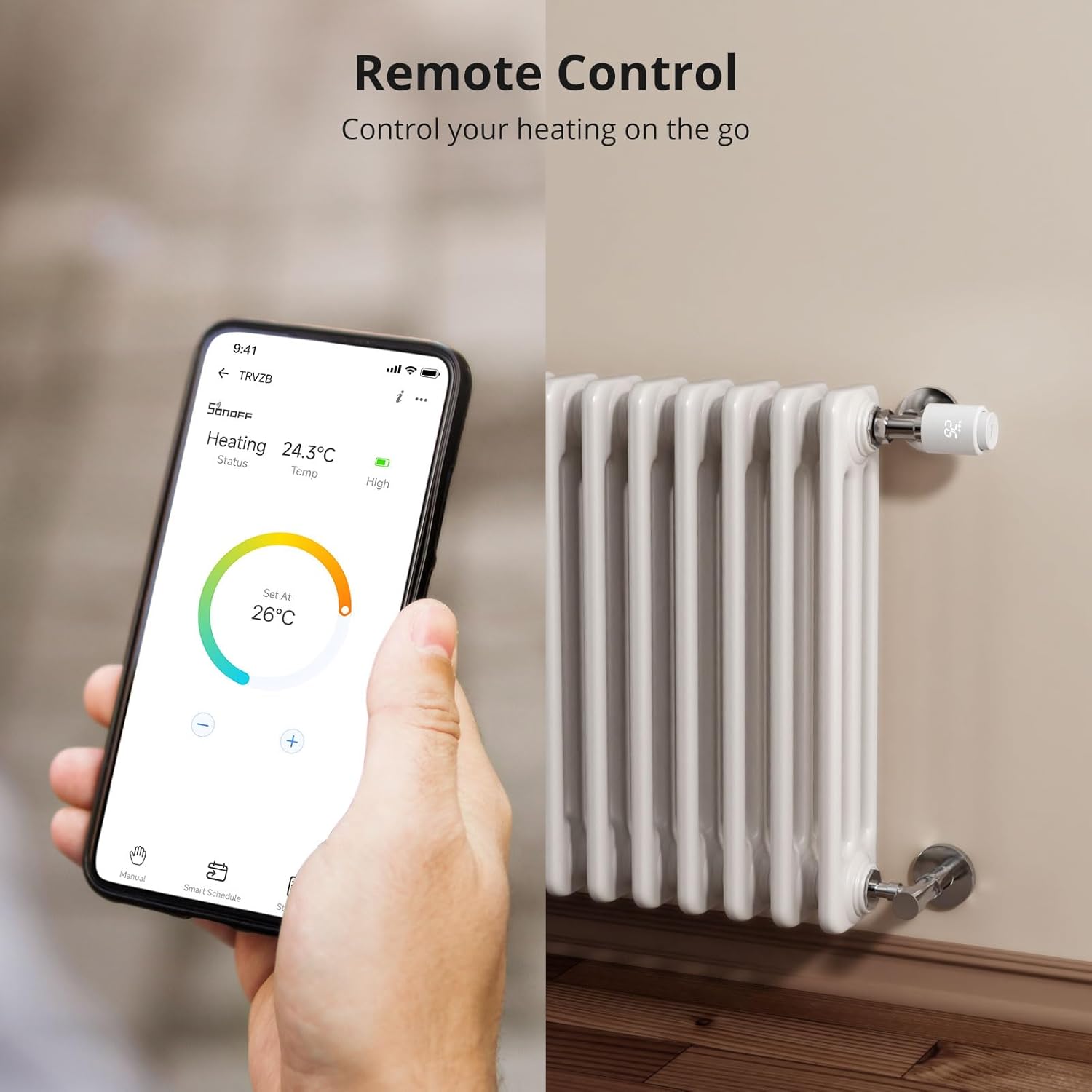
The most useful warning in this review set has nothing to do with threads. The same UK buyer who found the M30 fit straightforward flags the thing that nearly caught him out: "you definitely need to measure the clearance around your radiator, particularly between the valve and the wall". His verdict on the TRVZB's bulk is measured rather than damning, "not the bulkiest out there by any means, but it is substantial", and then the number lands. This, he says, "only cleared my wall by about 1mm".
One millimetre. On radiators he describes as modern.
A French buyer makes a similar point from the other side of the Channel, noting the unit is perhaps a little long and that you should watch where it sits, particularly if you are near a door. His fittings are not your fittings and I would not lean on a continental install for UK fitment advice. But two buyers independently flagging the same thing, that this valve head is physically substantial, is a signal worth taking.
So before anything else, put a tape measure on the gap between your valve and the wall, and on the gap between your valve and any skirting, pipework or door living near it. It is the quickest check in this entire article and it is the one most likely to actually stop you.
'Add-On' Is the Word to Read Twice
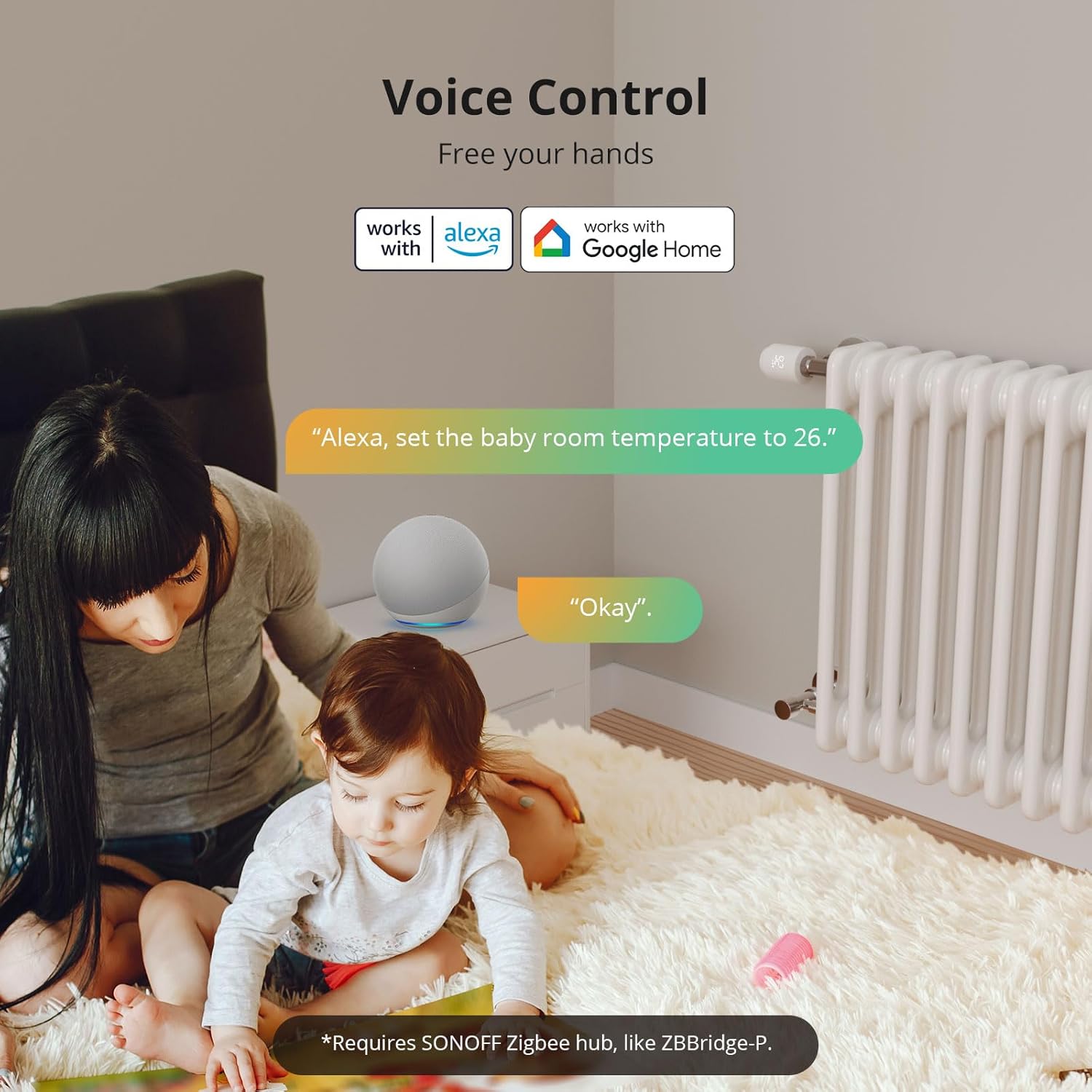
The product name says Add-On Smart Radiator Valve, and the third bullet is where you find out what that costs you: "it requires a Sonoff Zigbee 3.0 hub, such as ZBBridge-P, ZBBridge-U, NSPanel Pro, iHost, and more". SONOFF repeats it on the listing's own voice control graphic, in small grey text along the bottom edge: "*Requires SONOFF Zigbee hub, like ZBBridge-P."
This valve does not work on its own. It talks Zigbee rather than WiFi, and it needs something to talk to. The "Works with Alexa" and "Works with Google Home" badges on that same graphic are real, but everything they promise runs through a hub you have to own first. One UK reviewer puts it more sharply than SONOFF's marketing department would like: "There is some hype about interoperability with Google and Alexa, and I can indeed control this valve in that way, but that has nothing to do with the valve itself."
In practice the reviewers get there by three different routes. Mat pairs his straight to an Amazon Echo and adds a caveat the listing never mentions: "Note you need to use an actual Echo not something like an Echo dot." Maverick bought the Sonoff gateway alongside his valves. The Home Assistant crowd use the Zigbee coordinator they already run and never touch a SONOFF hub at all. Whichever route you take, budget for it, because the valve is only part of what you need to make this work.
There is a small consolation prize, and Mat spotted it. Because it uses "Zigbee rather than Wifi, its not using up one of your device limits on your router". Fit eight of these and your router never knows.
The Home Assistant Crowd and the App Crowd Are Reviewing Different Products
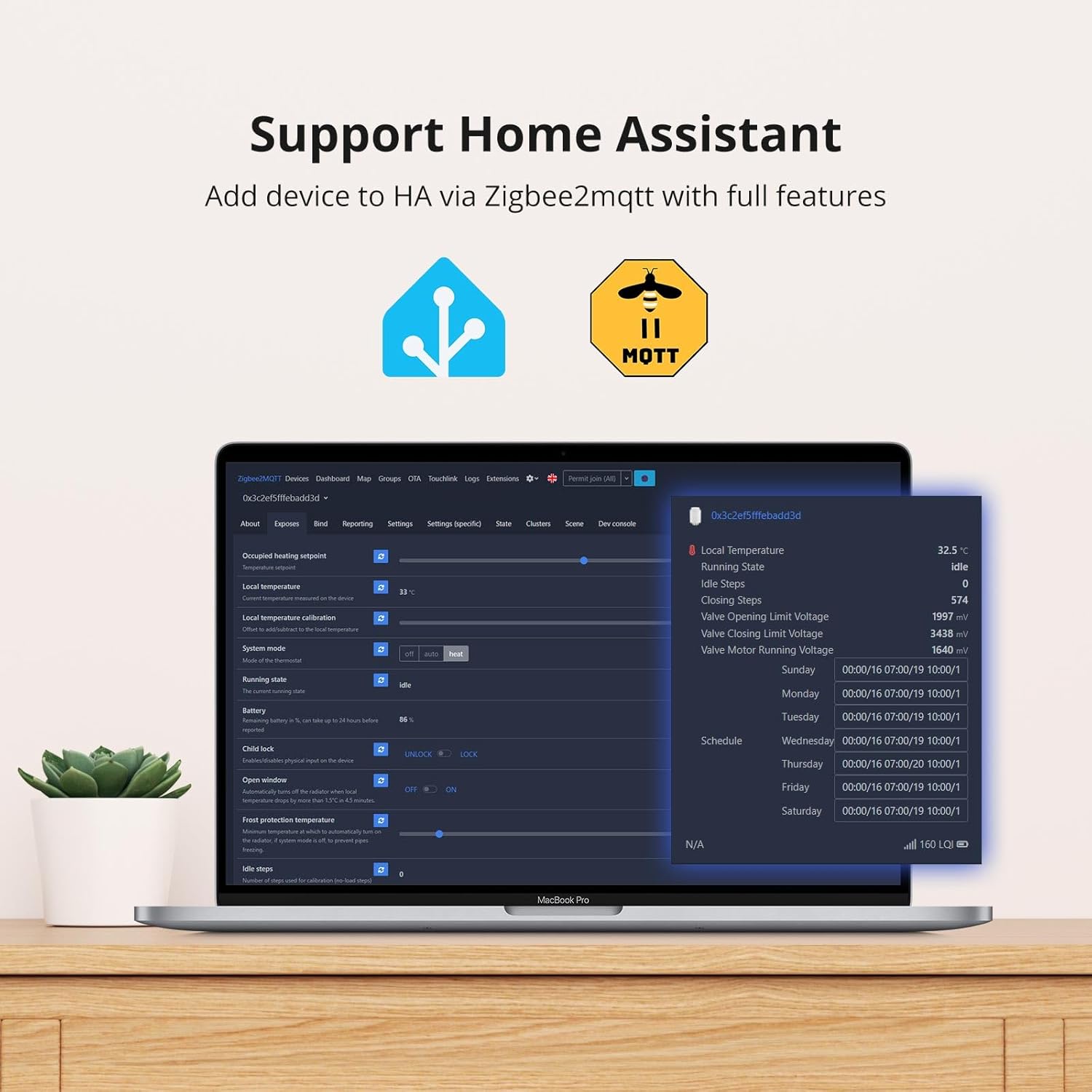
Split the eight UK reviews by what they plugged the valve into and a pattern falls out. Three of them mention Home Assistant, and all three gave it five stars. Three of them rate it below five stars, and not one of those mentions Home Assistant. The remaining two are five-star UK buyers running eWeLink and Alexa.
Three cards is a thin base and I am not going to dress it up as a study. But it matches what the review bodies say. Mike calls them "rock solid in Home Assistant" and then adds, almost in passing, "I haven't bothered using these with a Sonoff app, I've only used them in Home Assistant." He is not reviewing SONOFF's software, because he never sees it.
Ilovecheese, the single one-star card here, sees nothing else. The valves themselves he can live with. The app he cannot: "Always get the message 'failed, please try again' so you can never change, alter or save anything and therefore the valve just becomes and expensive manual trv." That last phrase, typo and all, is the sharpest summary of the risk anyone in this set manages. A smart TRV whose app will not save a schedule is a dial you overpaid for.
Before you take that as the whole story, though: Richard Stafford runs eWeLink, gave it five stars, and reports the opposite, that "once schedules/automation are set up in eWeLink, they just get on with the job." So the app is not universally broken. It is simply the part of this product that has a failure mode, and the Home Assistant users have quietly routed around it.
It Clicks, It Whirrs, and It Lights Up at Night
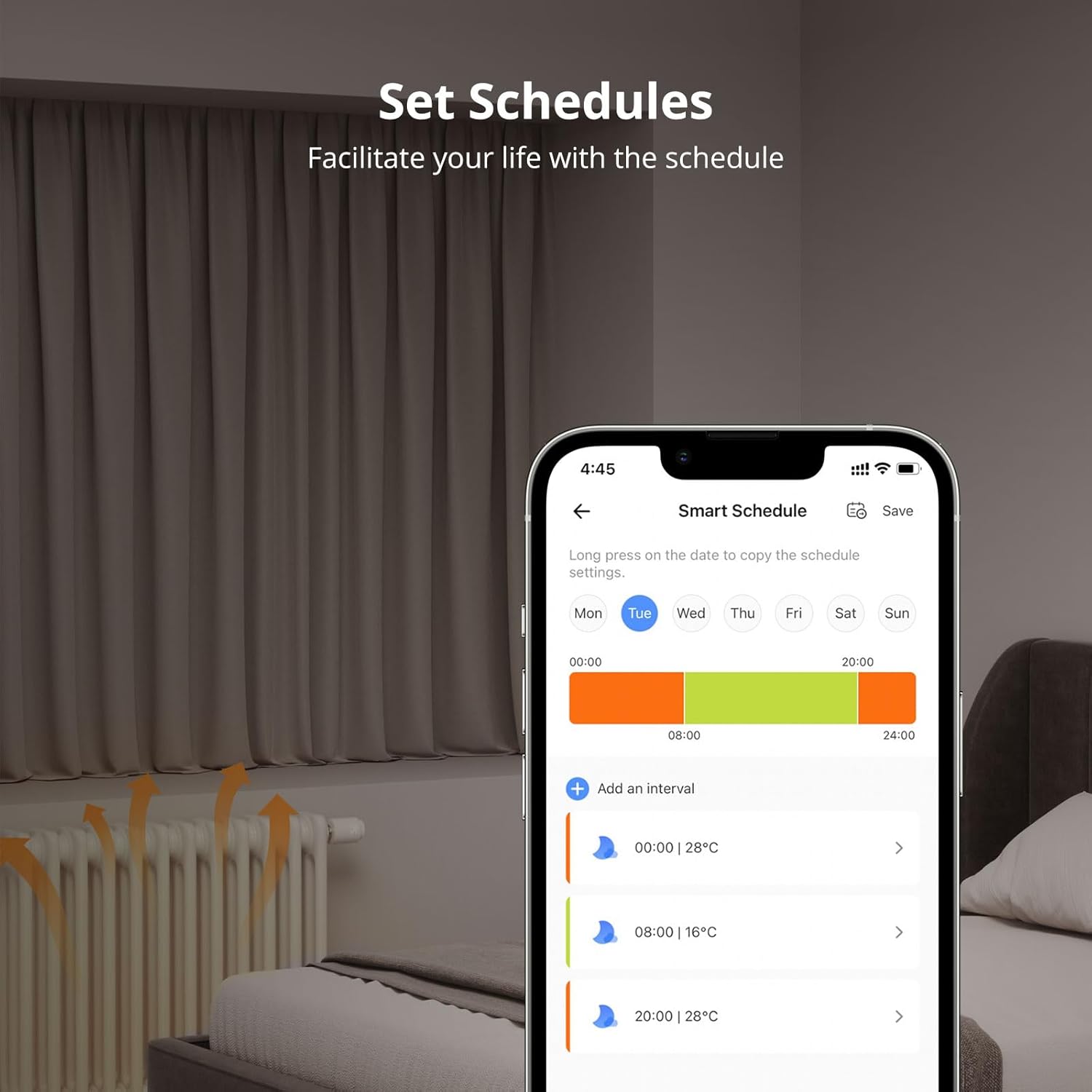
Five of the eight UK reviewers mention the noise, and they flatly disagree about whether it matters. The disagreement is really about one room.
GoaHaris, the four-star card, is blunt: "Would not use it in bedrooms due to audible operation on open/close." Ilovecheese put two in bedrooms and regretted it, reporting the valve is "very noisy in the night, quite often opens/closes for no reason". Mike, who has them across most of his house, says the exact opposite: "When activating, noise is minimal - you can hear them moving, but I've had no problems installing them in bedrooms and no complaints." Richard Stafford lands in the middle and rather likes the sound, calling it "audible when adjusting the valve, but it's not loud or irritating". The fifth, our five-star M30 buyer, is neutral about it, noting only that "you can hear the motor when the temperature demand changes".
A Polish buyer adds a variable nobody else raises. Screwed on without an adapter he found it loud, and with an adapter almost inaudible. That is one card, on a continental fitting, so do not plan your bedroom around it. It does hint that the noise may not be a fixed property of the valve.
The light is the quieter complaint and it is oddly consistent. Two of the eight UK cards raise it. Ilovecheese again, on the valve being "also bright in a dark room and frequently lights up every hr or so again for no reason". And the five-star buyer who otherwise loves the thing concedes: "I am also not sure if I like that the valve lights up when it is dark in the room." Two out of eight is not an epidemic. But if you sleep lightly, note that this complaint comes from a fan as well as from a critic.
Two Valves, a Nest, and a Plan That Did Not Survive Contact

The three-star review is the one I would make every buyer read, because Maverick did not have a fitment problem, a noise problem or an app problem. He had an expectations problem, and the listing helped him have it.
His plan was the obvious one: "install these in specific rooms and heat only the rooms these stats in and reduce energy costs." He bought two valves and the Sonoff gateway. Pairing went fine, and he says the valves are "good and easy to set up". Then: "My next step was to link these 2 valves to the Nest thermostat and this is where my plan did not work as you cannot link these STRVs to the Nest learning thermostat." His conclusion earns the three stars on its own: "everything is still controlled by the nest thermostat and not by the rooms STRVs as planned".
He is careful to add that "They may well work with other Thermostats the way I had planned, but unfortunately not with the Nest thermostat", and I will be equally careful. That is one buyer's experience with one thermostat, and SONOFF never claims Nest compatibility anywhere on this listing. But if you own a Nest and you are picturing room-by-room control, settle that question before you order rather than after.
Mat's workaround shows what people do instead. He keeps his valves parked at around 27 degrees and turns them on and off by voice, so the rooms he wants heated get heated and the rest do not. Mike, meanwhile, has a house rule of his own: "always keep a couple of radiators on a heating circuit with the normal valves so flow can't be completely shut off while the heating is running". That is his practice rather than a SONOFF instruction, and no reviewer here contradicts it or confirms it. But it is the sort of thing worth hearing before you smarten every radiator you own.
Adaptive Mode, and the Firmware Note Underneath It
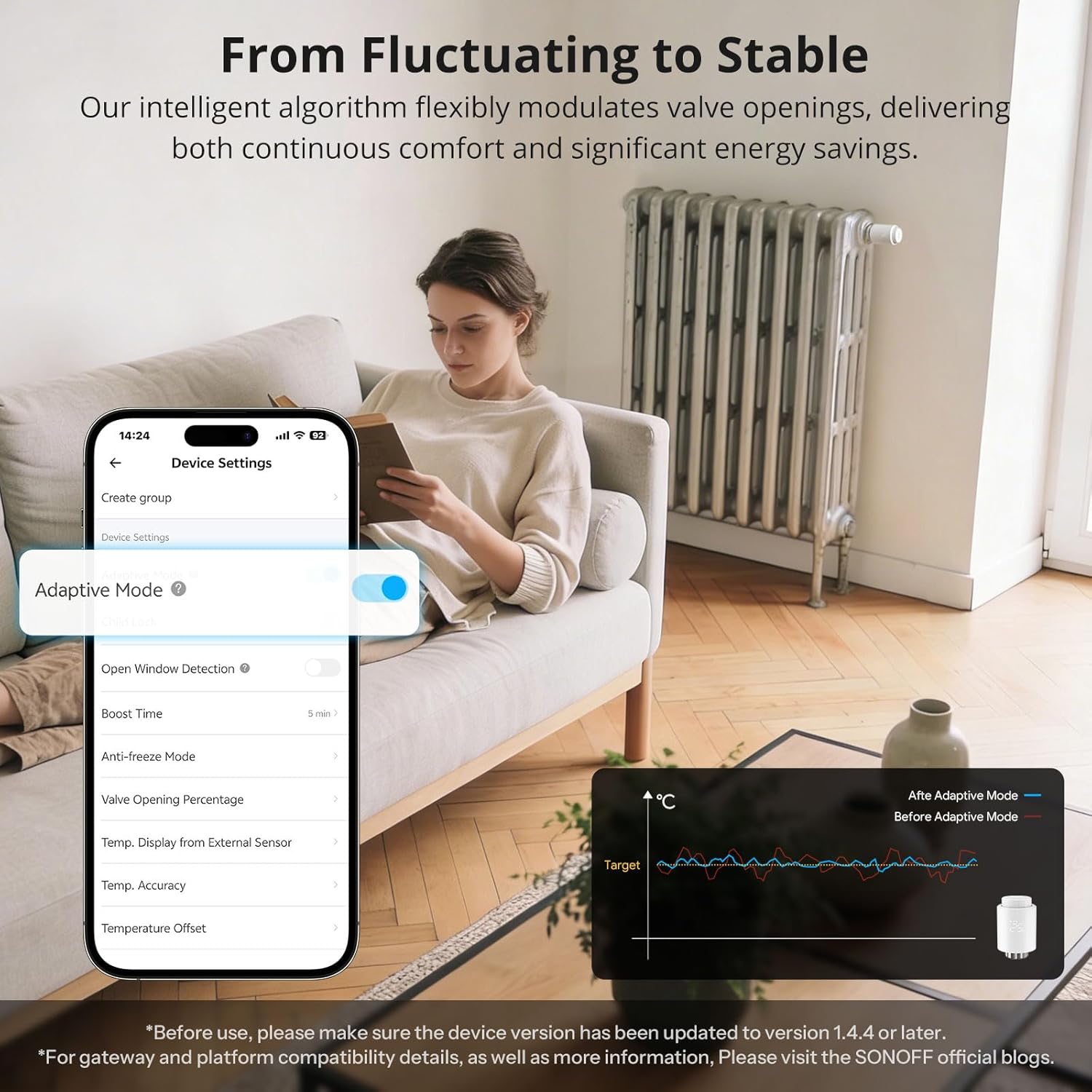
SONOFF's graphics push a feature called Adaptive Mode, with a chart showing a jittery temperature line settling onto target once it is switched on. The same graphic quietly lists the rest of the settings menu: child lock, open window detection, a boost timer, anti-freeze mode, valve opening percentage, temperature offset, and a display fed from an external sensor. For a draughty old house, that list is the actual argument for putting a smart head on the radiator at all.
Then read the line of small print along the bottom of it: "*Before use, please make sure the device version has been updated to version 1.4.4 or later." Which brings us back to Ilovecheese, whose October update reports that "I now can't update any of the firmware, it fails each time on all but 1 of the valves." A feature gated behind a firmware update is worth precisely as much as your ability to apply the firmware update.
Open Window Detection Is a Thermometer Watching for a Draught
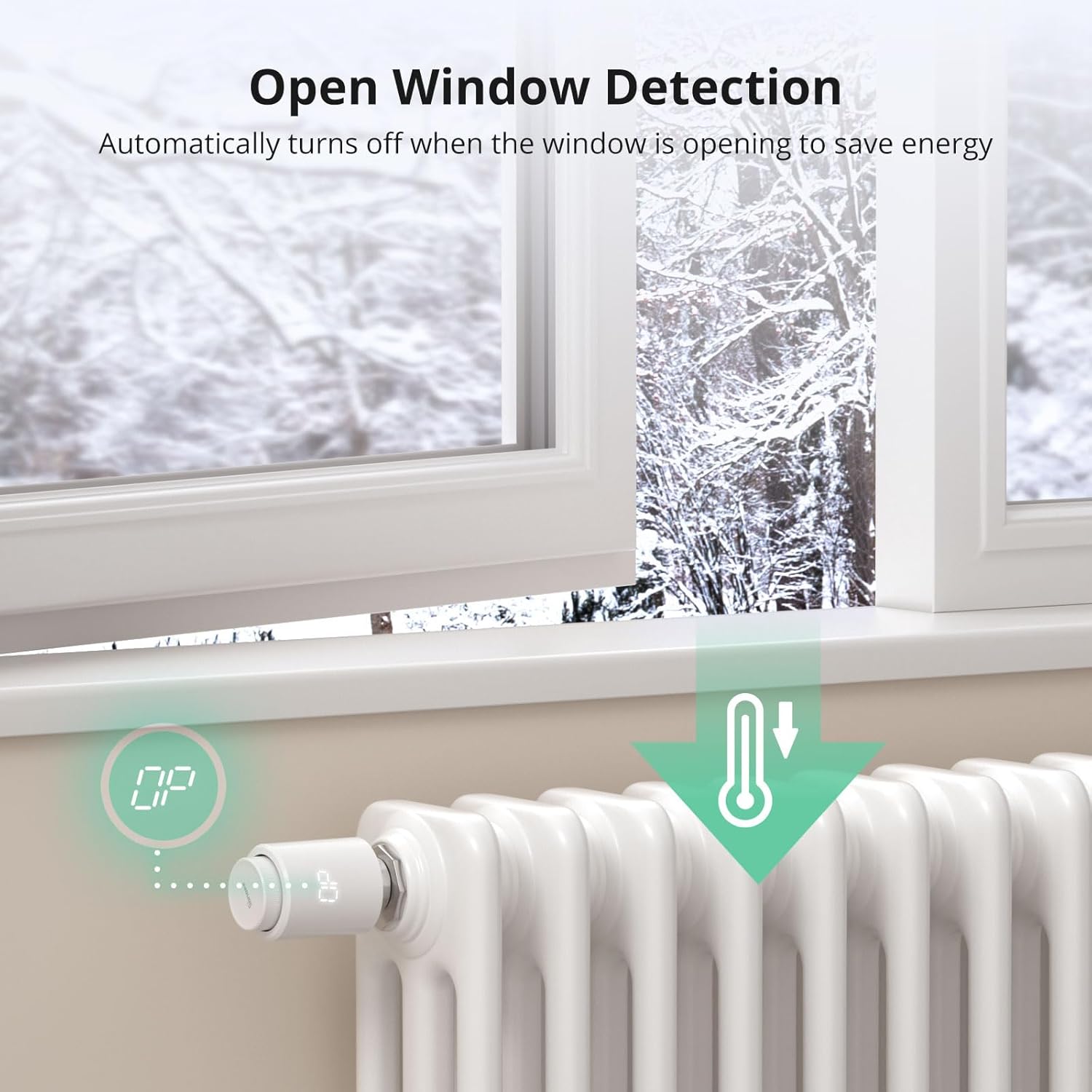
Open window detection is the feature people buy these for, and the listing's own Home Assistant screenshot is unusually specific about how it works. It shuts the radiator off when the local temperature "drops by more than 1.5°C in 4.5 minutes". So it is a thermometer noticing a draught rather than a sensor watching your window, and the five-star buyer who read it the same way is wary for good reason, pointing out that it can be fooled by "opening the door to the room where the TRV is located and letting in cold air". If your internal doors do not seal well, that is worth knowing before you lean on it.
The related soft spot is where the valve reads the room from, which is a sensor sitting directly next to a hot radiator. Two five-star reviewers independently tell you not to trust it. One warns that "You will probably need to have other temperature sensors rather than rely on the one built into the TRV, which is next to the radiator", and Richard Stafford calls pairing it with a separate ambient sensor "a great upgrade". Neither of them is complaining. They are both telling you the same thing, which is that the ceiling on this valve is set by what else you own.
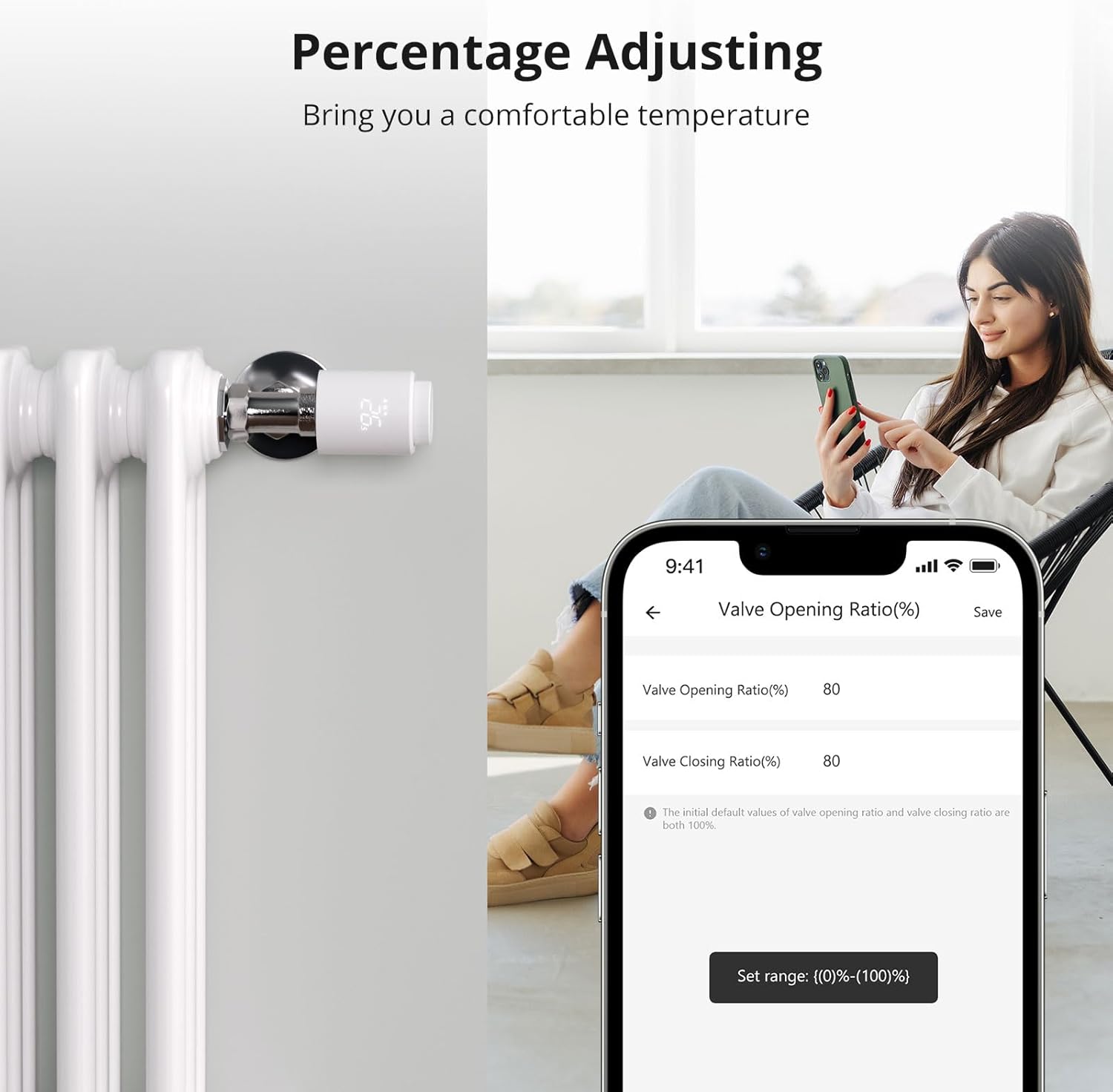
The counterweight is the valve opening ratio, adjustable from 0% to 100% "with an accuracy of 1%". That is SONOFF's answer to a radiator that overshoots its target and cooks the room, and on an old oversized radiator it is more useful than it sounds.
Tado at Three Times the Price, Aqara at Twice, and the Buyer Who Went Back
Telling you what else you should be looking at is the job here, and for once the reviewers have done the work themselves. Two of them name an alternative they would buy instead, and both of those cost more.
Ilovecheese went to Tado, which he pegs at "3x the price". His one-star update is the most damaging thing in this set precisely because he is comparing rather than just complaining: "I've downgraded to 1 star after trying the Tado TRVs it really does highlight how bad these sonoff ones are." Note that even then he concedes they "look good and intergrate well into sonoff systems", so his quarrel is with the app and the noise, not with the hardware.
GoaHaris points at the Aqara W600 at "more than 2x price", calls it "exceptionally quiet", and then delivers the most practical line in the whole set: "Stick these cheap Sonoff in all other rooms to save £££ and you will be happy." That is a strategy rather than a review, and it is a good one. Quiet valve where you sleep, cheap valve everywhere else. It comes from someone who rates this valve four stars while telling you to buy something else for the bedroom, which is about as balanced as advice gets.
A German buyer arrives from the opposite direction, having swapped out nine Moes thermostats for SONOFF ones because the Moes units were not closing when they should, two of the nine kept locking up, and battery drain was high. That is a continental setup and I would not transplant his fitment experience onto a UK radiator. But it is a reminder that the cheap Zigbee TRV category covers a lot of ground, and this one is not the bottom of it.
909 Buyers Landed on 4.1. The Thirteen on the Page Are Sunnier Than That.
A word on where these numbers come from, because it matters. Amazon's full review pages would not open for us on this listing, so the thirteen reviews quoted above are the ones Amazon itself surfaces on the product page, sorted by relevance rather than by date. They are not the most recent thirteen and they are not a random thirteen. Eight are UK, and the other five come from Turkey, Poland, Germany, France and Belgium.
They also flatter the product. Those thirteen cards average 4.46. The lifetime score across all 909 ratings is 4.1. The gap is not enormous but it only points one way, and the direction is the point: the reviews you and I can see on the page are meaningfully sunnier than the reviews we cannot. Whatever is dragging 909 buyers down to 4.1 sits mostly outside this window. Do not read the enthusiasm above and conclude nobody complains.
One more thing this window does show. Of the thirteen, exactly one came back months later to update their review, and they came back to downgrade it to one star after living with the app and trying a Tado. Long-term evidence here is thin, and what little of it exists leans negative.
So, the verdict, and it turns almost entirely on a question that has nothing to do with your radiator. If you run Home Assistant, or you already own a Zigbee hub and know your way around Zigbee2MQTT or ZHA, this is a straightforward recommendation. Every reviewer in this window who mentions Home Assistant gave it five stars, though that is only four of the thirteen cards, and the valve hands you setpoints, calibration, battery level, child lock, frost protection and open window detection to automate as you please. If you were planning to live in the eWeLink app instead, understand that you are buying the part of this product that generates the complaints. It may well be fine, as it is for Richard Stafford. The one-star card is a fair warning about what it looks like when it is not. If you own a Nest, resolve that before you order. And if you want a smart valve in your bedroom, the four-star reviewer's advice beats mine: buy something quieter for that room, and put these everywhere else.
On the old radiator question itself, the listing promises "most heating systems and manufacturers", and that is a promise about most, not a promise about yours. Go and look at what is actually on your valve, hold a tape measure to the gap between it and the wall, and put three AA batteries in the basket while you are there, because SONOFF does not put them in the box.
SONOFF Zigbee Thermostatic Radiator Valve, TRVZB
A cheap, well-built Zigbee TRV head that screws onto existing M30 x 1.5mm valves and ships with adapters for most systems. Superb with Home Assistant, patchier on the app, and it needs a Zigbee hub plus three AA batteries you supply yourself.