16,500 Ratings, 13 Readable Reviews, One About a Water Bottle: The Outdoor Ethernet Cable for a Garden Office UK Keeps Buying
Thirteen reviews are readable on this listing. One of them is about a water bottle, one is about the 75m version, and the most upvoted one describes a crimp tool that does not come in the box. Strip those out and three buyers are left who actually ran this thing down a garden. They are worth the trip.
- Thirteen Cards, and Three of Them Are Not This Cable
- Three Sheds, Three Buyers, and the Outdoor Ethernet Cable for a Garden Office UK Reviewers Actually Buried
- 550MHz on the Reel, 250MHz in the Bullet Points, Same Page
- The Jacket Decides Everything Outdoors, and It Is Only Named Inside a Photo
- Fighting the Coil Is the Only Complaint That Got Through the Filter
- CCA, Not Copper, and What That Costs if the Shed Also Gets a Camera
- The Reel, the Powerline Plug, or This: A Reviewer Names Your Rivals For You
- The Verdict: A Good Cable Behind a Careless Listing
The wifi reaches the garden office. That is the whole problem. It reaches it the way a radio station reaches a tunnel: technically present, practically useless, and at its worst during the one call that mattered. So you go looking for a wire, and Amazon hands you this one. MutecPower's 30m Cat6, black, waterproof, direct burial, 4.6 stars from 16,500 ratings, cheap enough that you stop comparing.
Then you try to read the reviews, and the floor gives way.
Amazon's full review pages would not open without a login. What is left is the small stack of cards Amazon pins to the product page itself: thirteen of them, picked by Amazon's own relevance sort rather than by date. Twelve are five-star, one is four-star. That averages 4.92, which is not this cable's rating and never was. The rating is 4.6, and the distance between those two numbers is the most useful thing on the page. Every complaint that drags 16,500 ratings down to a 4.6 exists. None of it is in front of you.
And one of the thirteen is about a water bottle.
Thirteen Cards, and Three of Them Are Not This Cable
Start with the water bottle, because it tells you more than the other twelve combined. Card ten, five stars, verified purchase, from a Swedish buyer: "Väldigt bra och behändlig vattenflaska, som håller drycken kall." Very good and handy water bottle, keeps the drink cold. That is a five-star rating sitting on a network cable listing, marked verified, counting toward the same 16,500 that sold you on the product.
It is not alone. Card nine is titled "PoE över 75 meter", which is the 75m version, not the 30m you would be buying. And card eight is the most upvoted of the thirteen, 18 people found it helpful, more than 300 words of careful detail from 2014. It is also not this product. Read what he actually received: "Given the price of less than £80 inc VAT and delivery when purchasing and the fact that I recieved 50 RJ45 plugs, a crimp tool and some coloured cable ties I am very impressed with the value." Fifty plugs and a crimp tool. He bought a drum of bare cable to cut and terminate himself. This listing is a patch cable that arrives with the plugs already moulded on, for a small fraction of that. He also notes his cable carried "length marks each meter", which is a detail you need when you are cutting a run to size and not when your lead already ends in two plugs.
So three of the thirteen are off the table. Of the ten that remain, six are one-liners of twenty words or fewer: "Good quality cable that works well", "Great price and good quality", "Great product great service". Pleasant, and worth nothing to you. That leaves four cards with any substance, and one of those is in Dutch.
Three usable English accounts, then, plus a Dutch one that matters later. That is the evidence base behind 16,500 ratings, once you actually count it. And here is the strange part: they are good ones.
Three Sheds, Three Buyers, and the Outdoor Ethernet Cable for a Garden Office UK Reviewers Actually Buried

Three of the thirteen mention a home office or an outbuilding, and all three are UK. They are also, between them, almost everything this listing can actually tell you.
The best is B. McClune, four helpful votes: "Bought in 2021 to extend internet from my house out to my home office." The route is the one you are dreading, through a floor joist, down the side of the house, out through the garden, "buried under gravel and soil and exposed at some minor points". The verdict, five years on: "It was worked, flawlessly and uninterrupted since installation 5 years ago and will likely continue for many years to come." Typo and all, that is a buried cable through five British winters with no failure. Nothing else on the listing page is worth as much as that sentence.
Michael Bullen is doing the same thing from the other end: "I'm using this to link an outbuilding with a dataswitch in the house", with the cable "installed externally clipped to surface and buried in the ground." He says it "does exactly what it should and seems pretty durable". Two buyers, two buried runs, two working links.
Then KSM, and this is the card to read twice, because KSM is the only person in the sample who confirms the 30m version and the only one who did not give five stars. "I wanted this cable to run 30m to the end of the garden, for my temp WFH office. I can pick up the WiFi but only weakly, and figured that a wired connection would be a more robust solution." That is the search you just made, written out by a buyer in 2022.
KSM is also the only source of performance figures anywhere in the thirteen: "I got 67mbit download, and 18Mbit upload with a latency of 19ms, much better than the 7mb up, 10mbdown and 56ms latency of the WiFi." He has his up and down muddled in the second half, but the shape is unmistakable. Latency fell from 56ms to 19ms. That is the difference between a video call that talks over you and one that does not, and it is the actual reason to dig the trench.
550MHz on the Reel, 250MHz in the Bullet Points, Same Page
Now the part that should make you slow down. This listing cannot agree with itself about its own headline number.
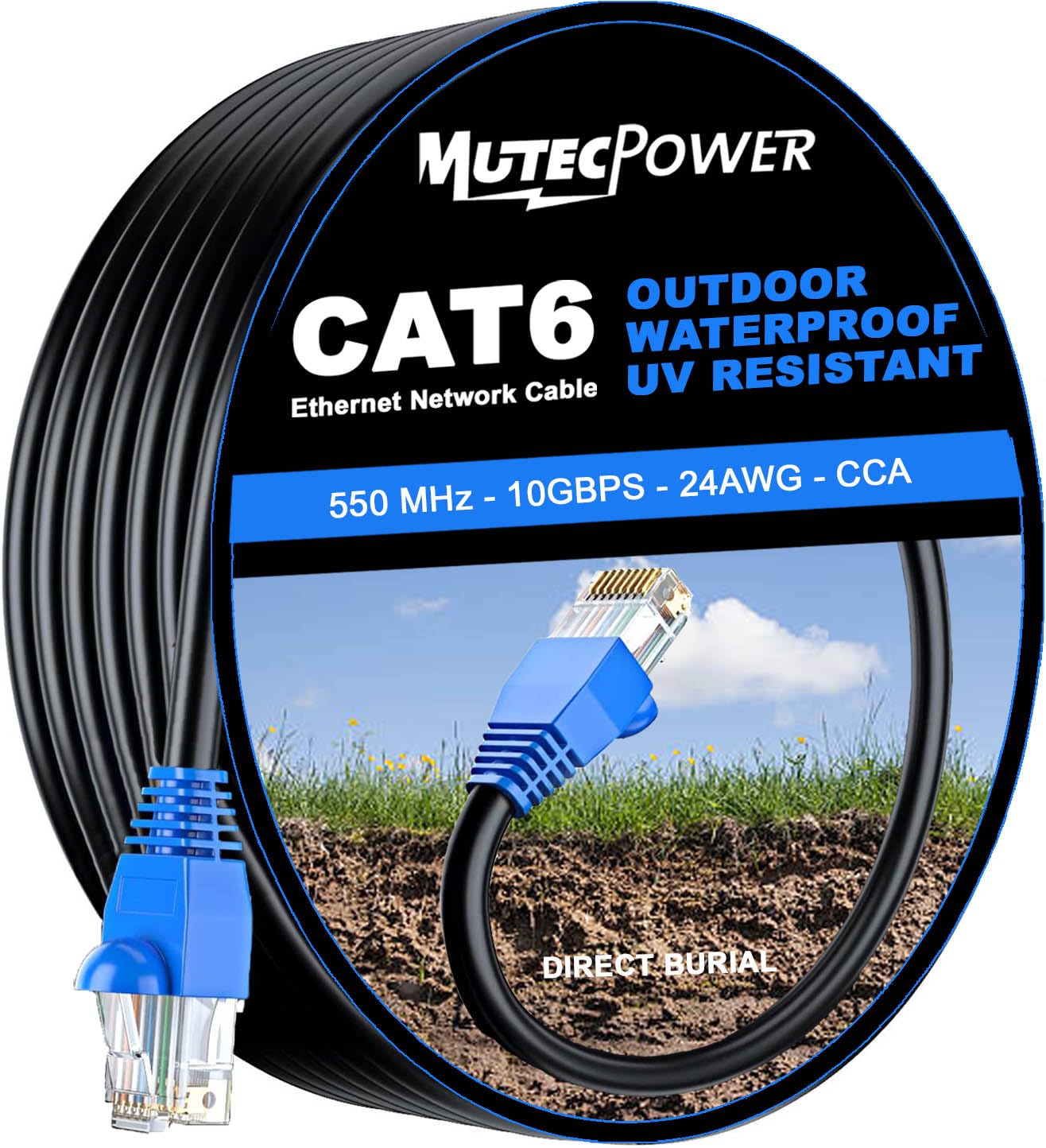
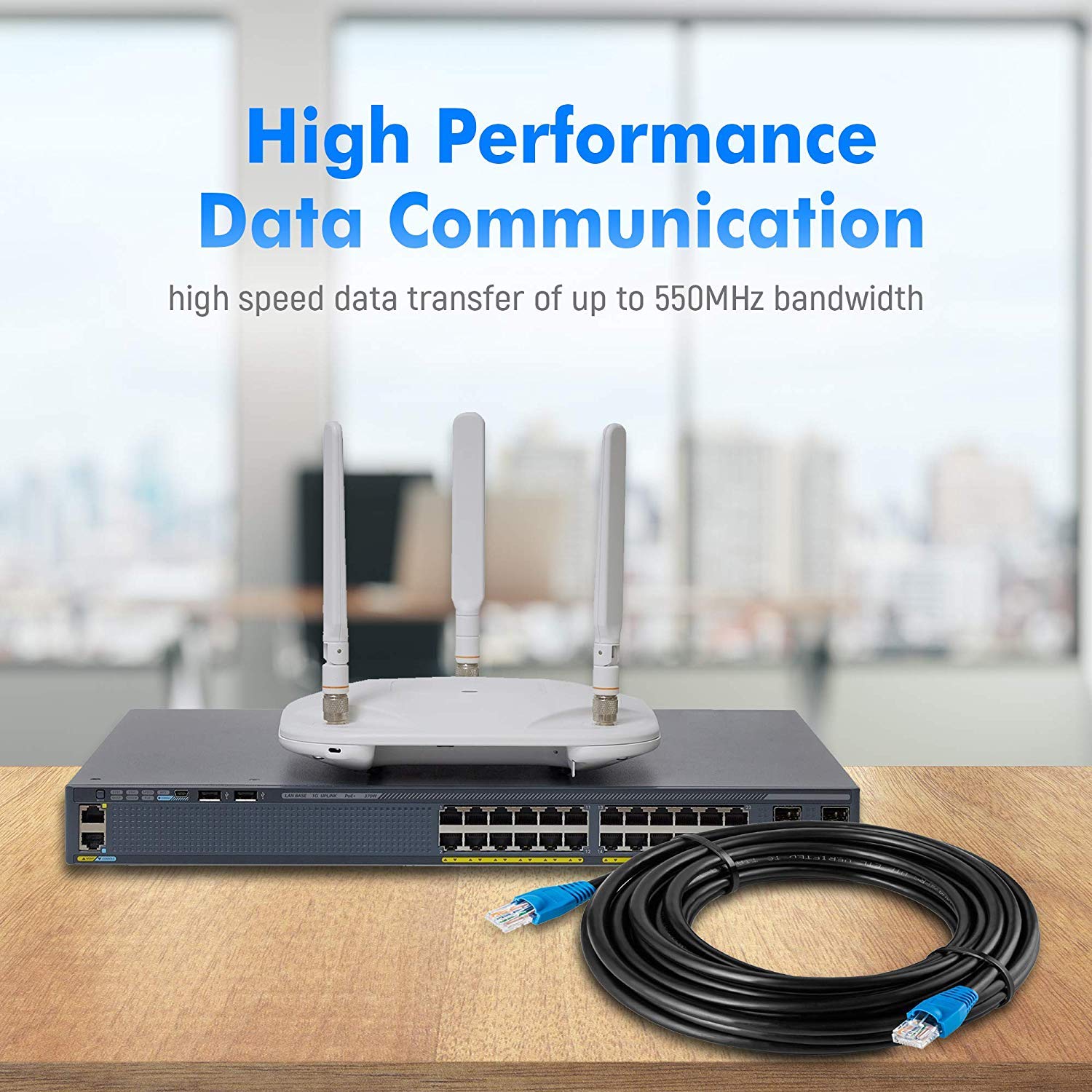
The product title says 550 Mhz. The packaging label in the main photo says "550 MHz - 10GBPS - 24AWG - CCA". A third image repeats it: "high speed data transfer of up to 550MHz bandwidth". Then the bullet points, on the same page, say the cable has "category 6 Rated Gigabit Ethernet performance, and 250 MHz bandwidth capacity". Two numbers, more than double apart, on one product page. The label and the small print are not describing the same cable.
The 10GBPS gets the same treatment. The packaging states it flat, as a property of the cable. The bullet point demotes it to something your network might grow into later, with backwards compatibility to 10/100/1000 listed straight after. Those are two different claims wearing one number.
While you are down there: bullet five, the satisfaction guarantee, is signed by a company called Access Fox. The brand on the box is MutecPower.
Does any of this stop the cable working in your garden? No, and pretending otherwise would be theatre. KSM measured 67mbit through 30m of it. A gigabit link to a shed is untroubled by the gap between 250MHz and 550MHz, and your broadband will run out long before the cable does. What the contradiction really tells you is how much attention went into this page, which is worth knowing before you trust the next claim on it. Take the numbers on the reel as marketing and the bullet's "Gigabit Ethernet performance" as the promise. That one, the reviews back.
The Jacket Decides Everything Outdoors, and It Is Only Named Inside a Photo
A cable buried in a British garden is a jacket with some copper inside it. The jacket is the product. So what is it made of?
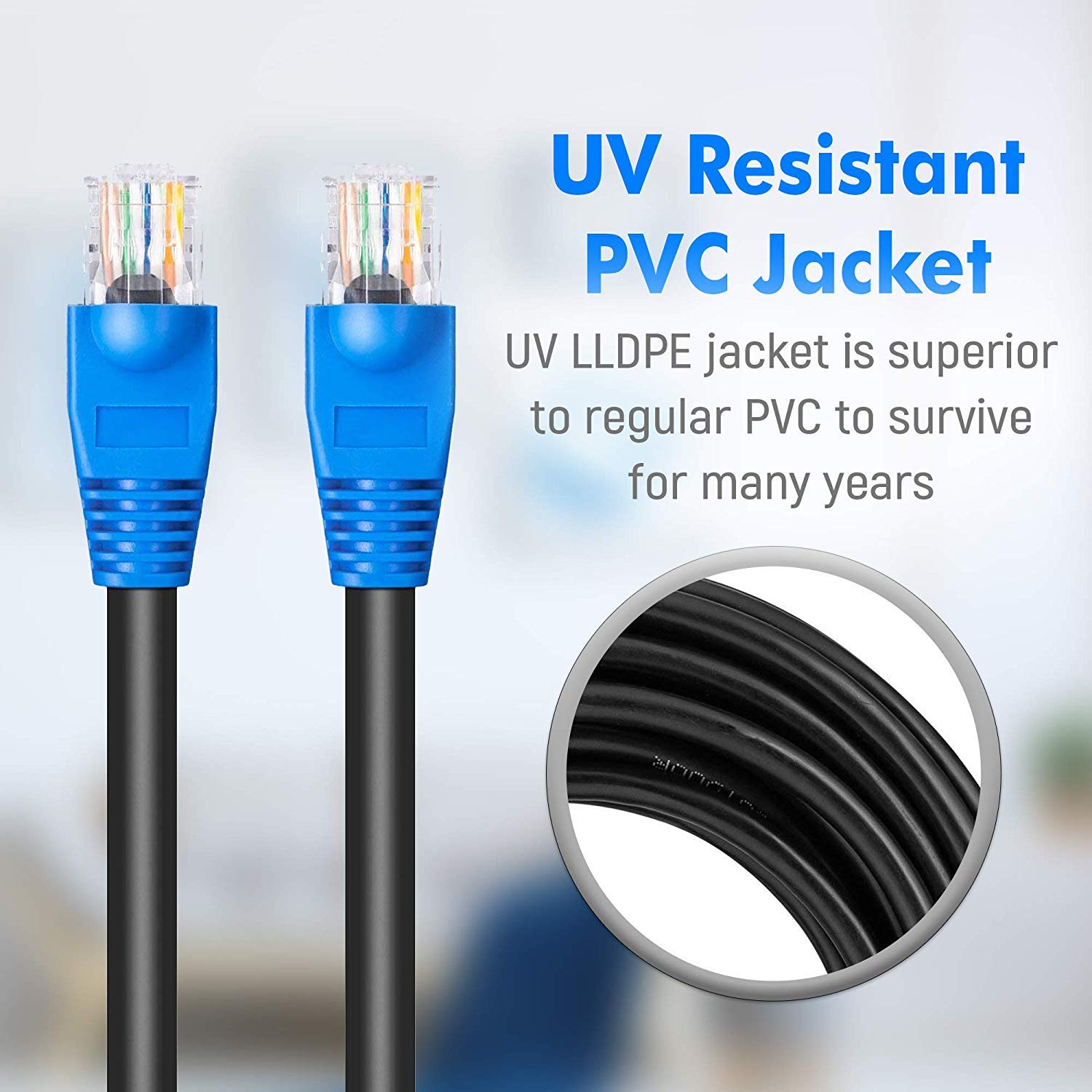
The written listing never says. The description field is empty, and the bullets get as far as "Double outer Jacket for CMX Outdoor use" and "UV proof for direct sunlight exposure" without naming a material. The answer exists in exactly one place, inside a photo, which reads: "UV LLDPE jacket is superior to regular PVC to survive for many years". That is the spec, and it appears in no line of text anywhere on the page.
It gets better. The headline printed directly above that sentence, in the same image, reads "UV Resistant PVC Jacket". One panel, two materials, and the caption arguing against its own headline. I cannot tell you which is right, because the listing does not appear to know.
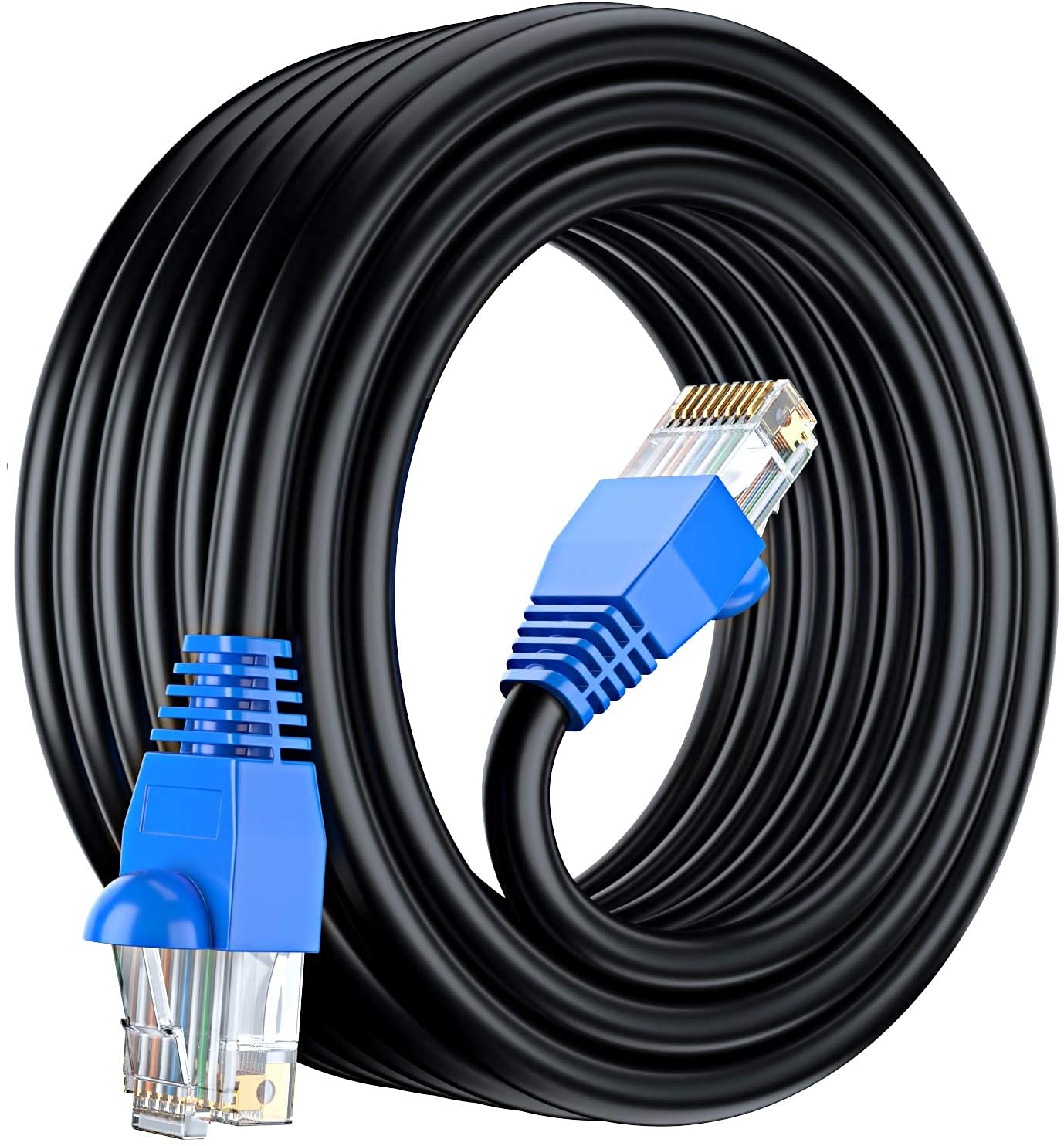
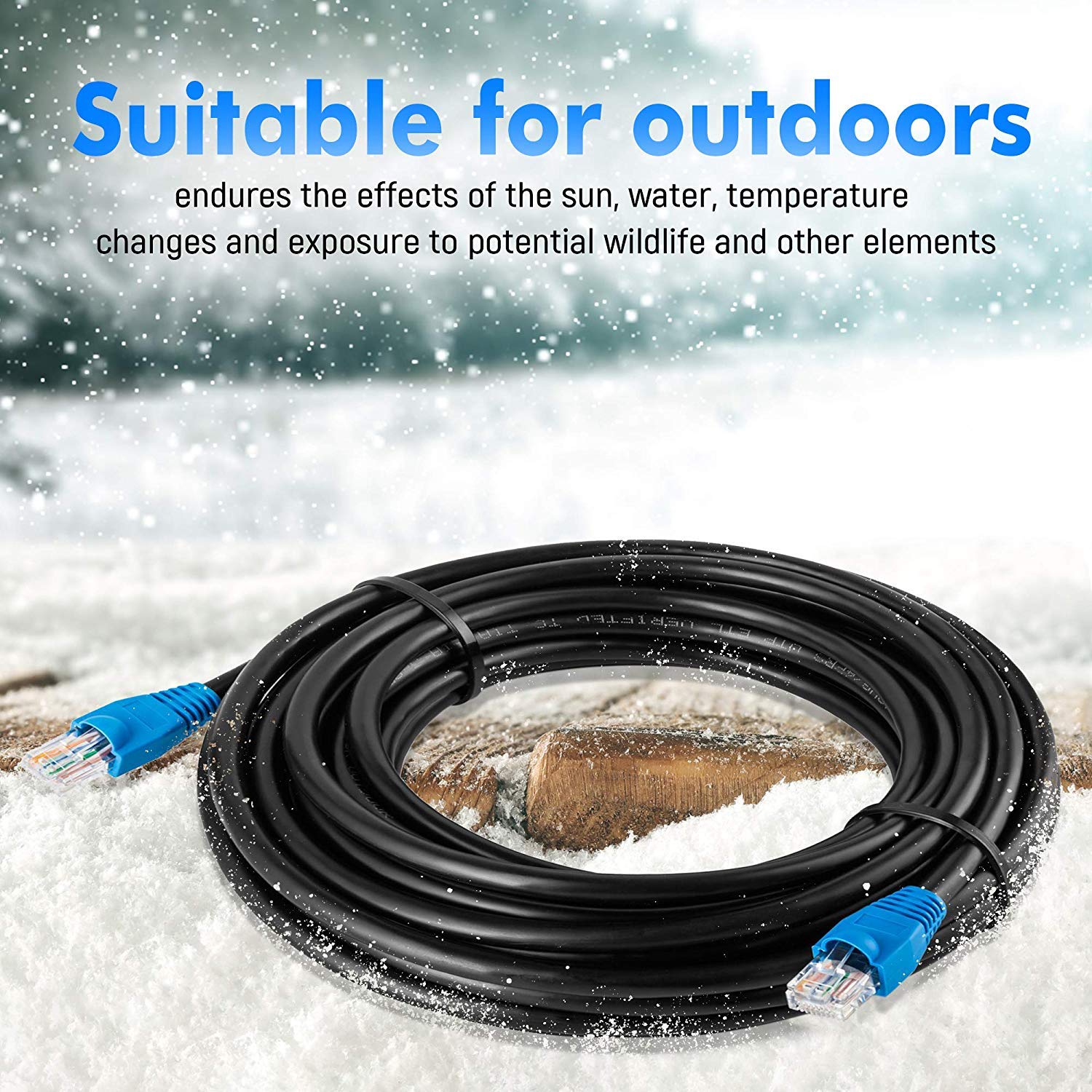
What the images do agree on is the outdoor case. One says the cable "endures the effects of the sun, water, temperature changes and exposure to potential wildlife and other elements". Another states "Suitable for direct burial installation" over a photo of the cable lying in an open trench. And James, the reel buyer, dissected the construction in detail worth borrowing, because what he describes matches this listing's own figures: he measured "Overall cable diameter is approx 6-7mm" against a stated Cross OD of 6.8mm, and found a tough exterior sheath that "causes some stiffness in the cable but is also very tough" over a second full sheath underneath, which is the double jacket the bullet claims.
Against all that marketing, B. McClune's five years under gravel is the only field evidence, and it outweighs the lot. Nobody in the readable sample reports a chewed, split or waterlogged cable. Do not read much into that silence: with ten on-product cards and not one critical review among them, this sample could not show you a failure if it wanted to.
Fighting the Coil Is the Only Complaint That Got Through the Filter
Two of the thirteen raise the same practical gripe, from two countries, and it is the only negative Amazon's curation let through. That makes it worth more than its count suggests.
KSM's four stars come down entirely to it. He says "the cable is quite plastic to the point where it has 2 negatives". The first: "it is coiled, so when you are trying to route it, you are fighting against the coils, to get the full length". The second is kinking. He got two sharp kinks while unwinding and thought he had broken a conductor. Both times the cable survived, and he is careful to add that it "is not a problem I have seen with other cables".
The Dutch buyer, card twelve, lands on the identical thing in his own language: good quality, sturdy jacket, small downside that the cable is hard to get straight because the spiral it was wound in stays in it. Same complaint, same cable, no coordination between them.
On a 30m run down a garden this is not trivia. You are fighting the memory of that coil for the entire length, on your knees, probably in drizzle, trying to hold a line straight in a trench that keeps rejecting it. Unroll it in the sun for an hour first rather than dragging it off the loop cold. Keep it in proportion, though: KSM still says "connecting it was straight forward" and signs off with "Buy with confidence", and another buyer records simply "Was a good length and easy to install." The stiffness is not a defect, either. It is the double sheath doing the job you paid for, and it is the same stiffness James says "helps when passing a cable through drilled holes in a wall".
CCA, Not Copper, and What That Costs if the Shed Also Gets a Camera
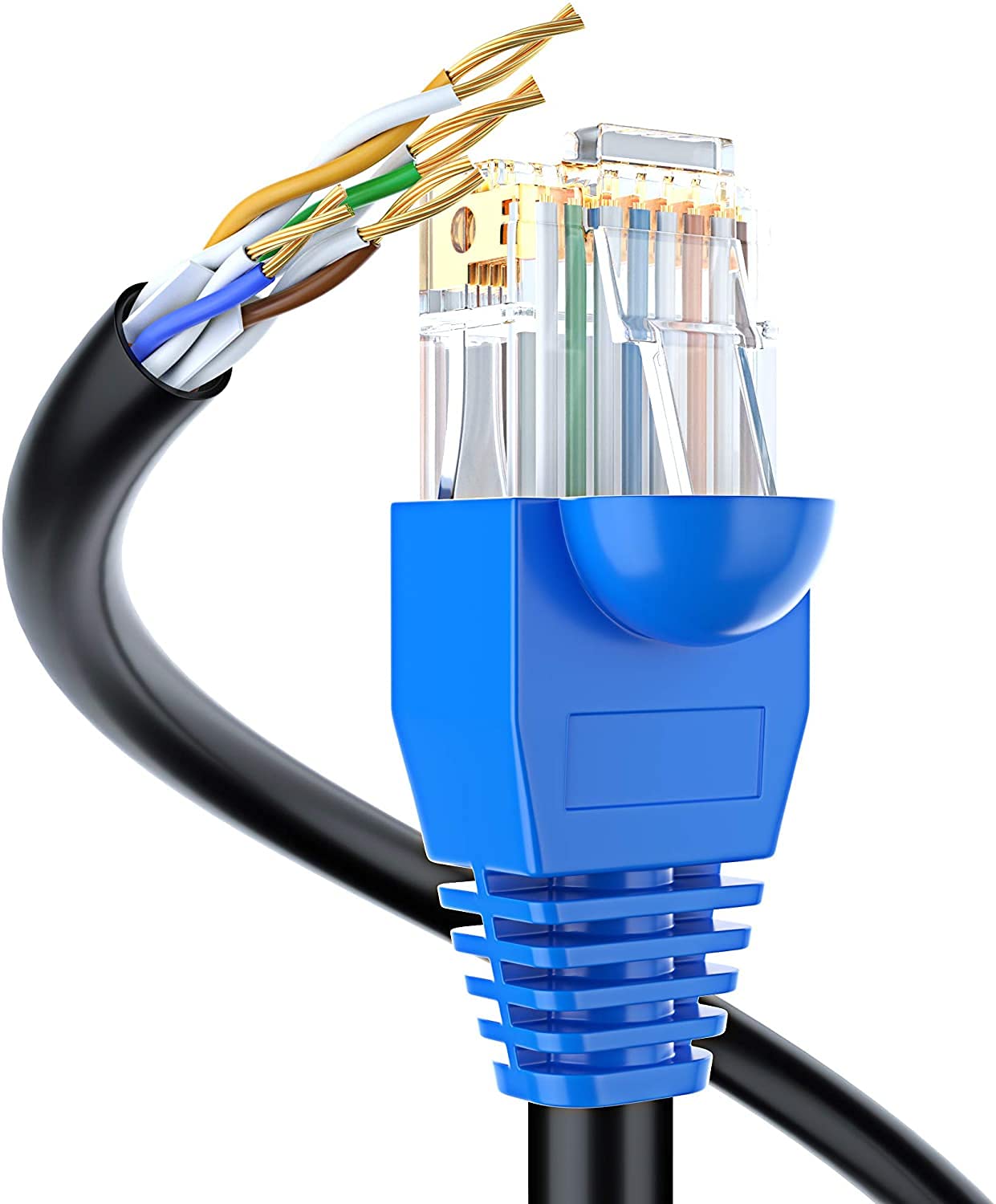
The listing is upfront about this, in its way. Bullet one: "30m outdoor waterproof UTP (Unshielded Twisted Pair) 24AWG Cat6 cable CCA (Copper Clad Aluminium) patch cable with RJ45 Plugs". The packaging label agrees: 24AWG, CCA. Copper clad aluminium, in the listing's own expansion of it, means conductors of aluminium wearing a copper coat, and it is a large part of why this costs what it costs instead of what a solid copper run costs.
The cut-away photo backs the rest up: four twisted pairs, no foil, no braid, no drain wire. Unshielded, exactly as bullet one says. Which sits oddly beside bullet four, where the same listing offers "Interference protection" as a selling point. An unshielded cable leans on the twist for that, not on a shield it does not have.
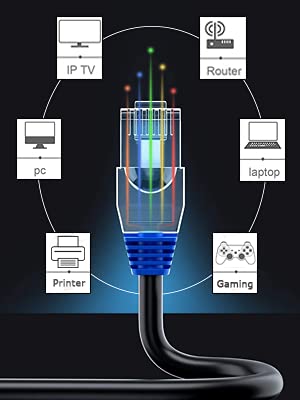
For a laptop and a switch in a garden office, none of this matters. KSM's 67mbit and Michael Bullen's dataswitch link both settle it. Where it starts to matter is PoE. The listing lists "PoE devices" among the hardware it connects, and one Swedish buyer did exactly that: "Användes till en övervakningskamera som styrdes av PoE.", used for a surveillance camera controlled by PoE. His card is titled for the 75m version, so that is the long variant's experience and not this one's, and it is the only PoE data point in the sample.
So here is the gap. The listing invites you to run PoE over this cable and never states a PoE class, a wattage, or a maximum powered distance. If your garden office plan puts a camera or an access point at the far end rather than just a laptop, the page gives you no figure to plan against, and CCA is precisely the construction choice you would want a figure for. That is not a reason to avoid the cable. It is a reason to buy it for data and think harder before you make it your power run.
The Reel, the Powerline Plug, or This: A Reviewer Names Your Rivals For You
Conveniently, the most upvoted card in the readable stack spells out the competition. James says this is "great if you need some reliable speedy networking around your home or between buildings when powerline ethernet or wireless just doesn't cut it." There are your three options, and his own purchase is the first of them.
Against a reel of bulk cable. James bought the drum, the fifty plugs and the crimp tool, and his review doubles as a quiet warning about how much work that is: strip the outer sheath back "as far back as possible without sacrificing the protection", or you will "struggle to bend cables back into place when screwing the faceplate onto the box". Bulk cable wins on nearly every technical axis. Cut it to your exact run, thread bare 6.8mm cable through a small hole, terminate into a proper faceplate at each end. It also costs more, needs a crimp tool, needs a skill, and needs you to care. If you are wiring a house, buy the reel. If you are wiring one shed, once, you are never going to buy a crimp tool.
Against powerline or a mesh node. KSM's figures are the whole argument, because he tried the wireless first: 10mb down and 56ms of latency became 67mbit and 19ms once the wire was in. A powerline adapter is a five-minute job with no trench, and it spends its life at the mercy of whatever your garden office's spur is doing. This is a wire. It sits under gravel and works for five years.
Against itself, in other lengths. Worth knowing before you click: the 4.6 and the 16,500 are not the 30m's score. Amazon pools the ratings across this listing's length variants, and the readable sample proves it, since one of the thirteen cards is titled for the 75m. It is the same pooling that drops a water bottle into your reading pile. For this job the 30m is the length you want anyway: a short lead will not clear the house, and the point of the exercise is the far end of the garden.
The Verdict: A Good Cable Behind a Careless Listing

I came into this ready to be unkind. A listing that contradicts itself on its headline spec, names its jacket material only inside a photograph, signs its guarantee with the wrong company's name and offers a water bottle as social proof has earned some suspicion. And then both buyers who actually buried the thing say it worked, and one of them has five winters behind the claim.
Buy it if your run is under 30m, both ends land near a router or a switch, and you want the job done in an afternoon with no tools. That is exactly the case B. McClune, Michael Bullen and KSM describe, and all three report a working link. Unroll it in the sun first.
Look elsewhere if you need a specific length, if you are terminating into faceplates at both ends, if the far end of the garden is getting a PoE camera whose power you need to plan, or if you want shielding. The fitted plugs are the convenience and the constraint in one package: every hole you drill has to pass a moulded RJ45 boot, not the 6.8mm cable.
The rating is 4.2, and the missing 0.8 is barely about the cable. Some of it is the coil, which cost the sample's only four-star review its star and is the one thing two separate buyers disliked without prompting. Most of it is that I cannot see a single critical review of this product, so I cannot tell you how it fails, only that 16,500 ratings averaging 4.6 rather than 4.9 means it sometimes does. Buy the cable. Do not buy the page it is sold on.
MutecPower 30m CAT6 Outdoor Waterproof Direct Burial Ethernet Network Cable
Thirty metres of UV-rated Cat6 with the plugs already fitted, for the run from the house to the shed. No crimp tool, no faceplate, no trip to Screwfix.