Does an EV Granny Charger for a UK 3 Pin Socket Still Make Sense Once the Wallbox Quotes Land?
Eighty-two of the hundred most recent buyers gave this portable Type 2 lead five stars. Ten gave it one. The gap between those two camps is not random, and the listing's own small print explains more of it than you would expect.
- What an EV Granny Charger for a UK 3 Pin Socket Replaces, and What It Does Not
- Where the 10 Metres Actually Goes
- Eleven Owners Named Their Amp Setting. Seven Stayed at 10A or Below.
- Will It Fit Your Car? Type 2, CCS2 and the Hybrid Sweet Spot
- The Ten One-Star Reviews Split Five and Five
- IP65 on the Box, and One Reviewer in the Rain
- A Two Year Guarantee, and the Five Who Could Not Reach It
The expensive way to charge an electric car at home is to have a wallbox fitted, and two owners of this EzGoGo cable put the number they avoided in writing. One says buying it meant he did not need to spend "that £800 to £1000". Another calls it "better than paying a £1000". That is the comparison a granny charger actually lives or dies on. It is not really competing with other cables, it is competing with the decision to spend properly.
The 100 most recent reviews on this listing are unusually clean data. Every single one is from the United Kingdom, and 98 of the 100 are verified purchases. They are also unusually split. Eighty-two are five stars. Ten are one star. Barely anything sits in between, and those ten are not a random scatter of grumbles. They fall into two tidy groups of five, and once you line them up against what the listing itself says in its bullet points and its product images, the picture gets a lot more useful than the 4.5 star average suggests.
What an EV Granny Charger for a UK 3 Pin Socket Replaces, and What It Does Not
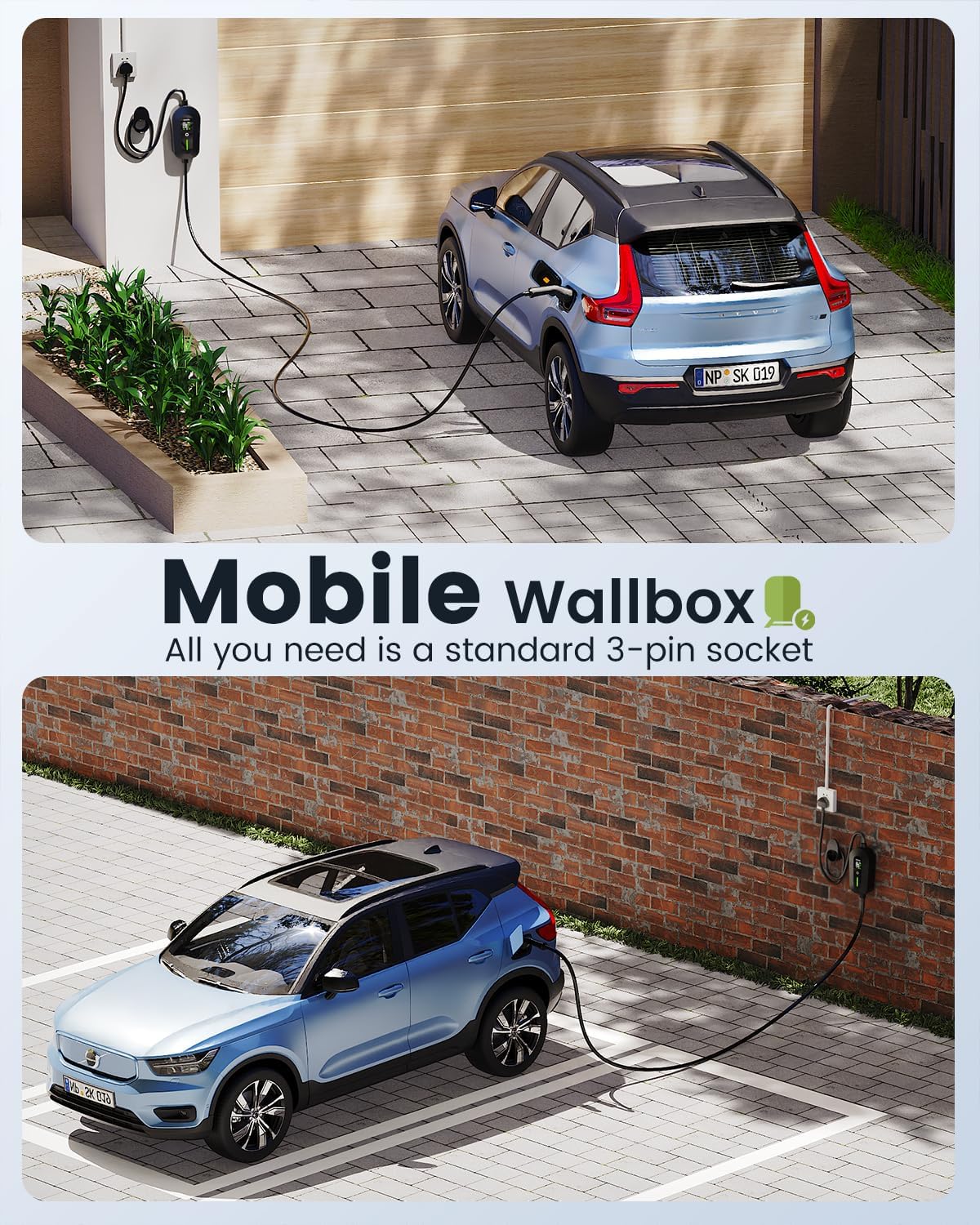
Worth noting straight away: EzGoGo never uses the phrase. The listing title calls this an "EV Charger Cable Type 2 to 3 Pin Plug", and one of the product images markets it as a "Mobile Wallbox" with the line "All you need is a standard 3-pin socket". Granny charger is what buyers call it. Three of the hundred reviewers use the term unprompted, including one who describes watching YouTube videos about "granny chargers" before buying.
Read the reviews for intent and two distinct groups appear. Six people describe buying it as a stopgap while they waited for a proper home charger to be fitted, and every one of those six gave five stars. One says it "really saved me using public chargers" during the wait. Another kept it afterwards anyway, noting he now has a 7kW unit but that the cable is "great for away to do a small charge if I need one".
The second group is more interesting for anyone weighing up the spend. Four reviewers describe using it instead of a wallbox, not before one. One retired owner charges on his drive most of the day and concluded he did not need to spend that sum. Another says it "saved me alot of money just charging my plug in hybrid". A third, charging a Jaecoo hybrid, "can't see the payback on a full charger at this time". The fourth is the owner quoted at the top, weighing it against paying a thousand. Against the cable that came with the car, one buyer is blunt: "Way better than the one that came with the car."
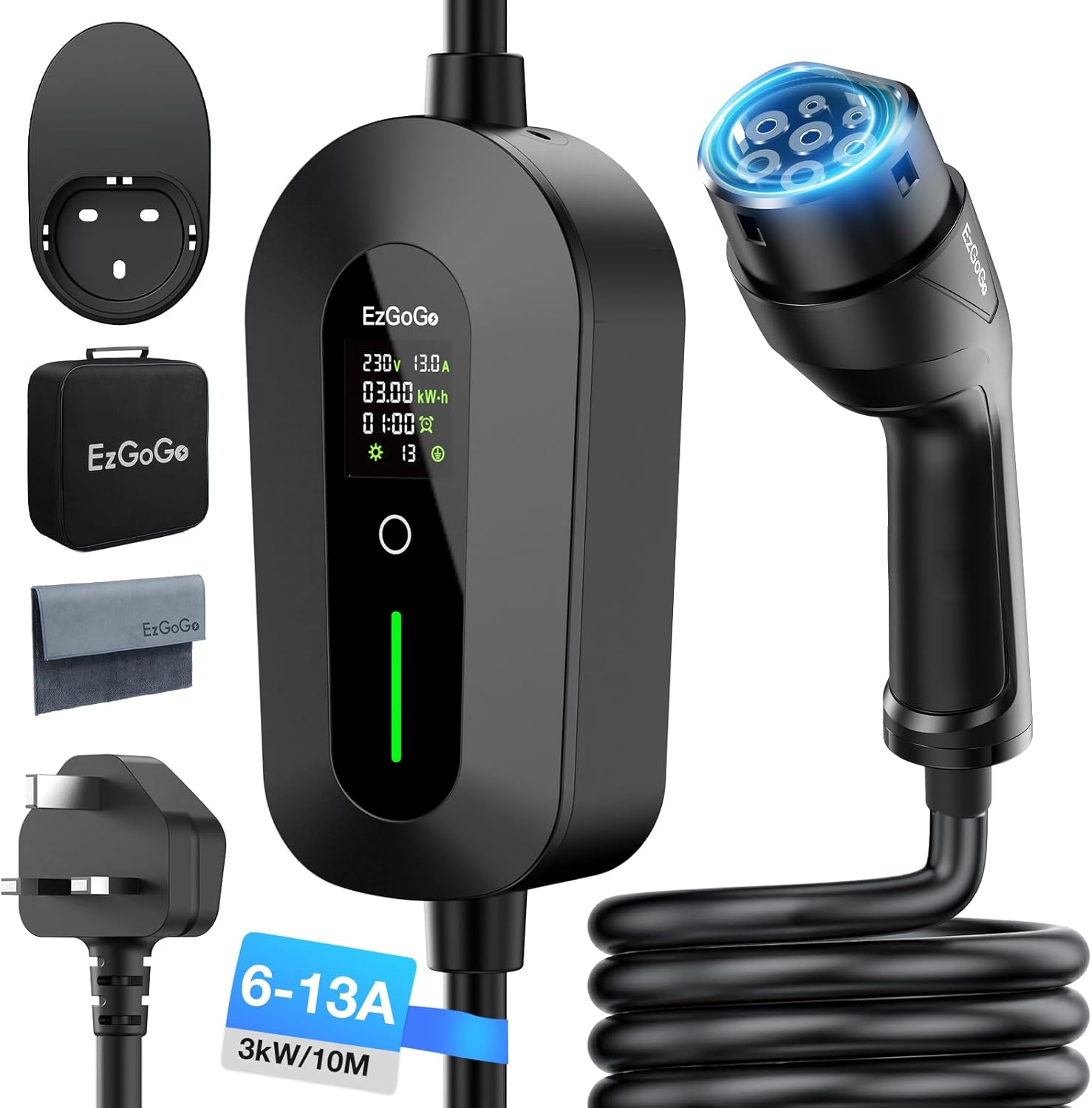
What it will not do is charge quickly, and the listing does not dress that up. This is a 3kW device, stated in the listing title and printed on the first product image as a "3kW/10M" badge. Real numbers from reviewers: one reports "around 2kw per hour", a Polestar 2 owner says it "charges at 2.9kWh so my Polestar 2 takes 10 hours for 29kWh of charge", and a hybrid driver got "from 40% to 100% in 4 hours". The sharpest summary of who this suits comes from a plug-in hybrid owner: "If you were full electric this would take too long to charge but as a hybrid charger it is spot on."
Where the 10 Metres Actually Goes
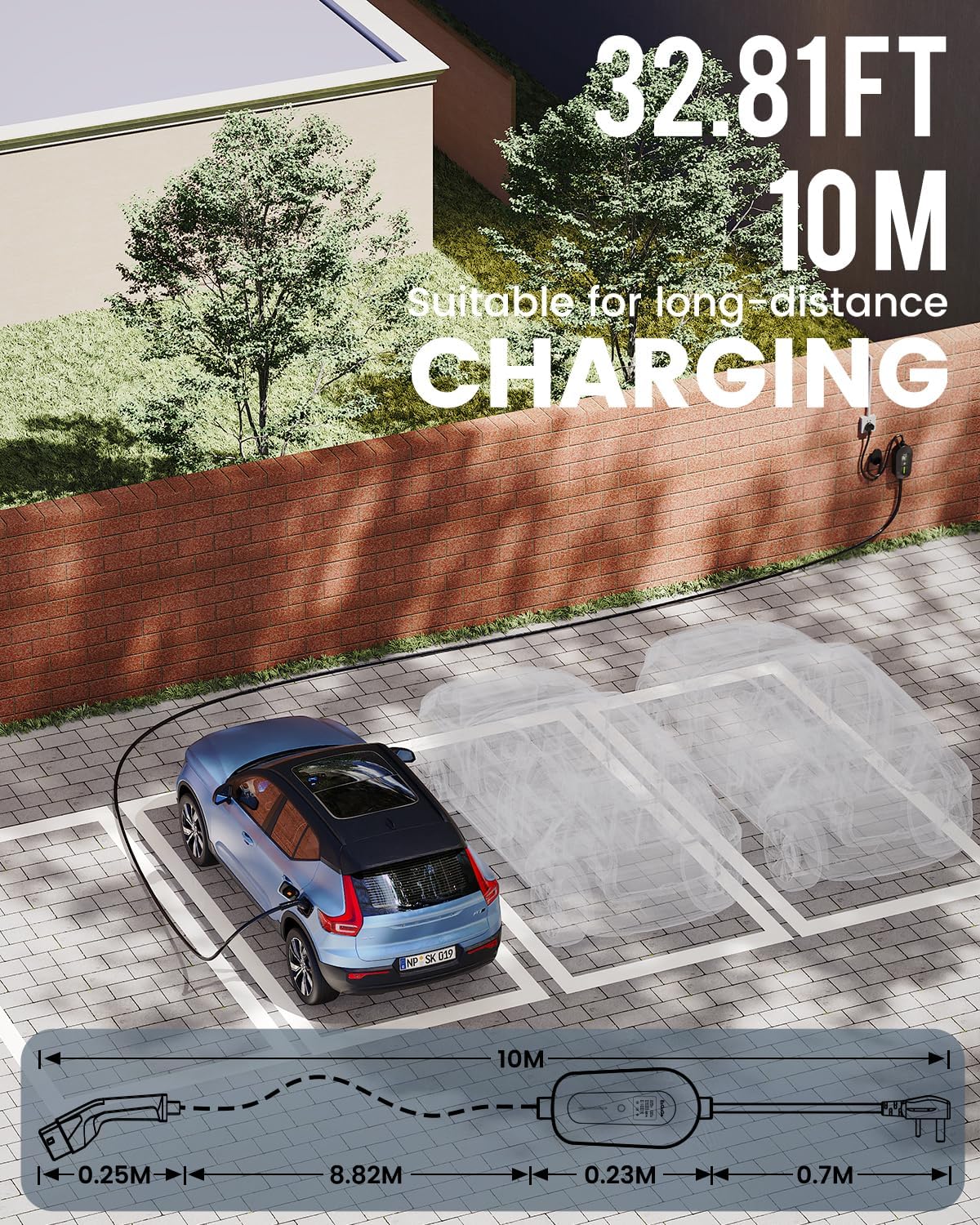
The listing sells 10m and the third product image shows exactly how it is divided, which is the sort of detail that decides whether this works on your driveway. The diagram breaks the run into four parts: 0.25M of Type 2 connector, 8.82M of cable, a 0.23M control box, then 0.7M of tail to the 3 pin plug.
That last figure is the one to sit with. The control box, the part with the screen, hangs about 0.7m from your wall socket. It does not sit at the car end and it does not sit at your feet in the middle. The first image shows a wall holster in the box alongside the carry bag and a microfibre cloth, and one reviewer inventories the lot as "a carry case, a wall mount to hold the type 2 end of the plug, a microfiber cloth and sone securing straps". Read that description again: the holster is for the Type 2 connector, not for the control box. One owner sorted the box out separately, fitting it "to a wall in the garage next to a 3 pin plug".
The short tail also sits behind a three star review from someone charging from an outdoor socket. They warn that "the lid of the housing won't close because the cable is too thick where it joins the plug" on a standard sized weatherproof housing, calling it "somewhat of a design oversight". If your outdoor socket lives in a sealed box, measure before you order.
One disclosure on the reviews themselves. Amazon pools reviews across the different cable lengths sold on this listing, and it shows. One of the most helpful voted reviews in the sample is titled around "The 8m length is a lifesaver" and describes an "8-metre (26.25Ft)" cable, so that owner is not reviewing the 10M version at all. Another five star reviewer opens with "20Meters!" and explains they started with the 10M and "got this 20M mid-2026 from the same make". Anything either of them says about reach, coiling or charge rate belongs to a different cable. For the 10M specifically, one buyer confirms plainly: "I chose the 10m cable which gives good coverage depending on where the car is parked."
On build, the listing claims an ABS shell tested to "1.5 tons of vehicle load" and a "1-meter drop test", a plug rated for "15,000 connections" and a TPU cable put through "over 10,000 bend tests". Reviewers broadly back the feel of it, with repeated notes about it being robust and well packaged even from someone who later had problems.
Eleven Owners Named Their Amp Setting. Seven Stayed at 10A or Below.
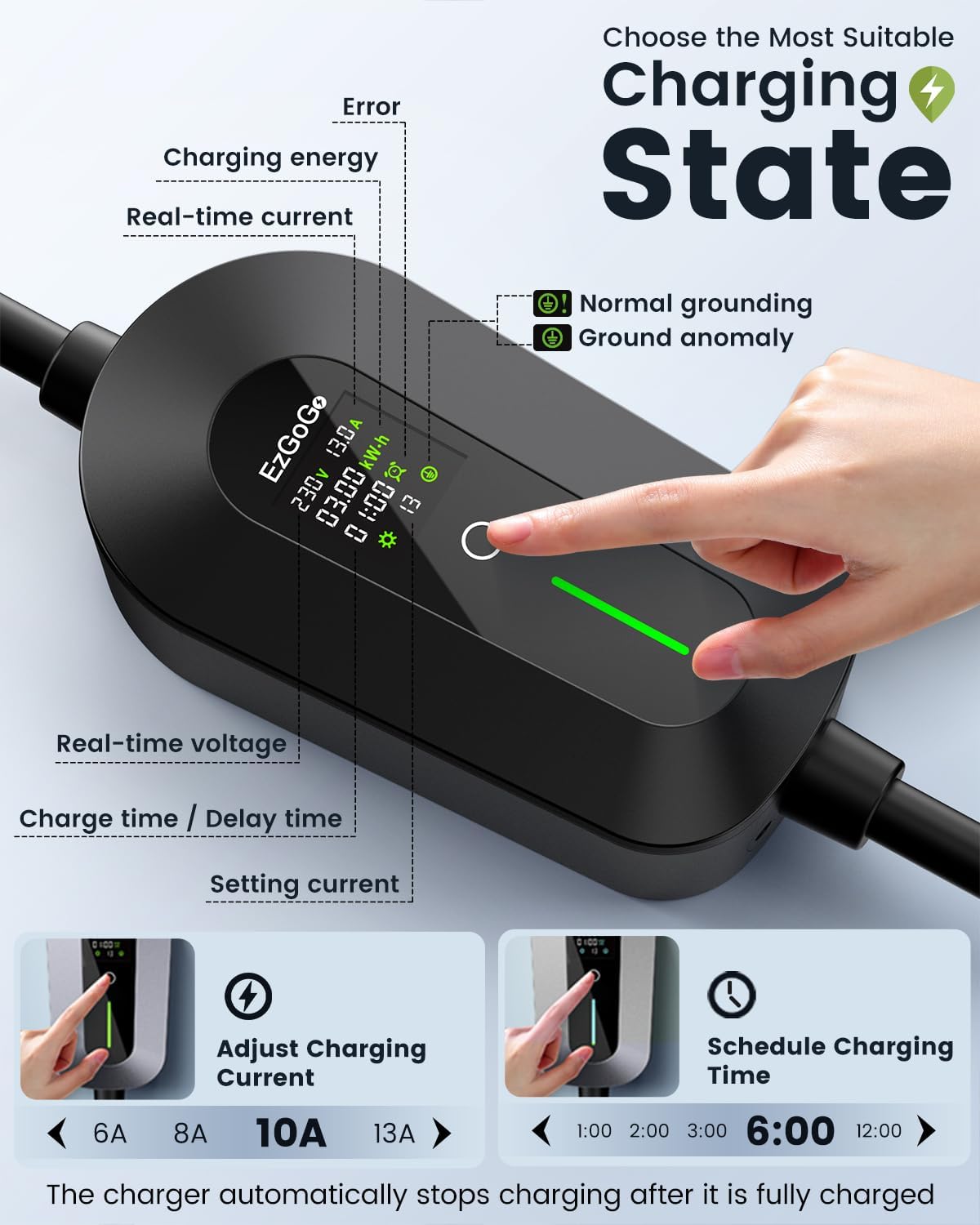
The screen is the reason to pick this over a dumb lead. The second product image labels every element: real-time voltage, real-time current, charging energy, charge time and delay time, setting current, an error field, and a pair of indicators for normal grounding and ground anomaly. Four current steps are selectable, 6A, 8A, 10A and 13A, and the delay timer runs from 1:00 to 12:00. The same image states that "The charger automatically stops charging after it is fully charged", which one reviewer confirms in practice.
Here is the pattern worth reporting. Eleven of the hundred reviewers name the current setting they personally run at. Seven of those eleven run at 10A or lower. Three run at 13A. One reports figures at both, quoting "slightly over 3KWH on the 13 amp setting/ 2KWH on the 10 amp setting". All eleven gave five stars.
The reasons they give are their own. One says "I use the 6A level as it places less stress on the power socket". Another reports reading the manual and setting "it to 10 amps max as the 13 amp setting should not be used often or for long periods". A third, charging from a garage, says "10 amps worked great" and that his "mains socket and the plug remained cold". A fourth, at 10A, reports "No problems with heat in plug etc."
That is not the whole story, and it would be wrong to pretend it is. All three of the reviewers who named 13A as their setting report no trouble with it. One using a dedicated garage circuit says that at 13 amps the "plug/socket no more than slightly warm to touch". Another charging an 18.5kWh hybrid says "Cables never get hot." A third, charging at a rental he is staying in for six months, found "The house electrics worked fine with the charger running on 13A". One more owner describes running at the top setting without naming a figure, and his account runs the other way: he is one of the one star reviewers in the next section, and reports the socket ruined after three months.
What we will say is what the listing says, because it is unusually specific for a marketing bullet. EzGoGo positions the steps as "13A for occasional fast charging, 10A/8A for regular charging, and 6A for special situations". Occasional is the manufacturer's word, not ours. Two practical notes from owners: the current limit "is retained when powered off", and you have to change it "before plugging into vehicle". One caravan owner's only gripe is that you cannot set an off time on the charger itself, you set it in the car.
Will It Fit Your Car? Type 2, CCS2 and the Hybrid Sweet Spot
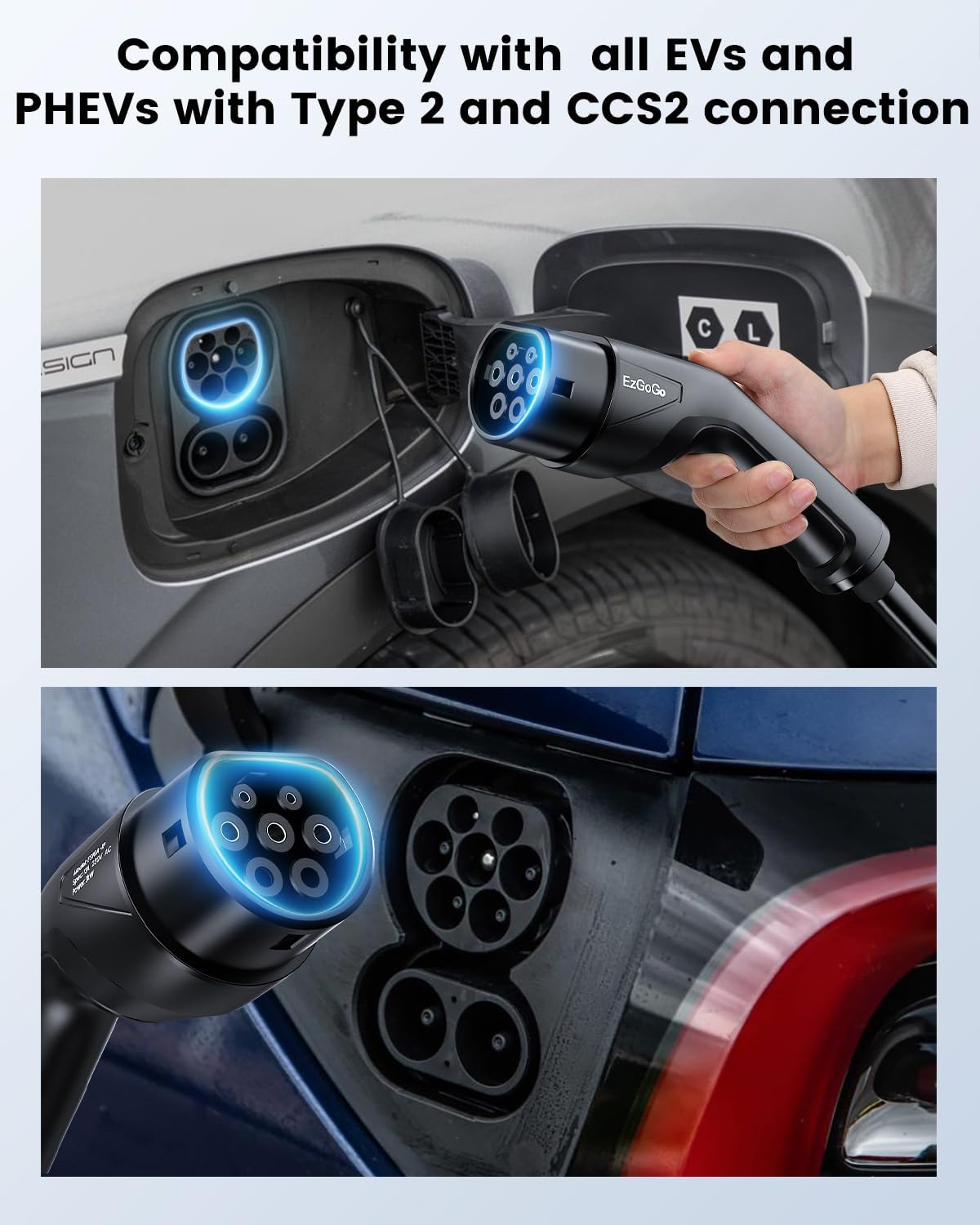
The seventh product image claims "Compatibility with all EVs and PHEVs with Type 2 and CCS2 connection" and shows the Type 2 head going into the upper portion of a CCS2 port. Read the bullet points and EzGoGo is noticeably more careful than its own graphic: there it says the cable suits "most European and UK EVs and PHEVs that comply with IEC 62196-2" and recommends you "check the specifications of your vehicle", especially for maximum charging currents. Take the bullet over the image.
In practice the sample covers a decent spread of UK metal. Reviewers name a Renault ZOE, a Polestar 2, a Tesla Model Y Juniper, a BYD SEAL, an e2008, a Mini EV, a Mercedes C300de PHEV, a BMW X1 hybrid, an MG HS PHEV and a Jaecoo hybrid. Nobody in the hundred reports a car that would not take the plug.
The clearest split is not brand, it is battery size. Plug-in hybrids come out consistently happy: an 18.5kWh hybrid charges in under six hours at maximum, a 29.8kWh PHEV owner calls it a well made "mains rated top up charger", and the owner of a 12kWh hybrid gets a full charge in about six hours overnight. Full EV owners are happy too, but with a caveat they add themselves. One with a 93 mile range battery notes it "take a long time to charge fully". Another simply plans around it, taking a "20 to 80% charge overnight" and treating that as sufficient. If you drive a big battery EV a long way every day, this is a top up device, not your main charger, and at least 14 of the five star reviewers explicitly describe using it that way, for top ups, overnight charging or as a backup.
The Ten One-Star Reviews Split Five and Five
Ten of the hundred are one star, and they divide cleanly into two groups of five with no overlap.
Five report damage at the socket or a blown fuse. One asks how the charger "has fried three of my wall sockets and extensions". Another, headed HAZARDOUS PRODUCT, says that within a year it is "overheating, melting/charring plugs and blowing fuses" and states they contacted the manufacturer and reported it to the Office for Product Safety and Standards. A third says that after running at maximum roughly three times a week, "it burnt out overnight and ruined the socket after 3 months". A fourth says it "will blow you plugs" and that "I wouldnt recomend nor would my electrician". The fifth is the rain review, covered in the next section.
The other five report the unit itself failing rather than anything at the wall. Two are single lines, "Didn't work" and "Not working." One says it "lasted about 6 weeks then showed a fault and stuck on 8amp charging" with the front button dead. One says that after nine months it "is now charging at half the speed it used to", dropping from 3kw to 1.5kw overnight. The last says it "barely last six months".
Widen the lens past one star and a timing pattern appears. Seven reviews across the one, two and three star bands give an explicit lifespan before something went wrong, and they land between about six weeks and roughly a year: six weeks, then a display that failed after about two and a half months, then two at three months, then six months, then nine months, then just under a year. Two of the two star reviewers are in that list, one whose display packed up and one whose unit stopped after three months with what they describe as an internal fault.
The obvious counterweight is that plenty of people have owned it a while and are fine. One reports it "has worked faultlessly for the past year and a bit" at the 10 amp setting. Another has "had the charger 6 months now and gets used every night for 7/8/9 hours" on a Mini EV. Both are five stars, and the year-and-a-bit owner has had it longer than any failure anyone in this sample reports.
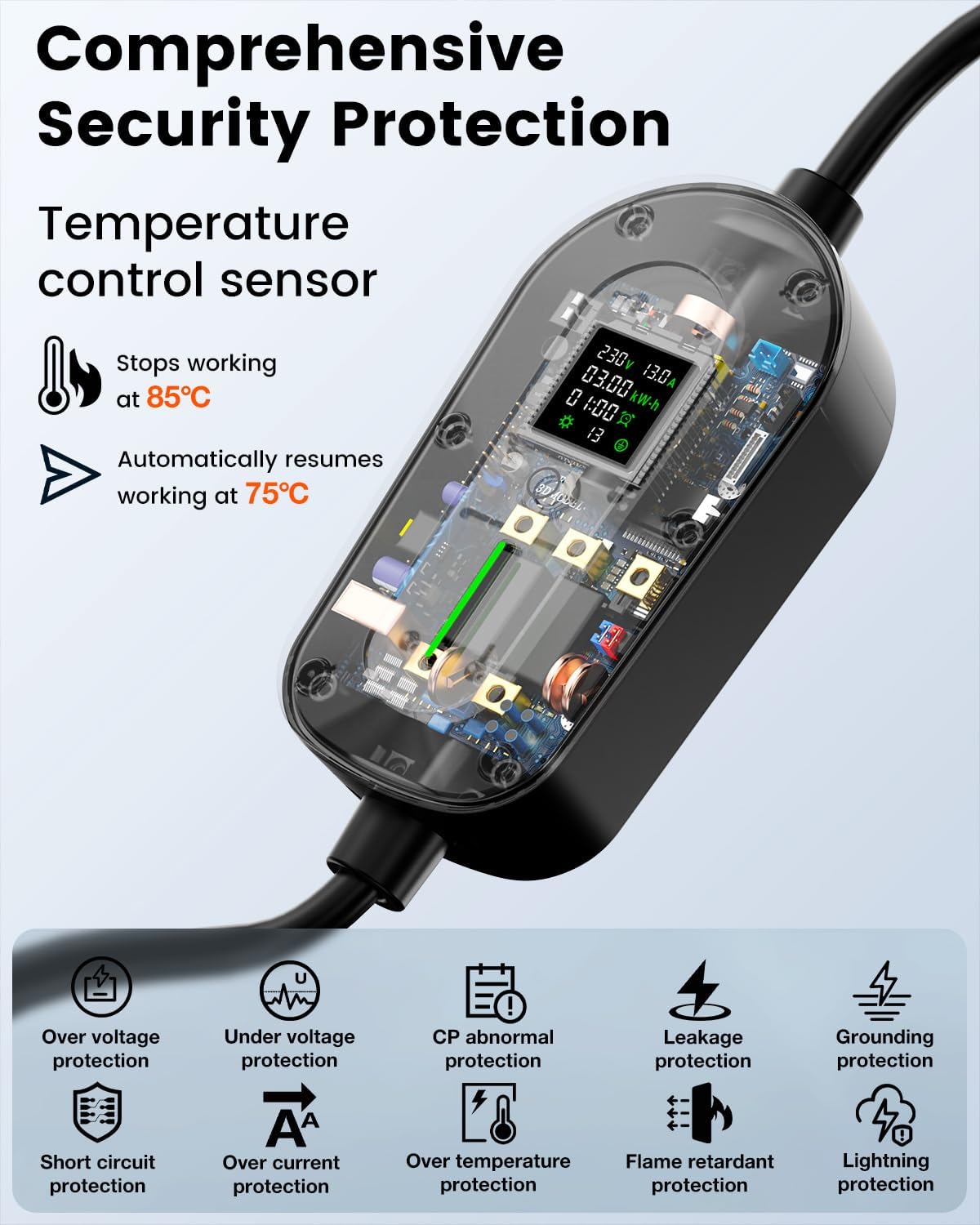
The listing's answer to all of this is a full page of protection claims. The sixth product image lists a temperature control sensor that "Stops working at 85°C" and "Automatically resumes working at 75°C", plus ten named protections including over voltage, under voltage, over current, over temperature, leakage, grounding, short circuit, flame retardant and lightning. The bullet points add CE, UKCA and ROHS certification. EzGoGo also prints its own installation advice in the same bullet: "To avoid overheating, we recommend using a new wall socket to prevent loose connections and heat buildup." One five star reviewer adds a warning of his own in capitals, that this should not be used with a mains extension lead because the extension gets hot, and says he found that out from an online granny charger review rather than the instructions.
We are not going to adjudicate between those ten buyers and the eighty-two happy ones, because a review page cannot tell you which one you will be, and the causes people assert for their own failures are their assertions, not established fact. What the sample does tell you is that this is a mains device drawing meaningful current for hours at a time, that the manufacturer itself distinguishes between occasional and regular use of the top setting, and that a non-trivial minority of UK buyers had a bad time. Read EzGoGo's own socket advice before you plug it in, and if you are in any doubt about the socket you intend to use, ask an electrician rather than a review site.
IP65 on the Box, and One Reviewer in the Rain
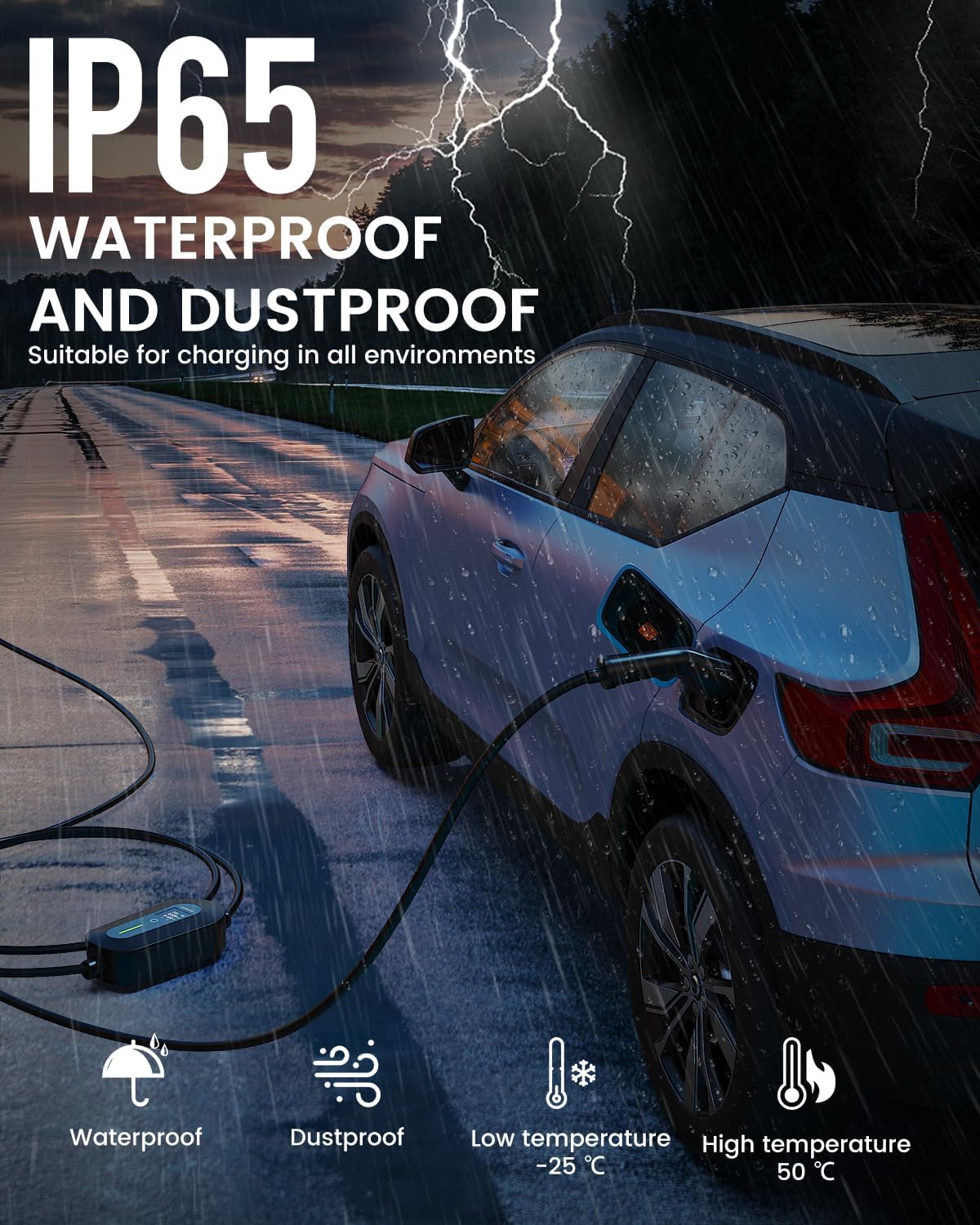
The fifth product image is a full page of weather marketing: "IP65 WATERPROOF AND DUSTPROOF" over a car charging in a thunderstorm, with the strapline "Suitable for charging in all environments" and an operating range given as low temperature -25°C to high temperature 50°C. The IP65 rating is repeated in the listing title and bullets.
One reviewer in the hundred disputes it directly, and it is the fifth of the one star reviews from the previous section rather than an extra complaint. Their account is short: "It rained a bit and the display took on water and then it blew the fuses on the house." They say they are returning it as not fit for purpose. A two star reviewer separately notes their unit was "used outdoors" before it stopped after three months, though they attribute the fault to internal hardware rather than weather.
One water ingress report out of a hundred is one report, not a pattern. Others charge outdoors happily. One had an outside socket fitted by an electrician specifically for this and says it "does the job perfectly". Another, a month in, describes a "Waterproof long strong cable". But when a listing says all environments and a UK buyer says light rain, that is worth knowing before you leave it hanging on a wall through a British winter.
A Two Year Guarantee, and the Five Who Could Not Reach It
There is one more thing the reviews expose, and it is the reason this lands at four out of five rather than higher. The listing promises "2 years quality guarantee, and lifetime technical support". Five of the hundred most recent reviewers describe being unable to act on any of that.
One whose display failed at roughly two and a half months writes "Out of returns period so hard luck on me!!" One whose unit died at three months was "Unable to find any contact details to make a refund claim" and adds that Amazon could not help because the order came direct from the seller. One says there is no way to return it via Amazon outside the return window. One at nine months found "they only have a 30 day window in which you can return it". One waiting on a repair says "Getting a repair has had so far no reply." A two year guarantee you cannot reach is a 30 day guarantee with extra words, and since the failures in this sample cluster well past 30 days, that gap is the thing to price in.
None of which stops this being a good buy for the right person. Eighty-two of a hundred UK buyers gave it five stars, the screen and the four current steps are meaningfully better than a basic lead, the accessories are more generous than the price suggests, and for a plug-in hybrid or a small EV that only needs topping up it does the job for a fraction of a wallbox quote. One buyer sums up the experience of ordering it despite the bad reviews: "Was a little a skeptical when ordering this, some of the reviews weren't good, please that did as it works really well!"
Get it if you drive a PHEV or a modest battery EV, you have a socket you can dedicate to it, and you are treating it as an overnight top up rather than a fast charge. Be more careful if it will be your only means of charging a big battery every day, if your outdoor socket lives in a sealed weatherproof box, or if you need a guarantee that still exists in month seven. And if you are unsure about the socket itself, that is an electrician's question, not ours. Check today's price on Amazon before you decide, since at least one buyer watched it drop by £20 days after ordering.
EzGoGo EV Charger Cable Type 2 to 3 Pin Plug 10M
A 10m portable Type 2 lead that charges from an ordinary UK 3 pin socket, with four selectable current steps, a 1 to 12 hour delay timer and an LCD that shows voltage, current and energy delivered. The cheap way to charge at home without a wallbox quote.