Before You Buy Wireless TV Headphones for Hard of Hearing UK, Look at the Back of the TV
The person wearing these is often not the person buying them, and that changes the questions. Will it work on their television? Can they operate it alone? Will you be back round next Sunday to fix it? Here is what 100 UK reviews and nine listing images actually answer, including the two five-star ratings left by people who had not got it working yet.
- Two Five-Star Reviews Come From People Who Had Not Got It Working Yet
- Wireless TV Headphones for Hard of Hearing UK: The One Port That Decides Whether They Work at All
- Setting It Up for Someone Who Is Not Technical
- Can the Rest of the Room Still Hear the TV?
- Clear Voice, Lip Sync, and the Buyer Who Got Too Much Bass
- Thirty-Five Hours, and the Dock That Means You Never Find Out
- Where These Break, According to Nine of the Hundred
- What Happened When Buyers Contacted Avantree
- Sennheiser, Sony, Panasonic, and Where This Lands
The person wearing these is often not the person who bought them. Fifteen of the 100 most recent UK reviews describe a set bought for, or used by, somebody other than the reviewer: a dad in a retirement flat worried about the neighbours, a husband of 80 who likes late-night TV, a sister who would find the setup difficult on her own. That changes which questions matter. Less how does it sound, more will it work on their television, can they use it without help, and how often will I be called round to sort it out.
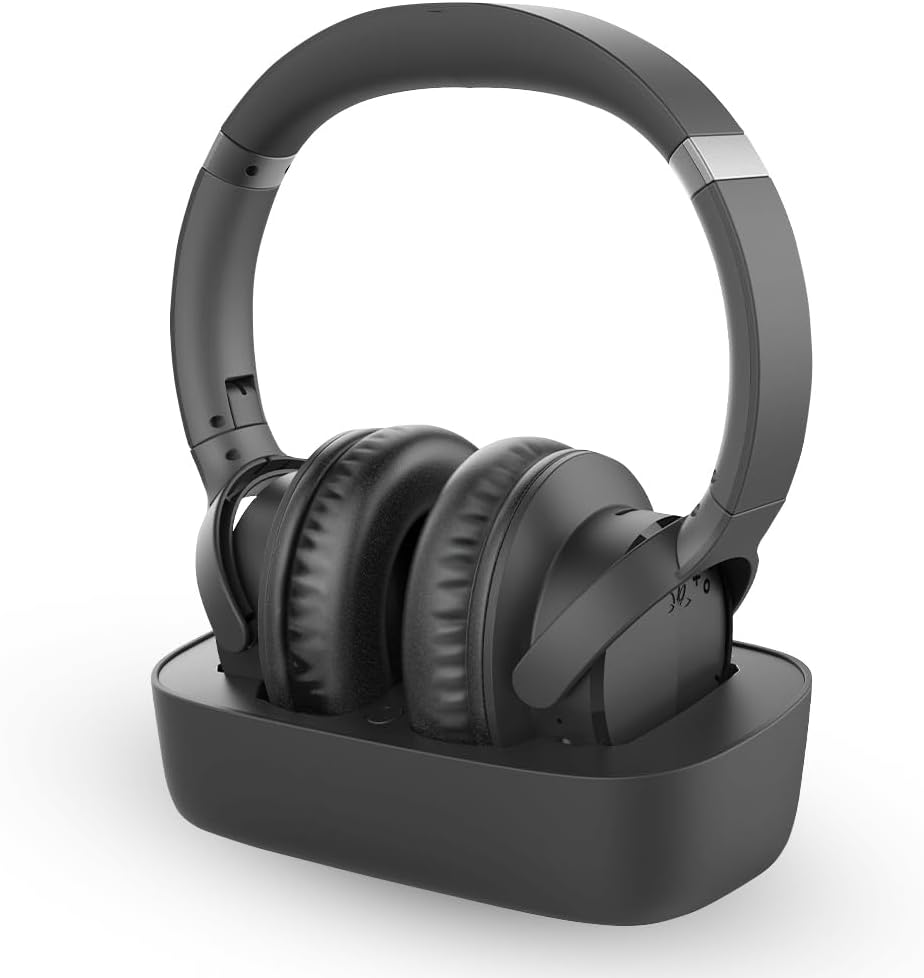
The Avantree Ensemble is aimed squarely at that buyer. It is a pair of over-ear wireless headphones that sit in a charging dock, and the dock is also the transmitter that plugs into the TV. Avantree pitches it at "seniors, shared bedrooms, or anyone who struggles to hear TV dialogue clearly while keeping the room quiet". It carries 4.4 stars across 14,765 ratings. The 100 newest UK reviews come out lower than that, and they come out lower in a specific and useful way.
Two Five-Star Reviews Come From People Who Had Not Got It Working Yet
Sorted by most recent, the 100 reviews on this listing are all from United Kingdom buyers and 98 of the 100 are marked verified purchases. That is an unusually clean sample. It averages 4.21, under the 4.4 the listing holds across 14,765 ratings, so the recent run is harsher than the lifetime figure rather than a fair summary of it. Seventy-two are five-star. Twenty-four sit at three stars or below, which is a substantial critical block for something rated this well.
The five-star count is softer than it looks, too. Two of those 72 were left by people who had not managed to set the thing up. One reads, in full, "Im sorry I can't set it up has yet. A bit of. A struggle." The other, also in full, is "I'm 86 and am really struggling." Both awarded five stars regardless. Neither tells you a thing about the headphones, but together they tell you something about the buyer: two owners, one of them 86, found the first ten minutes hard and still felt warmly enough about the purchase to rate it top marks. If you are ordering this for a parent and will not be in the room when the box opens, that is the risk to plan around.
So read the bodies, not the stars. The critical reviews here are unusually specific, and they cluster on two things: which TV the transmitter is plugged into, and one part of the headband.
Wireless TV Headphones for Hard of Hearing UK: The One Port That Decides Whether They Work at All
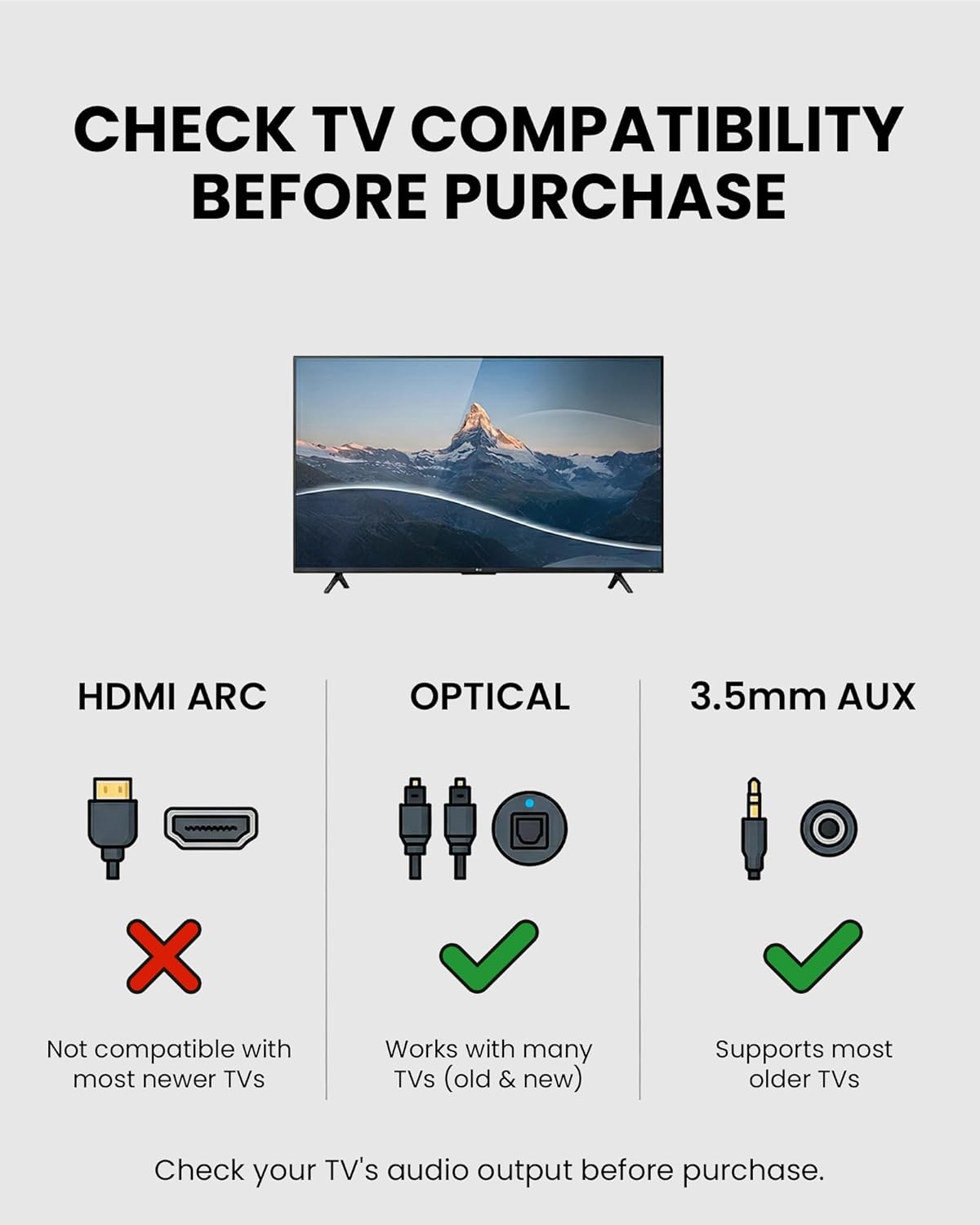
Avantree puts this first in its own bullet list and then repeats it across two separate listing images, which tells you how often it goes wrong. The wording is: "Your TV must have Optical (TOSLINK) or 3.5 mm AUX output. TVs with HDMI only will not work. Soundbar passthrough setups are not supported."
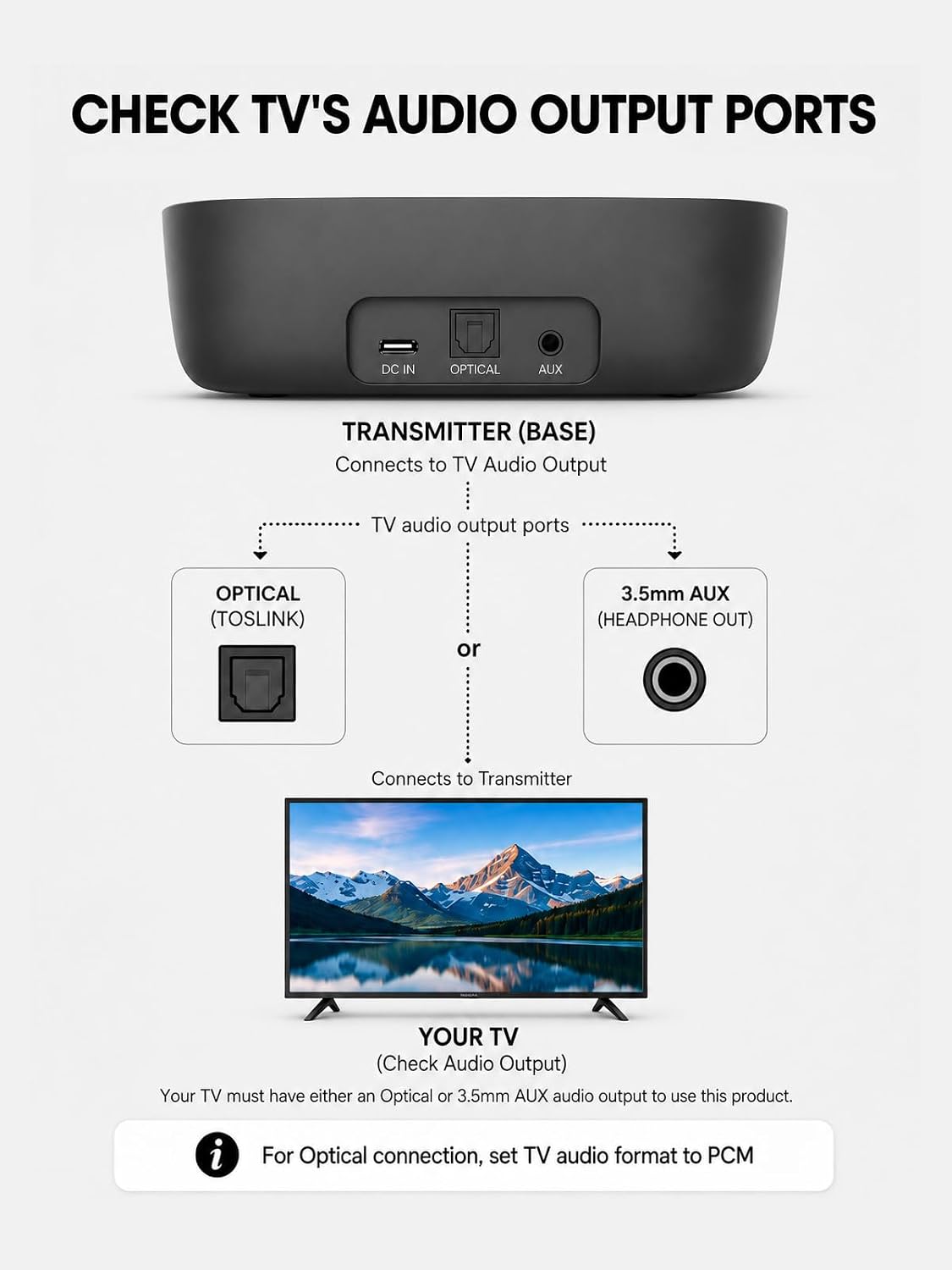
The compatibility graphic is blunter. HDMI ARC gets a red cross and the caption "Not compatible with most newer TVs". Optical gets a tick and "Works with many TVs (old & new)". The 3.5mm AUX socket gets a tick and "Supports most older TVs". A second diagram shows the back of the transmitter itself: three sockets, labelled DC IN, OPTICAL and AUX. One reviewer, though, describes connecting "with optical or AUX or RCA connection", and an RCA socket is not on that diagram. The listing and the review do not agree and nothing here settles it, so if RCA is the only output your TV has, ask Avantree before ordering rather than trusting either source.
This is the buying decision, and it happens before you get to sound quality or comfort. Go and look at the back of the television it will be used with. If the only audio output is HDMI, this is the wrong product and no amount of fiddling will change that. Avantree's own captions point the same way: HDMI ARC is flagged against most newer TVs, while the AUX route is described as supporting most older ones. Optical is the exception, captioned as working with many TVs old and new, so a newer set is not ruled out. It just has more riding on whether it kept its optical socket.
Two smaller traps sit behind the first. If you use the optical route, the TV's own audio format has to be set to PCM, which the listing states twice and the transmitter diagram repeats in a footnote. One reviewer hit precisely this with a Fire stick and wrote up the fix: "I resolved it by going into TV advanced audio settings and switching digital out to PCM instead of Auto". Another could not get optical working on an old Sony at all and simply used the AUX cable instead, which is the sensible fallback. And note the tension in Avantree's own copy: the product name says it works with "Optical, AUX & Bluetooth TVs", while the first bullet and the transmitter diagram both say the TV must have an optical or 3.5mm output. Buyers do pair the headphones straight to Bluetooth sources, a Fire stick and a Samsung TV among them in this sample, but treat the optical or AUX socket as the requirement and Bluetooth as the bonus.
Setting It Up for Someone Who Is Not Technical
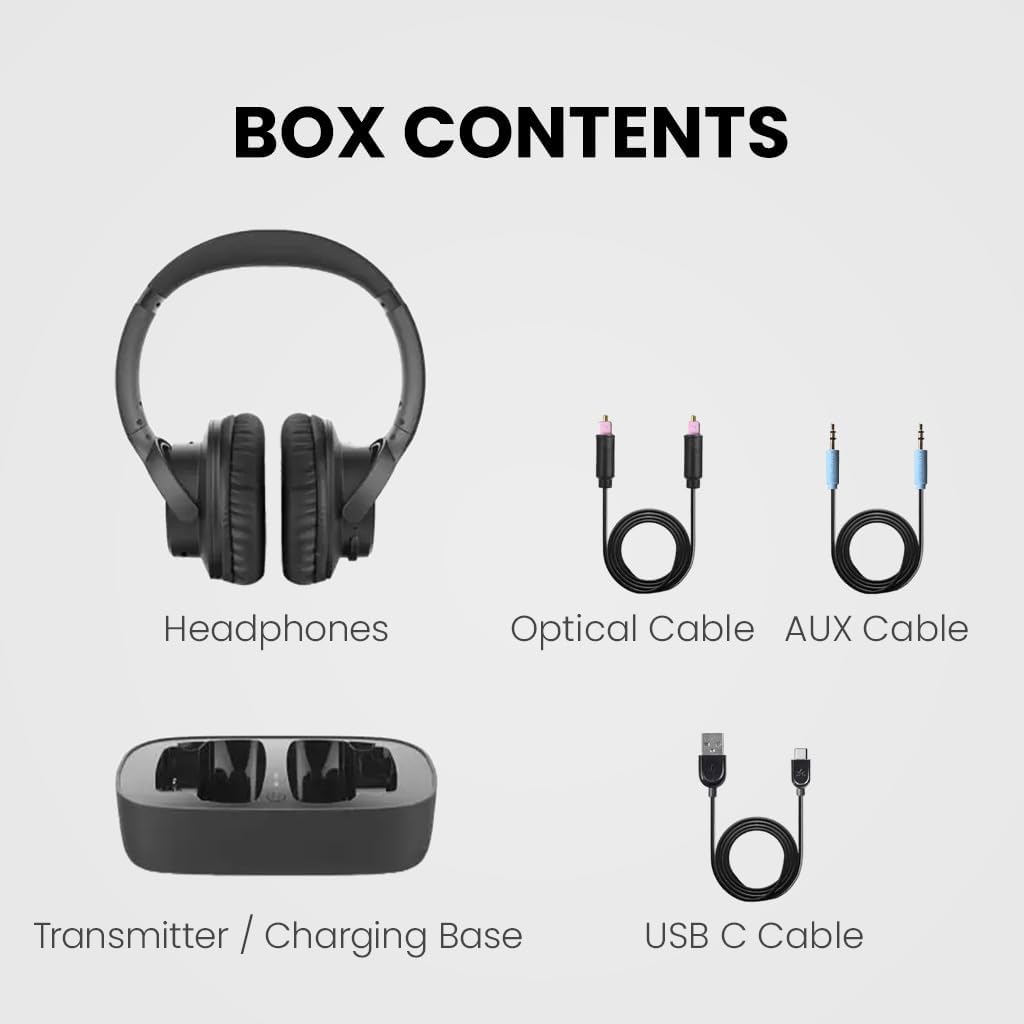
Good news first: the box has everything. The contents graphic lists the headphones, the transmitter and charging base, an optical cable, an AUX cable and a USB-C cable, so whichever of the two routes your TV supports, you are not placing a second order. One buyer did want a longer run than the cable supplied and bought an extension, which is worth thinking about if the telly is wall-mounted and the dock needs to sit on a sideboard.
Twenty-six of the 100 reviews describe setup as easy, in words like plug and play, ten describe friction of some kind, and the remaining 64 do not comment either way. The two groups do not overlap, which is a cleaner split than these things usually give you. The friction is not evenly spread, either: it is concentrated in first connections. One buyer could not pair with a Sony Bravia. Another simply reports "They won't pair." A third needed an email exchange with Avantree to get the transmitter talking to an old LG plasma, and a fourth could not get Bluetooth going on a Samsung set until support walked them through it.
Against that, the reviews from people buying on someone else's behalf are mostly reassuring. One bought for a sister and noted the set was "very easy to set up as my sister would find it difficult to do this herself". Another describes a set used daily and calls it "easy enough for my 72 year old dad to use every day". One 89-year-old got there unaided and was pleased about it: "took me over an hour to set up not bad for 89 years old".
Two practical notes. The box contents graphic does not list a printed manual, and a reviewer confirms you scan a QR code to get the guide, which the listing's support image backs up. If you are setting this up for someone who does not use a smartphone, download it yourself first. And the daily routine that Avantree leans on, "Just place the headphones on the charging dock after use", is slightly fiddlier in practice than it sounds: two owners independently warn that the headphones have to be seated precisely or they will not take a charge, with one adding that you should "wait until your sure red light stays on". If arthritis or eyesight is a factor, that is a real consideration, not a nitpick.
Can the Rest of the Room Still Hear the TV?
This is the question that decides whether the purchase works socially, and the listing does not answer it. Not in the five bullet points, not in any of the nine listing images. Which is a shame, because it is the difference between one person listening privately while their partner watches along normally, and one person listening privately in a silent room.
Three of the 100 reviewers address it directly, and they do not agree. One is emphatic that both work at once: "you can have these on and still have sound on for others in room to watch and listen to TV OR you can just listen with these if alone and have TV on mute". A second says it is configurable, describing a set that "can be set up to have others hear the tv and control the volume separately or to have the sound just in the headset". But a third, replacing an earlier set they do not name, reports losing the feature: their previous set allowed the TV sound to stay on for them while their husband wore the headphones, and of this one they write "No facility for this on these ones I think". Note the hedge in their own words. They are not certain either.
What the diagrams do tell you is that the two connection routes are not equivalent. The transmitter takes either the optical socket or the 3.5mm AUX socket, and the AUX option is labelled on Avantree's own diagram as "3.5mm AUX (HEADPHONE OUT)". What a television does to its own speakers when something is plugged into its headphone socket varies by set, and Avantree publishes nothing about it. If keeping the room's sound live matters to you, that is the first thing to test when the box arrives, while the return window is open, and it is a reason to prefer the optical route if your TV offers both.
Clear Voice, Lip Sync, and the Buyer Who Got Too Much Bass
The product name says "Clear Voice", so the dialogue angle comes from Avantree rather than from us. It is worth reading exactly how far the company takes the claim, because it draws its own line: the set "helps improve speech clarity for everyday TV watching", but is "not intended for users with very limited listening ability". That is the maker's wording, and it is the right frame for this whole section. These are headphones. Nothing in the listing presents them as anything else, and nothing in the reviews should be read as anything else either.
On the experience side, six of the 100 praise the clarity of the sound specifically. The most detailed account comes from someone replacing a long-serving Sennheiser set, who describes a voice clarity control on the headphones and concludes, after guessing at how it works, "However it is done, it works". Another had tried several TV headphones and found "none have been as clear, easy to use, and effective as these".
Then there is the disagreement. One reviewer got the opposite result: "I found in use the sound had too much bass", and says it buried the speech. Two others go the other way entirely and call the sound thin, one writing "But they are so tinny!" and another describing it as very poor and very tinny. Six of the 100 fault the sound at all, so this is a minority, but it is a minority pulling in two directions, which makes it harder to guess which camp you would land in. No reviewer describes a bass or treble control, and the one who wanted to adjust the balance did not know whether it was possible.
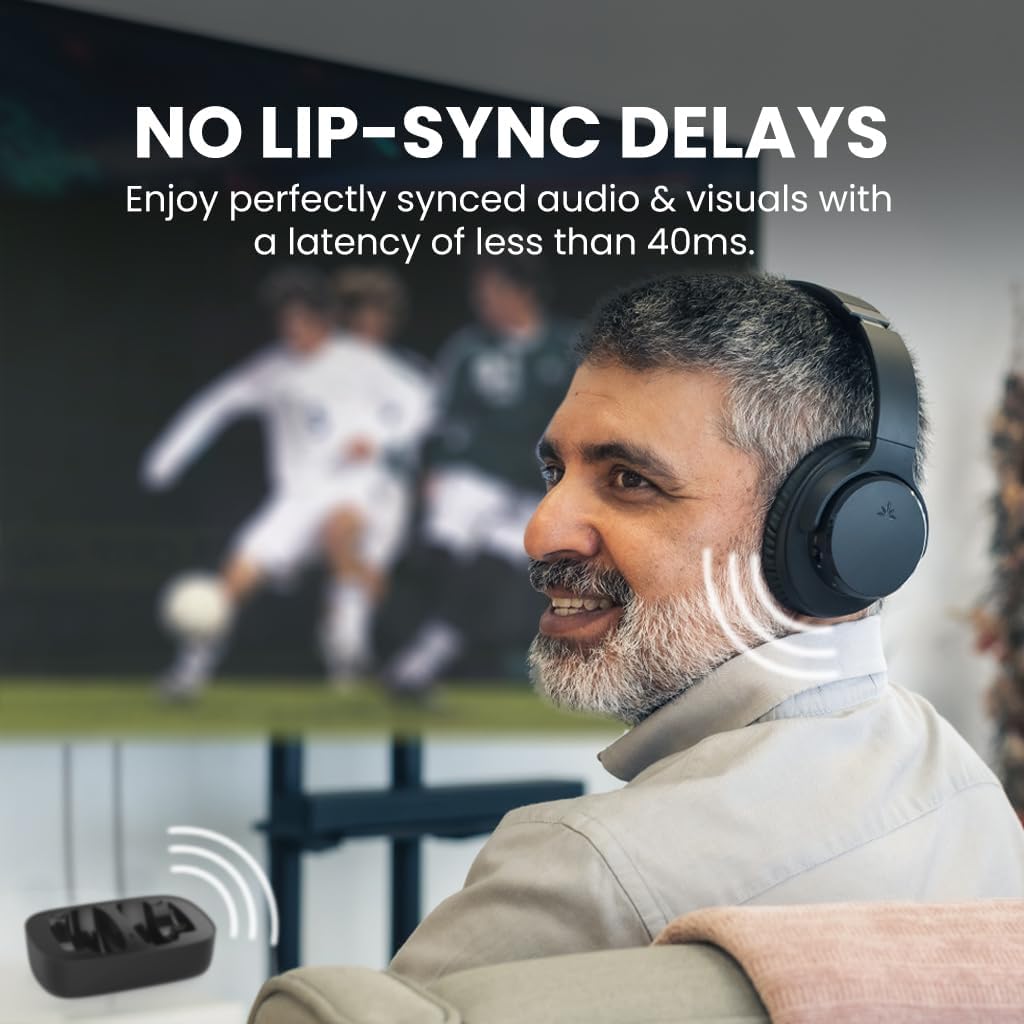
Lip sync is a common worry with wireless TV audio, and here the listing does publish a figure: a graphic claims a latency of less than 40ms. The reviews broadly back it. One of the 100 reports a "slight delay on the sound". One built a whole review title around getting perfect lip sync from the digital output. A third chose the wired connection deliberately as a precaution against Bluetooth lag, rather than because they had experienced any.
Three reviews mention hearing aids. One says in its title that the set can be worn over them. The two that describe using them alongside aids both describe taking the aids out: one had static in the left ear with an aid in and removed it, the other wears aids in both ears and is "so pleased i can take them out and use them". Three accounts is not a pattern and they do not settle each other. If aids are part of the picture for the person you are buying for, treat it as the thing to try in the return window rather than something the listing has answered.
Thirty-Five Hours, and the Dock That Means You Never Find Out
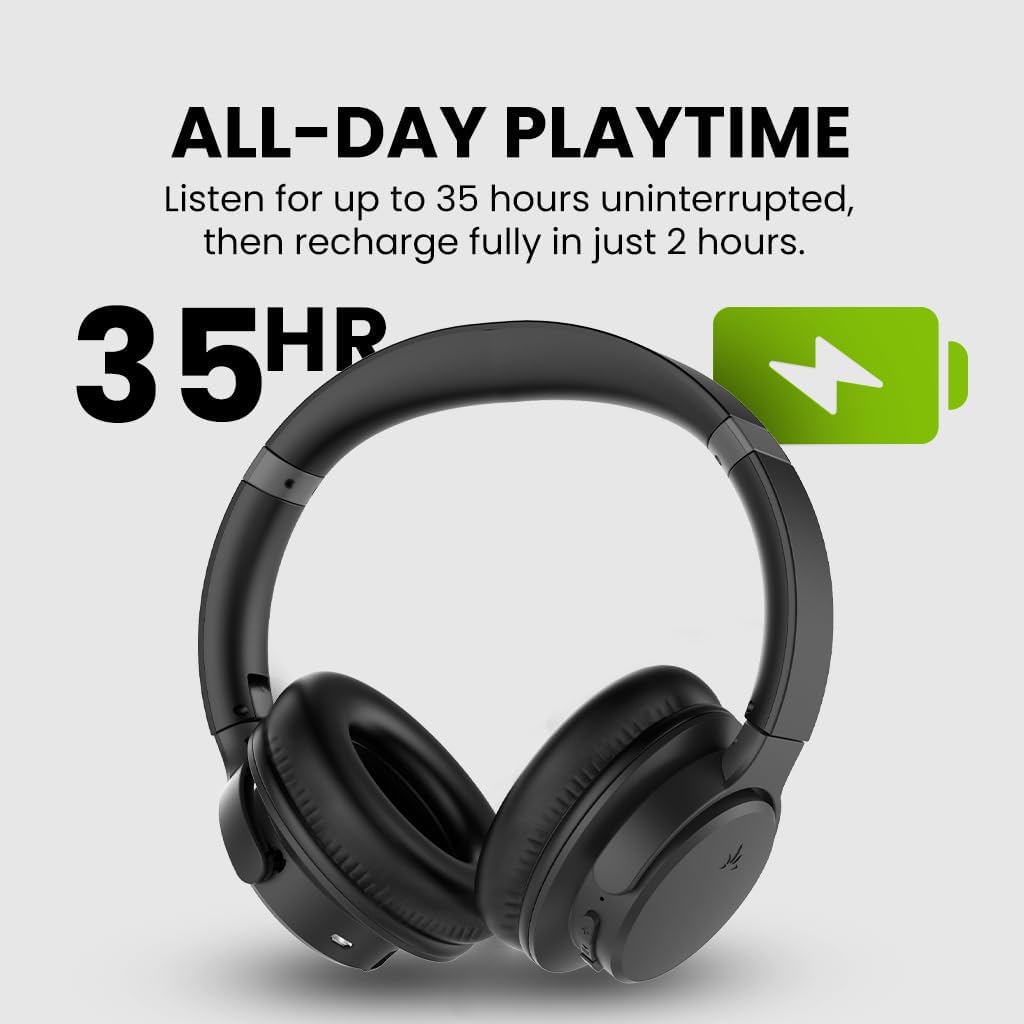
The listing claims up to 35 hours of playtime and a full recharge in about two hours. The interesting thing is how few owners can confirm the first number, because the dock design means the battery rarely gets run down. One says it plainly: "I have not reached the limit yet as I put them on the recharging dock after each use". Another, watching three to four hours most nights, reports they "still get about 7 days use before recharge". A third describes a set worn for most of the day, every day, that "charge just fine overnight and last the entire day".
That is the real point of the dock, and it is the feature that matters most to the buyer it is sold to. There is no cable to find, no port to locate on the underside of an earcup, no flat battery on a Sunday evening. The headphones go back in their holder and they are full again next time. For anyone buying on behalf of a relative who would rather not manage another charging cable, that is worth more than the hours figure.
Not everyone is sold. One three-star reviewer who connects over Bluetooth argues the dock is redundant for them and "just keep space on the desk collecting dust", which is fair if you never use the transmitter. One buyer's dock failed at 38 days. And, as above, seating the headphones correctly is a small daily skill rather than an automatic action. Avantree does not publish a battery capacity, so treat the 35 hour figure as the manufacturer's claim that almost nobody in this sample has had cause to check.
Where These Break, According to Nine of the Hundred
Sixteen of the 100 reviews report a set that broke or stopped working. That is the number to weigh against the 72 five-star ratings, and it is high. More usefully, nine of those sixteen name where it went: the headband, the ear arm, or the joint where the ear cup meets the band.
The descriptions are consistent enough to read as one fault. "the whole padded ear section detached". "the right ear arm snapped". "the headband snapped/broke in half". One reviewer, writing about the clip that holds the earpiece to the band, calls it "very weak and not strong enough to hold them together". Another puts it more bluntly: "The construction is just too weak and weedy". A third describes the small pieces that keep the ear piece attached breaking off entirely.
Timing is scattered rather than clustered, which argues against a single bad batch. Failures in this sample land at 12 hours, 38 days, a little over five months, seven months, eleven months, just over a year, and around the two-year mark. Three buyers report a second set failing as well, two of them saying it went the same way as the first. One notes they had expected trouble because the listing carried a frequently returned item warning at the time they ordered.
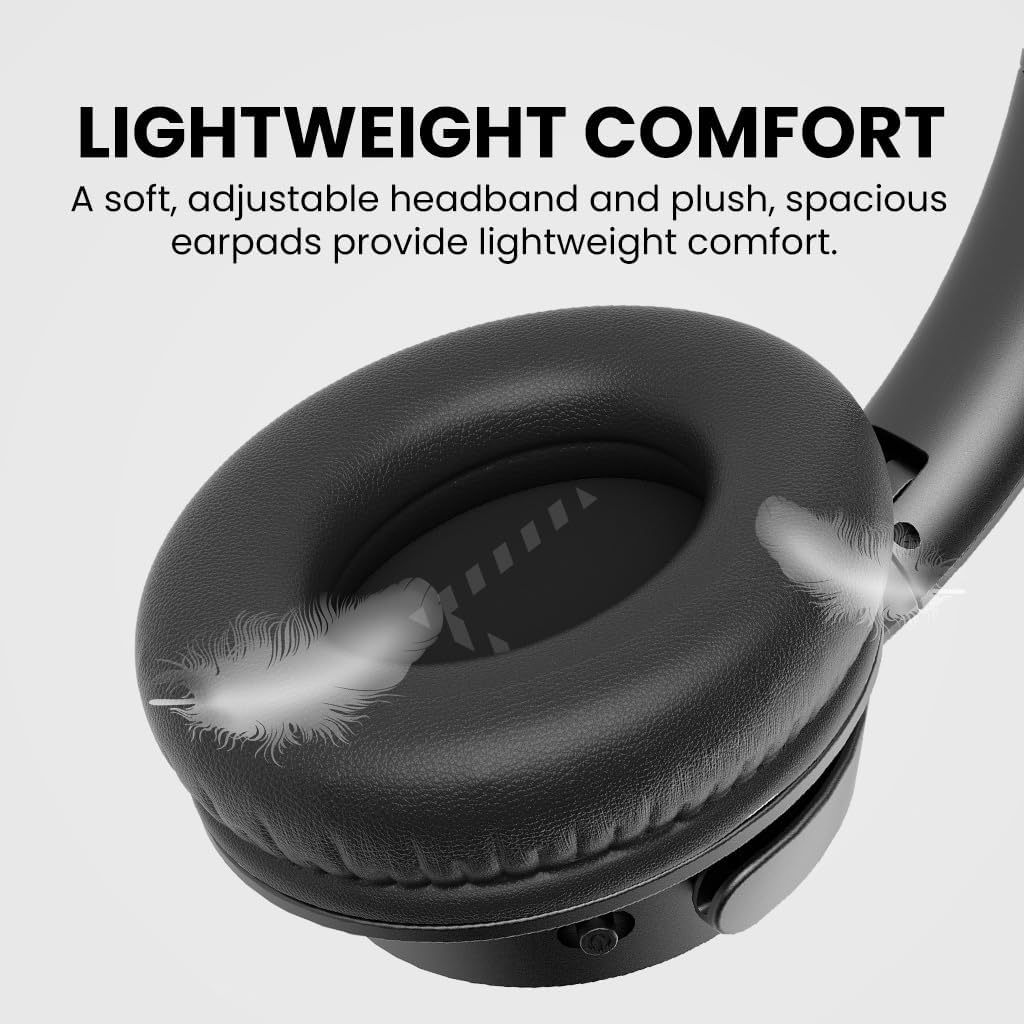
Weight and clamp are a separate, smaller complaint, and they matter here more than they would on a commuter headphone. Six of the 100 fault the fit. One bought a pair each for elderly parents in their 80s and found that after 15 minutes for one and about half an hour for the other, "they found them too heavy for their head", while adding that the sound itself was faultless and it was the first time they had been able to hear the television. Another writes that "the head set is quite heavy and keeps sliding off your head". A third found the clamp far too tight. Twenty-four reviews mention comfort or fit by name and eighteen of those are positive, so the balance sits firmly with the comfortable camp. Avantree's own image goes further, headlining the earpads "LIGHTWEIGHT COMFORT" and promising "a soft, adjustable headband and plush, spacious earpads", yet it publishes no weight figure anywhere to back that up. Two of the six complaints come from the demographic the product targets, an older wearer sitting still for a couple of hours, which is reason enough to check this inside the return window.
What Happened When Buyers Contacted Avantree
This is where the picture turns, and it is the reason this product still gets recommended despite the paragraph above. Fifteen of the 100 reviewers credit Avantree's support team with sorting their problem, replacing the set or handling a fault under guarantee. The same first names keep coming up across unrelated reviews, which is not something you see often on a listing this size. Several of the five-star ratings are explicitly for the service rather than the hardware, including one buyer whose set failed after about two years and who was sent a replacement anyway, and one whose scathing initial review was later updated to five stars after a free replacement arrived in under 24 hours.
Now the caveat, because it matters more than the praise. Of the sixteen reviewers who report a breakage or failure, five mention support resolving it, one says they contacted Avantree and heard nothing back, and the remaining ten do not mention support either way. So the sample does not support treating a replacement as guaranteed, only as well evidenced when people ask. Two reviewers report the opposite experience: one whose earpiece broke after just over a year writes "I've tried contacting Avantree but haven't heard anything back", and one who could not complete setup found "Avantree customer support were less than helpful".
Two reviewers refer to a two-year warranty, one having had a headband fail just before it expired and been replaced without argument. Avantree does not state a warranty length in the listing text, though its support graphic does offer a warranty registration option alongside the user guide, so register it when it arrives. If you are buying this for someone who will not chase a manufacturer themselves, keep the order details somewhere you can find them, because on this evidence the outcome depends on somebody making the call.
Sennheiser, Sony, Panasonic, and Where This Lands

Four of the 100 reviewers name a rival brand they came from, which is more useful than any spec comparison. One replaced a Sennheiser wireless set that had lasted 15 years and rated the Avantree top marks. Two came from Sony sets, one of them RF headphones and calling this pair far superior, the other reporting it was "a lot louder then his old Sony set". The fourth went the other way and preferred what they already had: "My old Panasonic radio controlled headphones far surpass this set". Three of four upgraded happily, which is a small sample but a consistent one.
Against a soundbar, this is not really a contest, because they solve opposite problems. A soundbar makes the television clearer for everybody in the room and louder for the people next door. This makes it clearer for one person and quieter for everyone else. Worth noting that the listing rules out putting one in front of the other: soundbar passthrough setups are not supported.
Against the Bluetooth headphones somebody already owns, the case is narrower but real. Ordinary headphones depend on your TV having usable Bluetooth, which plenty of UK sets either lack or implement badly, and they depend on the wearer remembering to charge them. The dock removes both problems, and the optical route sidesteps the TV's Bluetooth entirely. The counter-argument comes from a reviewer in this sample who uses Bluetooth exclusively and considers the dock dead weight. If that describes the person you are buying for, and their TV pairs reliably, a decent pair of over-ears will do the job for less.
So where does this land? Buy it if the television has an optical or 3.5mm output, if the wearer needs something they can put on and take off without thinking about cables or charging, and if the household needs the TV quiet. It is very good at that specific job, and 72 of the 100 most recent UK reviews are five-star. Go elsewhere if the TV is HDMI-only, if the person wearing it has found other over-ear headphones too heavy before, or if you need certainty that the room's speakers stay live, because Avantree does not commit to an answer on that and its owners disagree. And go in expecting the headband to be the weak point rather than being surprised by it: keep the paperwork, register the warranty, and know that fifteen reviewers in this sample credit the support team with putting a fault right. Check today's price on Amazon before you order, and check the back of the TV first.
Avantree Ensemble Wireless TV Headphones
Over-ear wireless headphones that live on a charging dock, and the dock is also the transmitter that plugs into your TV's optical or 3.5mm output. Built for private TV listening in a shared room, and simple enough that the person wearing them does not have to think about charging.